| | |
|
Equilateral Hexagons E6 are polygons having six sides of the same length.
Simpler subsets of E6 can be defined applying restrictions.
Lenses
Next restrictions produce lens shaped equilateral hexagons:
- first internal angle = fourth internal angle = w1.
- second internal angle = fifth internal angle = w2.
- w1 / w2 must be a rational number.
The order of the angles must be in in strict sequence CW or CCW.
Then every lens can be specified with 3 angles such as
X = Lens(w1, w2, w3).
Using regular (6 + 4*n)-polygons (n = 0, 1, 2...) subfamilies of lenses will be created.
The lenses family members can tile the plane in unexpected ways under odd symmetries.

|
Triangular Symmetry
|
|
There are only one regular hexagon. Here is named A.
The minimum angle between two lines in this construction is:
a = (2p / 3) = 120�
|
 |
|
Equilateral hexagon A has six internal angles:
a, a, a,
a, a and a. So we can define:
A = Lens(a, a, a)
(Note that 1 + 1 + 1 = 3).
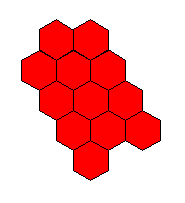
Copies of A can tile the plane in only one way:
|
|
|
Pentagonal Symmetry
|
|
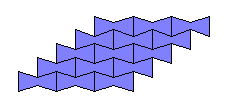
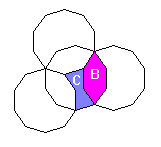
Four intersected regular decagons create two distinct equilateral hexagons.
They are named B (purple convex lense shape)
and C (blue concave lense shape).
The minimum angle between two lines in this construction is:
b = (2p / 5) = 72�
|  |
|
Equilateral hexagon B has six internal angles:
b, 2b, 2b,
b, 2b and 2b. So we can define:
B = Lens(b, 2b, 2b)
(Note that 1 + 2 + 2 = 5).
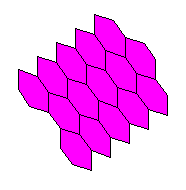
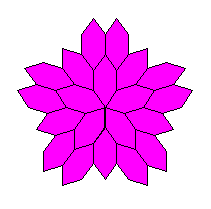
Copies of B can tile the plane in two basic ways shown at upper row.
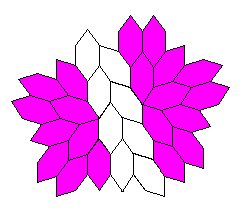
Splitting and rotating the basic tilings an infinite number of variants can be
obtained. One case is show in figure in lower row.
|
|
|
Equilateral Hexagon C has six internal angles:
b, b, 3b,
b, b and 3b. So we can define:
C = Lens(b, b, 3b)
(Note that 1 + 1 + 3 = 5).
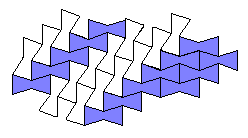
Copies of C can tile the plane in two basic ways too. Again, combining
orientations yield infinite new variants.
|
|
|
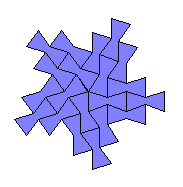
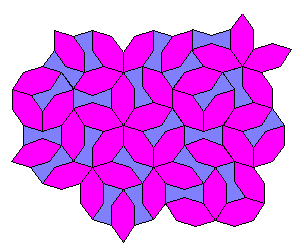
Copies of both B and C can tile the plane (maybe) nonperiodically:
|
 |
More of BC lenses:
|
Heptagonal Symmetry
|
|
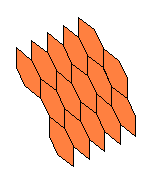
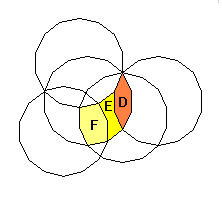
Five intersected regular 14-gons create three distinct equilateral hexagons.
They are named D (orange convex thin lense shape),
E (yellow concave skewed lense shape) and
F (light yellow convex thick lense shape).
The minimum angle between two lines in this construction is:
g = (2p / 7) = 51.428...�
|
 |
|
Equilateral Hexagon D has six internal angles:
g,
3g,
3g,
g,
3g and
3g. So we can define:
D = Lens(g, 3g, 3g)
(Note that 1 + 3 + 3 = 7).
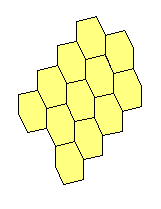
Copies of D can tile the plane practically the same way B does:
|
|
|
Equilateral Hexagon E has six internal angles:
g,
2g,
4g,
g,
2g and
4g. So we can define:
E = Lens(g, 2g, 4g)
(Note that 1 + 2 + 4 = 7).
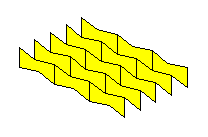
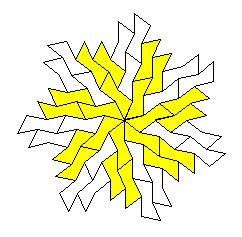
Copies of E can tile the plane like C does, but this time for the
radial tiling, some E's must to be flipped, shown in white instead of yellow:
|
|
|
Equilateral Hexagon F has six internal angles:
2g,
2g,
3g,
2g,
2g and
3g. So we can define:
F = Lens(2g, 2g, 3g)
(Note that 2 + 2 + 3 = 7).
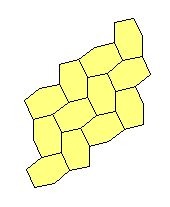
Copies of F can tile the plane in infinite distinct ways. Can be formed
strips having whether F horizontal or vertical:
|
|
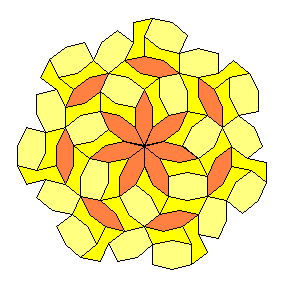
Copies of the three D, E and F can tile the plane (maybe) nonperiodically.
The big figure at the right has seven interlaced 14-gons
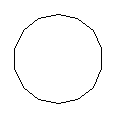
all identical but rotated.
Every 14-gon can be rotated in fourteen positions, and even each 14-gon can be flipped,
their pieces rearranged and the result can be rotated again...
|  |
|
OPEN PROBLEM: How many distinct 14-gons can be formed with lenses D, E and F?
|
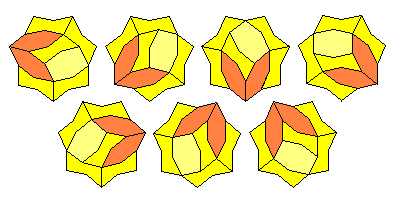
Inside this chaos we can found stars
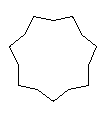
each one can be rotated inside the tiling in seven positions.
Also, the star can be flipped, their pieces rearranged and the result again rotated...
|
|
OPEN PROBLEM: How many distinct 7-stars can be formed with lenses D,
E and F?
|
Enneagonal Symmetry
|
|
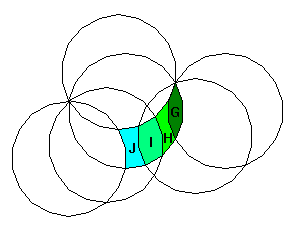
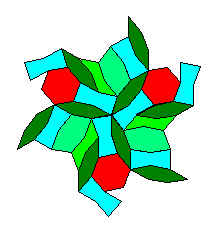
Six intersected regular 18-gons create four distinct equilateral hexagons.
They are named G (dark green convex thin lense shape),
H (green concave skewed thin lense shape),
I (light green convex skewed thick lense shape),
J (cyan concave thick lense shape).
The minimum angle between two lines in this construction is:
d = (2p / 9) = 40�
|
 |
|
Being nine multiple of three, is posible to fit copies of G, H, I and J
in a triangular symmetry, and since A belongs to triangular subfamily, A can be added:
|
 |
There is more to mention later...
This Java program was used to draw the images of this page.
|
|
J0R6E M1RELE5
2002/09/02
|
Also in this site: