
©2001 Jon Youngblood
Unity Through Understanding
A Guidebook for the Recently Alive



|
|
|
|
|
©2001 Jon Youngblood Unity Through UnderstandingA Guidebook for the Recently Alive |
||
|
|
|
|
Part One: FaithChapter One: Elementary My Dear1.3 Early BurialsThe act of burial is perhaps the oldest expression of man's changing awareness of himself as a spiritual being. The idea of survival after death is universal to religion. In fact, the idea that death was the total and final cessation of life was not even fully considered as a possibility until the 6th century BC in India by the Buddhists.
It has recently come to light that the Egyptians were not the first to invent the process of mummification. Predating them by about two centuries, the South American tribe known as the Chinchoros were preparing the bodies of their dead for an afterlife. By the great care that was taken to preserve the body, it would appear to suggest that these ancient cultures believed that the physical body itself would be needed at some future time when the deceased would live again. This is very different from belief in an eternal and non-corporeal spirit that defines our religious views today. So that even though earlier cultures could conceive of spirit, free and unfettered of the flesh in the form of deity and the various underlings of deity, man himself was still viewed as being in some way dependant on the flesh that once sustained his existence. In this way Man was maintained as an inferior spirit still inextricably linked to this world. Even before the Egyptian and South American embalmers, Paleolithic man was revealing his belief in survival of one's spirit beyond death by not only burying their dead, but also providing them with survival items, such as clothing, food, or tools, to assist them in their "life after". It is suggested that the first human race to engage in burial were a now extinct line of humanoids, the Neanderthals.
What defines this radical change in human behavior - the advent of ritualized burials and its implication of spiritual conception - is not an emotional one (although heightened emotional states are commonly associated with a religious epiphany, or spiritual experience). It is not the acquisition of a new kind of emotional ability that irrevocably separated us from all other creatures. Animals grieve and appear to feel, and display, a sense of loss when a companion dies. Studies (and simple experience with household pets) show that many animals clearly display mourning behaviors when confronted with the loss of a companion. Wolves, for example, have been seen to, one by one, pace around, sniff and wail, as a means of "paying their respects" to a fallen comrade; even one of the lowest social order. But they do not bury them. The first human burials, showing concern and respect for an everlasting spirit, clearly marks a departure from the ways of animal behavior and the turning point in the spiritualization of man. Neither was this change solely defined by intellect. Our use of tools showed that we had reached a turning point in our ability to conceptualize in new ways. Again, animals are now known to use tools for foraging, such as using a stick to pluck termites from their mounds. It was defined, however, by our use of non-tools. Completely non-functional creations such as clay figurines, which we will discuss shortly, did separate us from all other living beings. Amazingly, the idea of a spirit from an intelligent and reasoned position, with no substantiation or evidence of any kind, would seem more in the realm of emotional wishful thinking than a seasoned intellect. It is the emergence of the abstract "creative" mind that seems more likely to be responsible for the creation of these ancient figurines than anything as logical and calculating as simple intelligence. Concepts such as burials and abstract artifact production were, to a large degree, the result of the emerging role that language was playing in our lives. Animals, again, communicate very effectively with basic "here and now" information. But the Holistic effect of language (oh boy, our first example of holism), by combining sounds into words, which could be further combined with other words into phrases, allowed for a total number of expressible ideas that could be conveyed which was far greater than the few component sounds of which these phrases were composed! More than any other aspect of our development, then, it is language that defines the changes taking place in the human Mind and outwardly made manifest in abstract behaviors such as burials, rituals, and religious ideology.
|





Home Introduction Forward Part One Part Two Part Three - Links by Topic Timeline GlossaryFaith and Physics is Sponsored by Scoot On This! LLC, changing the world one electric vehicle at a time. Think Big - Drive Small. Visit: http://www.scootonthis.com |
|
#1: See also: The Mystery of the Cocaine Mummies at http://www.druglibrary.org/schaffer/Misc/mummies.htm [Back to Text] #2: See also: Mummies of the World at: http://www.pbs.org/wgbh/nova/peru/mummies/mworld2.html [Back to Text] |
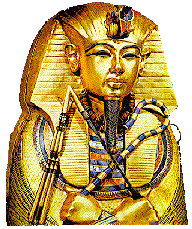 The ancient Egyptians were
well known for their elaborate burials. The image of the mummy wrapped
in layers of cloth are an icon of ancient Egyptian culture. The
pyramids, presumably intended to shelter these highly preserved dead
were, by their very design, somehow intended to assist the spirit
onwards towards a heavenly existence. Pyramids are being reveled
by archeologists to be equally cross-cultural in an age where
communication between the continents was not supposed to be happening
according to earlier archeological theories.
The ancient Egyptians were
well known for their elaborate burials. The image of the mummy wrapped
in layers of cloth are an icon of ancient Egyptian culture. The
pyramids, presumably intended to shelter these highly preserved dead
were, by their very design, somehow intended to assist the spirit
onwards towards a heavenly existence. Pyramids are being reveled
by archeologists to be equally cross-cultural in an age where
communication between the continents was not supposed to be happening
according to earlier archeological theories.