
©2001 Jon Youngblood
Unity Through Understanding
A Guidebook for the Recently Alive



|
|
|
|
|
©2001 Jon Youngblood Unity Through UnderstandingA Guidebook for the Recently Alive |
||
|
|
|
|
|
Audio sample now playing (IE Only): Reflections of Remoh - The Bloodhound Gang - One Fierce Beer Coaster, Geffen Records |
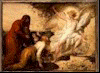
Part One: FaithChapter One: Elementary My Dear1.2 Spirit and The SpiritsReligious ritual is perhaps the oldest of our non-survival related activity since becoming sentient beings. Anthropologists inform us that several physiological changes occurred simultaneously in the human brain, and adaptive changes which revised the position of the larynx in the throats of our ancient ancestors, that combined gave rise to the “creation” of who we are today. With the culmination of these modifications, man was given The Word. And as, over time, language developed beyond mere expressions of need, or want, for food or for sex, we began to explore more elusive and abstract ideas that are either a by product, or direct imperative of language. These ideas are imbedded in some of our oldest myths which we will review in more detail in subsequent sections. Many of the written texts that we depend upon for historical insight, we written several or more generations after the events recorded. This may lead to inaccuracies, but when several writings are compared, a generalized truth can be mined from the stories contained in those ancient writings. There is a great deal of archeological evidence of religious activities that predates history (which is based only on the written record, presumably by a contemporary of the time in which the events recorded took place). But even before we had devised ways of recording our thoughts and actions, we had learned to think. Once our prehistoric ancestors had learned to utilized language internally, they began to think in much the same way we do today; and as ever young human has thought to themselves, they likewise thought "why?". Wondering about the world around us, we, by our nature, attempted to explain it’s existence. To find reason and purpose because our minds now reasoned and purpose became relevant. Bereft, at that time, of complex language or logic, attempts at answering those basic questions, such as the origin of the world, or what happens after death, was still beyond our ability to articulate. Then, out of the dark came light, and mythologies emerged; providing the answers that our Inquiring Minds wanted to know about the world around us. Mythology, or the explanation of existence, arose out of Mind. There has never been, on our world, this appearance of a totally abstract mental construct, though physical equivalants in the natural world were widespread. And with the emotional reactions to this novel mental construct, from the heart1, came Faith. Faith2,in it's broadest sense, is related to something outside of our normal waking experience. To Gods or beings existing in some "other" or "next" world. Whether existing above, below, or co-existing in another dimension, this Other, Unseen World inspires us to feel that there is something greater than ourselves and our day to day lives. And most disastrously for the history of our species, a belief in something beyond life. An esseence or soul that continued to exist after the body dies. So where did this sense of an unseen "other world" first arise? Short of time travel we can never be entirely sure, but it's existence is evidenced in antiquity in many non-written clues; many of which have only recently become known. From the evidence available it seems that once we had learned to reshape natural materials into more useful items, we began creating objects of a seemingly religious nature. The purpose of many of these early objects can not be known for certain, but they are a clear record of the increasingly complex thoughts of our early ancestors. By the end of the last Great Ice Age around 30,000 years ago, Faith was already firmly implanted into the Mind of man. Inspired by more historically correct films such as Clan of the Cave Bear, and Quest for Fire, I have often wondered what it might have been like back in the really old days. When language was a relatively new ability and, for the first time, we could begin to communicate increasingly complex ideas. What an individual experienced could now be shared. Imagine, if you will:
Could it have been a scene similar to this that led to our first conception, and subsequent expression, of a belief3 in something beyond life? A belief in some Unseen World where loved ones continued to exist? A world tapped into by the sleeping mind? There again, what is dream? Where do dreams come from? Did they have the acuity to comprehend dreams fantastical nature, or did early man assume that the dream experience to be literal, but different from waking consciousness. Was this the same "plane" of existence that one accessed with the aid of mind altering plants? In fact it was, but the nature of dreams is still unknown scientifically, so from the early humans perspective it was the same, but without the explanations of "processing" and neurological "rest state" that we know today to be the reasons for sleep - if not the reason why the brain, as developed and evolved as it is, requires from each and every one, this down time that leaves us vulnterable to attack and unproductive. Keep in Mind that without the word "hallucination", hallucinations don't exist. For these ancient ancestors of ours, they no doubt understood the difference in perceptual experience brought on by psychotropic plants, but they could not call it a hallucination because such a word did not yet exist for them. Nor did they have the words "brain" or "chemistry" with which to understand the mechanisms by which these chemicals affected them. For their Minds, it was only a different experience. Like the difference between tired and energetic, happy or sad, so aw with waking or sleeping. They could not associate "fabrication" or "illusion" with the experiences they had on these drugs because "fabrication" or "illusion" was not something they had discovered or understood yet. The term "all in your mind" would have meant nothing to them. So for them it was just another experience, just as real as any other, in which unusual things were seen, heard, and felt. Things that, logically enough for them, could only have come from the Other World. These plants were no doubt considered to be a means of connecting to the Other World and no more though on the subject was necessary. However the idea was conceived, it began a change in behavior that would forever mark us as special among all creatures. We began to express a continued concern for the "departed". We began to bury our dead. And created a concept that would forever change our way of life. The concept of Spirit4. Not only did there exist in this “other” world the spirits of our friends and family, but in time, a host of other “beings” whom had never known human flesh. Soon spirits were ubiquitous. In the trees, and in the plants. There were sacred rocks that contained spirits. Sacred places like glens or waterfalls were abundant with invisible beings that effected our lives. And to whom, with the proper skills and/or offering, could be persuaded to effect our lives in beneficial ways. But we will examine more on this later. (See 1.8 Animism) An older friend, a Christian woman, once commented on the loss of her husband years before. "I don't know how I could have gotten through it without my faith" she told me. My immediate, albeit irreverent, response was thinking to myself, "Oh, so that’s what religion is for…" And I began to wonder if faith is nothing more than a security blanket for the lonely and frightened child in us (even in, especially in, the elderly). A slippery slope towards atheism, to be sure, but the bad thing about thoughts, is that once they are "out", there is no way to put them back "in". The cat, as it were, being out of the bag, must be recognized and contended with. Any amount of reflection on the temporal nature of nature, brings an uneasiness to emotionally and psychologically cultured individuals; and shear terror to the rest of us. The finality. Why do we live and grow and learn and emote? If only, for all that is the experience of our lives, is to be lost irrevocably forever. The fear and anger at the helplessness of our puny being to do anything to change it, or even understand it, is not unique to our selves. God only knows when the exact moment was that human beings first experienced this horrible realization. Yet that moment forever changed our relationship to our environment - including our interactions with one another. All of this is simply stating the obvious, but I hope that a greater point can be made, and that the journey towards that point will be an enlightening one, and perhaps entertaining as well. Astro-physics alone has shown us that nothing is ever as simple as we might guess. We must be wide open for new revelations and be willing to entertain some different ideas if we are to gain the insights that so few have been privy to - and with which one can hope to become empowered in ways that we didn't even know we could be. Enlightenment is not just about acquiring some esoteric knowledge, but the empowerment that knowledge conveys. Without this new age of Mind, we will remain the gullible sheep of the few in power who make the decisions that determine the fate of all of us. If we can "cross over" and be "re-born" into a new age of empowerment, then this effort will be of great advantage to the Universe; since no matter who created it or how it came to be, it produces intelligence and it seems to delight in growth and in defeating it's own laws regarding entropy. Increasing the combined awareness of the people of our planet should please the Universe, wouldn't you think?
Home Introduction Forward Part One Part Two Part Three - Links by Topic Timeline Glossary
#1 As an ardent student of the Sciences, I have on occasion , felt compelled to carry the banner for righting the continued misuse of the Word “heart” when referring to the seat of emotion. The heart is a pump. It can’t feel (in the sense of emoting) anything. Yet as a widely recognized social convention, I use the “folklore” use of the word, since it has been believed to be the seat of emotion for thousands of years. I ask that the scientists amongst you to please excuse this terrible transgression of traitorous terminology. What I mean is that there was an immediate emotional response to this new “awareness” of the Other World. [Back to Text] #2 faith: (Amer. Her. 3rd Ed.) 1. Confident belief in the truth, value, or trustworthiness of a person, an idea, or a thing. 2. Belief that does not rest on logical proof or material evidence. 3. Loyalty to a person or thing; allegiance: keeping faith with one's supporters. 4. Theology. The theological virtue defined as secure belief in God and a trusting acceptance of God's will. 5. The body of dogma of a religion: the Moslem faith. 6. A set of principles or beliefs. [Back to Text] #3 belief: (Amer. Her. 3rd Ed.) 1. The mental act, condition, or habit of placing trust or confidence in another. 2. Mental acceptance of and conviction in the truth, actuality, or validity of something. 3. Something believed or accepted as true, especially a particular tenet or a body of tenets accepted by a group. [Back to Text] #4 spirit: (Amer. Her. 3rd Ed.) l.a. The vital principle or animating force within living beings. b. Incorporeal consciousness. 2. The soul, considered as departing from the body of a person at death 3. Spirit. The Holy Spirit. 4. Spirit. Christian Science. God. 5. A supernatural being, as: a. An angel or a demon. b. A being inhabiting or embodying a particular place, object, or natural phenomenon. c. A fairy 0r sprite. 6.a. The part of a human being associated with the mind, will and feelings: Though unable to join us today, they are with us in spirit. b. The essential nature of a person or group. 7. A person as characterized by a stated quality: He is a proud spirit. 8.a. An inclination or a tendency of a specified kind: her actions show a generous spirit. b. A causative, activating, or essential principle: The couple's engagement was announced in a joyous spirit. 9. spirits. A mood or an emotional state: The guests were in high spirits. His sour spirits put a damper on the gathering. 10. A particular mood or an emotional state characterized by vigor and animation: sang with spirit. 11. Strong loyalty or dedication: team spirit. 12. The predominate mood of an occasion or a period: "The spirit of 1776 is not dead" (Thomas Jefferson). 13. The actual though unstated sense or significance of something: the spirit of the law). [Back to Text] |
Home Introduction Forward Part One Part Two Part Three - Links by Topic Timeline GlossaryFaith and Physics is Sponsored by Scoot On This! LLC, changing the world one electric vehicle at a time. Think Big - Drive Small. Visit: http://www.scootonthis.com |