 Buying Guitars, Amps and Effects
Guitars |
Amps |
Effects |
MultiEffects |
Build your own effects
Electric Guitars
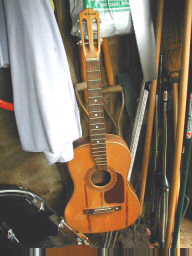 Budget electrics are much better and cheaper than when I was at school - cheapest are made in China, India and Indonesia, Korean made are better quality and worth paying a bit more for
Good budget makes - Fender Squier, Epiphone, Aria, Yamaha, Westone, Washburn, Old Vantage, Old Ibanez
Mid range - Fender Mexico, Peavey Korea, Parker Korea, PRS Korea
Pro quality - Fender USA, Gibson, Guild, Gretsch, Rickenbacker, ESP, Jackson, Parker, MusicMan, Levinson, Paul Reed Smith, Ibanez
Features
Pickups These come in single coil and humbucking varieties. Single coils are brighter and twangier, have less output and are good for clean sounds (eg Dire Straits), though many famous players use them with distortion too - Jimi Hendrix, Richie Blackmore and Jeff Beck, for example. Humbuckers have more output and are less bright, especially for clean sounds, but are used more with distortion - eg Jimmy Page, Slash, Metallica and all varieties of Metal
Tremolo Systems As a rule, unless you have a burning desire to play Steve Vai stuff, avoid locking tremolo systems as they are needlessly complicated. They take ages to tune up, if you break one string the whole guitar is out of tune, you have to carry the correct allen key, the guitar costs more and sounds worse, and the cheaper units don't stay in tune any better than non-locking systems.
Body Wood Cheaper guitars are often made of plywood. Generally speaking this doesn't do much for the sound, so try and go for solid wood - trasparent finishes are a good idea, as you can see the wood isn't ply
The Colour and the Shape Stratocasters and Les Pauls are that shape for a reason - they're comfortable to hold and easy to play. Odd shapes - Flying Vs etc aren't. Colour comes at the bottom of the list - if it sounds great and plays great but you hate the colour, buy it; it's a musical instrument, not a handbag
Recommendations
I'm going to stick my neck out and make recommendations for each price bracket, as I'm always being asked - remember though, you must then try them out and see what gives you the sound you want - plus individual guitars of the same model vary enormously - out of half a dozen you'll get one good one, one bad one and the rest so-so, so try more than one in the shop.
Price �120 - �200 Squier Stratocaster or Telecaster, though not the Affinity (Chinese) ones; pay a bit more and get a higher quality Korean model. These now come in every variety you can imagine - my personal choice would be a maple fingerboard Squier Telecaster Custom with two humbucking pickups = �159. Everything you need, and nothing you don't. Get a good example and you won't need another guitar for years, perhaps ever.
Price �200 - �350 Standard (Mexican) Stratocaster/Telecaster. Lots of different pickup combinations available
Gordon Smith - beautiful British made guitars - as good as US Gibsons/Fenders, I reckon
Price �400 plus If you're going to spend this much, don't waste your money on an intermediate guitar like an Epiphone, or in 18 months you'll be looking to upgrade again and taking a huge loss when you try and sell it. Save up that bit more and get a proper US Fender or Gibson that will hold its value - Gibson SG Specials are �489 at present (thanks to George Bush ruining the US economy) - or again, Gordon Smith make nice guitars in this price range
If I had known then what I know now, after having my first electric guitar long enough to know I was going to persevere, I should have gone out and bought a top of the range USA guitar and amp, then stuck with that. Why? Because I would have saved myself a fortune in cheap guitars, amps and multieffects over the years, and have had a quality instrument and a good sound all that time - and gear that would have kept its value pretty well too. So - in today's terms, we'd be looking at a PRS guitar and a Mesa Boogie amp - go on, you know it makes sense; in 20 years you'll thank me! (�3000 over 30 years is �2 per week, and by then it'll be worth �30,000)
If you don't do that, then a reasonable compromise would be; get the no-frills option real Fender/Gibson/Gordon Smith for around �500, an Ibanez TS7 Tubescreamer (Kirk Hammett uses one) and a 30-50w valve amp by Fender, Peavey, Laney, Ashdown or Marshall for about �450.
Of course, all this expense can be bypassed by going second hand. All my favourite guitars cost less than �100 used, my 60w valve amp sounds like a Mesa Boogie and cost �150 used, and the best distortion box ever, the Ibanez TS7 Tubescreamer, cost about �25 used.
Your Hero's Guitar 'Aha!' you think, 'My hero, Rik Fudge of the Great Unwashed plays a Fenderson Hypertwang Deluxe in Metallic Midnight Snot Green; if I get a guitar that looks like that, I'll sound like he does.' Er, no you won't, because 1. His guitar is handbuilt in the Fenderson Custom shop, where they made 12 from premium wood (not plywood like the copies in the guitar shop) and picked out the best sounding one for him, because they know 200 million guitar fans are watching to see what he plays 2. He's playing it through a custom modded amp that cost more than your Dad's car and was run at full volume 3. And a rack of effects bigger than a fridge with two Physics graduates to program it 4. That monster sound they got on the last album was actually 14 guitars overdubbed in NY's Gigabucks Studio with ace producer Ziplok Bagg. If you don't believe me, take a close look at Slash's gear - NONE of it is stock.
This doesn't mean you can't get a good sound without spending a fortune; you CAN, but don't imagine that the Epiphone ZW is going to sound like Zakk Wylde's Les Paul just because it has the same paint job.
Amplifiers (Combos) Top
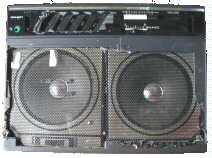 For practicing at home, 5 - 10 watts output is fine, to play with a band, you will need min. 25 watts RMS. Combo means it has a built in speaker. As a rule, valve amps sound best (most pros use valves), but solid state(transistor) is catching up. Some amps (eg Marshall VS series) are a mixture of valves and solid state
Decent makes: Marshall, Laney, Fender, Peavey, Ashdown - these all make both valve and solid state amps. A recent development is the 'modelling' amp, which uses a microprocessor to simulate valves - made by Line 6, Roland, Yamaha. However, the real test of an amp is how it sounds on a gig - many players (myself included) still swear by valves - the rest may sound OK in your bedroom, then duff live
Effects Top
Distortion is the one effect absolutely necessary for rock guitar. Nowadays most amps have it built in - called variously gain, distortion, pre, drive, overdrive, o/d, etc etc. Also available in 'stompbox', it comes in different flavours, viz
Fuzz - buzzy, sizzly, farty 'Satisfaction' tone, think Hendrix 'House Burning Down'. Good example - ElectroHarmonix Big Muff Pi
Overdrive - warmer, less radical distortion, intended to mimic the sound of overloaded valves - think Stevie Ray Vaughan. Good example - Ibanez Tube Screamer
Distortion - generally somewhere between fuzz and overdrive, intended to mimic flat out valves - think Joe Satriani. Good example - Boss Turbo Distortion
Metal Distortion - heavy distortion with 'scooped' EQ - less middle, more bass and treble - think Metallica. Good example - Boss Metal Zone
Multi Effects Top
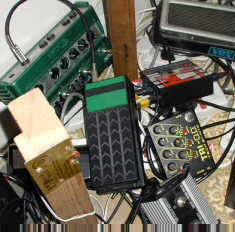 These have come on in leaps and bounds in the last few years, and are good value for money, as they include distortion, delay, reverb, chorus, flange, wah etc etc all in one box. Because the rate of progress is so fast, they lose their value very quickly (like any computer technology) - but this does mean that older models can be picked up very cheaply. Try Korg, Boss, Zoom and Digitech. Do remember, however, that they can't compensate for a lousy amplifier - whereas if you get a good amp, you may not need effects at all. Also, don't be dazzled by 3001 different multieffect sounds in the shop - 2 really good sounds (1 clean, 1 distortion) are all you need.
Alternatively, go for a couple of good stomp boxes - distortion, wah and delay being the most useful
For reviews of all this stuff, visit Harmony Central
Building Your Own Effects Top
Alternatively, why not try building your own effects boxes - if you're OK with a soldering iron, you can knock up a simple circuit like a fuzzbox in a weekend, for about �10
There are loads of circuit diagrams on the Web - try these:
Lots of circuits for various effects |
More circuits
There are also kits available from PAiA in the US - they will ship to UK