Instrument-Building, page 3
table of contentsnext page
Cigar Box
I'm facing a lot of instrument maintenance, I'm afeered. The bass needs a fret job. One of the guitars needs some general attention, including a bridge. Another, a recently obtained classical, needs a (home-built imitation of a) JLD Bridge Doctor. A banjo that was born ten months after my wife needs its neck dowel rereset. Another instrument I won't name needs some accordion straps.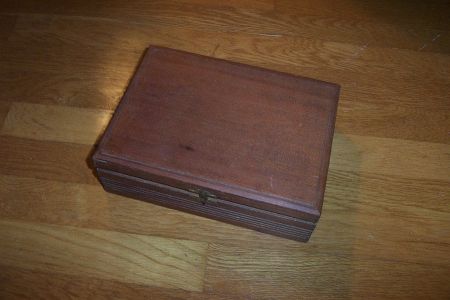 But to avoid all that I'm working on an octave mandolin, having started with this cigar box. The box is made of some kind of straight-grain cedar. It's been around for a while and never finished, so the wood has some age and stability to it. The top and bottom boards are pretty close to quarter-sawn.
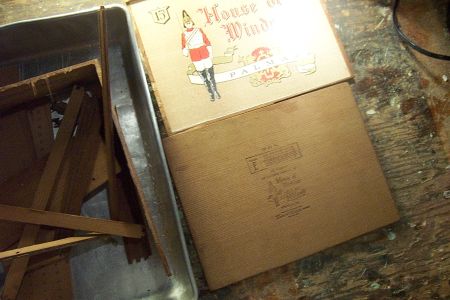 Here are the inside of the top and outside of the bottom of the box. This particular House of Windsor does not rule Britain but makes cigars in Pennsylvania. The fragments of the rest of the box are sitting in an aluminum ("aluminium" for some of you) cake pan, which will become part of this story.
| Here I have joined those two boards and thicknessed 'em down to under 0.1". Then I put some braces on 'em, and lacquered 'em�both sides because of the adage I grew up with: "Whatever you do to one side of a piece of wood, do to the other." The resulting soundboard is sized and shaped to fit right nicely on that cake pan (13x9"), which had been condemned to the dungeon for leakiness. So there's my back and sides. |
| After lots of CAD I've finally started on the neck. This is actually pretty far from how the design ended up, but it gives the basic idea. Soundholes are in the neckward side of the pan, and there's a couple triangular constructions to scoop the sound toward the screaming fans. |
Two or three years ago I picked up for $2 a hunk of mahogany that I suspect was somebody's rejected neck blank. A couple weeks ago I headed into a wood store in search of, I hoped, a piece of 1/4" maple long enough to make a fretboard and disliked enough to not make a financial ripple. Yeah right. But lo and behold they had a hunk of maybe-maple for $1 that screamed fretboard. It has some lines of spalting or somesuch to make it interesting. Could it be another rejected blank? It has a void on one side that would void it for pickier people, maybe where one of those beetles got a big bite.
I've done a rip and flip on the mahogany, cut out the fretboard, and put together a trussrod. I outlined the fretboard with an eye for interesting pattern, and the void on the other side of the maybe-maple ended up where there won't be any glue anyway because of the trussrod.
If I'm starting to sound like a genius to anyone (hardehar), then
- please get your hearing checked,
- check back for when I get some pictures posted,
- check MIMF for people who are smarter than I'll ever be, and
- get a load of how I get flat surfaces on wood without a jointer or a planer:
Alright, I know a lot of this would work better if I put some extensions on the drillpress table. Live and learn. I still have all my fingers, though a bread knife enthusiastically offered to relieve me of a thumb this morning.
Anyway, there's been some resort to the power sander to salvage things and get rid of Mr. Wagner's swirlies.
Oh yeah, I have a plane, the kind that's real quiet because it has a frog in its throat. But to use that not only would I have to remember what my shop teacher said forty+ years ago about how to use the thing but I'd also have to learn to sharpen it. And to do that I'd have to fabricate a proper toolrest for my pawnshop grinder. And grind while my wife isn't home so she doesn't worry about the sparks. Yesterday I was cutting the 1/8x1/2" steel for the trussrod with my notadremel (more about that on page 5) and merrily ignoring the sparks and a big one nailed me on the cheek. Better that than the open can of thinner, the rattle-can of lacquer, or the mahogany dust that Mr Sucky missed, and it didn't even catch my beard on fire.