[ Home ] [ My Bio ] [ My Photo Album ] [ Contact me ] [ My links ] [ Quotes ]
Hi there!
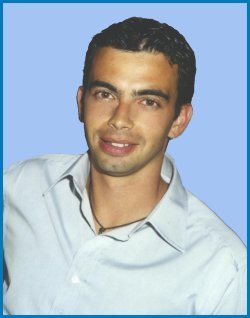
Let's start with my names... The easy part (at least for Greeks who can pronounce it :-) is my last name: Papadimitriou. My official first name is Ioannis (yeah, I know, too many vowels at the beginning, but actually it's not so difficult), which is the Greek word for John. Nevertheless, everybody calls me Yanni. Since this is the most common Greek name, I mixed things together and now a lot of people call me jpg, which are the initials of 'Johnny Papadimitriou the Greek' (no relation to the JPEG image compression format). Thank God, I don't have a middle name...
Born and raised in the so-called S.S (southern suburbs) of Athens - Greece, I quickly developed a strong inclination towards the new technologies. In 1994, I entered the Electrical and Computer Engineering department of the National Technical University of Athens and completed the five-year curriculum in just four years, having majored in Telecommunications. In the next couple of years, I did my military service and worked as a research assistant in the Telecommunications Laboratory of the National Technical University of Athens (for more information, please download my resume).
Then, I took the 'great step'. I left my family, my friends, the picturesque Aegean islands, the 'frappé' coffee and the famous Greek 'mousakas' behind and decided to go for a Master's degree in the Electrical Engineering Department of Stanford University. In September 2001, I reached the U.S. West Coast and since then I have met so many people from different countries and cultures, studied really hard (it seems to me that this is what people should mean by 'Californian madness' :-), visited a lot of interesting places, such as San Francisco, Seattle, Santa Cruz, L.A., San Diego, Santa Barbara, Las Vegas and Grand Canyon and became part of the American way of living. While working towards my graduate degree at Stanford, I was not alone: my brother, Iakovos, is studying in the Mechanical Engineering department of Berkeley University. Apart from this, I had three scholarships from the Fulbright Foundation, the A. S. Onassis Public Benefit Foundation and the Gerondelis Foundation.
Now that my coursework at Stanford has been completed, it is about time to go one step further. Starting from January 2003, I am with World-Link Telecom Inc., working as a network planning engineer. My primary focus is on improving the quality of voice services we provide over TDM and VoIP infrastructure. It is an interesting period full of changes: from school to a real job, from California to New York City...
 Networks
EE284 - Introduction to Computer Networks: Structure and components of computer networks; functions and services; packet switching; layered architectures; ISO’s Open Systems Interconnections (OSI) reference model; physical layer; data link layer; error control; window flow control; media access control protocols used in local area networks (Ethernet, Token Ring, FDDI) and satellite networks; network layer (datagram service, virtual circuit service, routing, congestion control, IP); transport layer (UDP, TCP); application layer. Projects: (a) Implementation of the basic functionality of the Spanning Tree Protocol (specified in IEEE 802.1d) in C language. (b) Implementation of a simple FTP client in C language.
EE384A - Internet Protocols and Standards: Local area networks protocol standards: MAC Addressing; IEEE 802.1 bridging protocols (transparent bridging, virtual LANs). Internet protocol standards: the Internet Protocol (IPv4, IPv6, ICMP); routing protocols for interior gateways (RIP, OSPF) and exterior gateways (EGP, BGP, Policy routing); IP multicast (IGMP, DVMRP, CBT, MOSPF, PIM); Multiprotocol Label Switching (MPLS). Projects: (a) Implementation of most features of the Spanning Tree Algorithm described in IEEE 802.1d. (b) Implementation of the GMRP/GARP protocols (described in IEEE 802.1q) in C language. (c) Implementation of the Open Shortest Path First (OSPF) routing protocol.
Routing
EE384X Packet Switch Architectures I: First part of two-course sequence. The theory and practice of designing packet switches and routers. Evolution of switches and routers. Output scheduling: fairness, delay guarantees, algorithms. Unicast switching: blocking phenomena and their alleviation, connection between switch scheduling and bipartite graph matching. Multicast switching. Theoretical complements: simple queueing models, Bernoulli and Poisson processes, graph matching algorithms, urn problems, stability analysis using Lyapunov functions, fluid models.
EE384Y Packet Switch Architectures II: Second part of two-course sequence. The theory and practice of designing packet switches and routers. Address lookup: exact matches, longest prefix matches, performance metrics, hardware and software solutions. Packet classifiers: for firewalls, QoS, and policy-based routing; graphical description and examples of 2-D classification, examples of classifiers, theoretical and practical considerations. Project: Stability of Congestion Control Algorithms Using Control Theory with an application to XCP (pdf format)
Wireless communications
EE276 - Introduction to Wireless Personal Communications: Frequency reuse, cellular concepts, cochannel interference, handoff. Radio propagation in and around buildings: Friis equation, multipath, narrow-band and wide-band channels, small scale and large-scale statistics, space and time signal variation. Diversity. Receiver sensitivity, sources of noise, range. Performance statistics: coverage, margin, digital modulation, adjacent channel interference, and digital error rates. Wide band channels: maximum transmission rates. Multi-server queuing and traffic: Erlang formulas.
EE278 - Introduction to Statistical Signal Processing: Random variables, vectors, and processes; time averages, expectations, and laws of large numbers; stationarity, autocorrelation and spectral analysis; mean square error estimation, detection, and linear filtering; independent increment, Gaussian, and Poisson random processes.
EE279 - Introduction to Communication Systems: Analysis and design of communication systems; analog and digital modulation and demodulation, frequency conversion, multiplexing, noise and distortion; spectral and signal-to-noise ratio analysis, probability of error in digital systems, spread spectrum.
EE359 - Wireless Communication: Performance of digital modulation in fading and intersymbol interference; capacity of wireless channels, flat fading countermeasures-diversity, coding and interleaving, adaptive modulation; multiple antenna systems; intersymbol interference countermeasures; equalization, multicarrier modulation, spread spectrum and RAKE receivers; multiple access, cellular systems, and ad-hoc networks. Overview of current systems and standards. Project: Modern Wireless Technologies for Office and Home Networking.
Software/Systems
Design
CS140 - Operating Systems and Systems Programming: The fundamentals of operating systems design and implementation. Basic structure; synchronization and communication mechanisms; implementation of processes, process management, scheduling and protection; memory organization and management, including virtual memory; I/O device management, secondary storage, and file systems. Programming Assignments: (a) Threads (b) Multiprogramming (c) Virtual Memory (d) Filesystem.
CS108 - Object-Oriented Systems Design: Software design and construction in the context of large OOP libraries. Taught in Java. Topics: review of OOP, the structure of Graphical User Interface (GUI) OOP libraries, Gui application design and construction, OOP software engineering strategies, approaches to programming in teams. Several programming assignments as well as a final group project are included.
CS193i - Internet Technologies: Programmer-oriented survey of the authoring, distributing, and browsing technologies. The role, use, and implementation of current Internet tools. Topics: TCP/IP, namespace, connections and protocols. Client/Server structures. Web/HTTP/HTML techniques for text, images, links, and forms. Server-side programming. CGI scripts. Security and privacy issues. Programming projects on client- and server-side in Perl or Java. Languages are introduced as needed. Emphasis is on understanding, exploiting and extending Internet technologies.
CS145 - Introduction to Databases: A comprehensive introduction to database design and the use of database management systems for applications. The relational model and XML, including the XML query languages XPath and XQuery, and SQL, the standard language for creating, querying, and modifying relational and object-relational databases. Relational algebra, relational design principles based on functional dependencies and normal forms, and the entity-relationship and object-oriented approaches to database design. Other issues include indexes, views, transactions, authorization, integrity constraints and triggers. Several advanced topics drawn from data warehousing, data mining, OQL, Datalog, temporal databases, middleware, or peer-to-peer systems. A 'Personal Database Application' project is also included.
Economics
MS&E 242 - Investment Science: Introduction to modern quantitative investment analysis: theory and practical application. How modern investment concepts can be used to evaluate and manage opportunities, structure portfolios, and use sophisticated investment products including stocks, bonds, mortgages, and annuities. Topics: deterministic cash flows (time-value of money, present value, internal rate of return, term structure of interest rates, bond portfolio immunization, project optimization); mean-variance theory (Markowitz model, capital asset pricing); dynamic and uncertain cash flows. Emphasis is on translating theory into actual procedures. Examples of applications for every major topic. Group project devoted to application of the theory
. Seminars
EE201A - Seminar: Weekly discussions of special topics of current interest in electrical engineering. Orientation to Stanford and to the EE department. Students with a conflict may view via videotape in the library
EE201B - Seminar: Looks at “Life after Stanford” through a series of presentations primarily directed at MS/EE students. The activities of graduates in industry (large, medium, and small), start-up companies, government laboratories, and community colleges
EE203 - The Entrepreneurial Engineer: Seminar furthers the knowledge base of prospective entrepreneurs with an engineering background. The contributions made to the business world by engineering graduates. Speakers include Stanford (and other) engineering and M.B.A. graduates who have founded large and small companies in nearby communities. Contributions from EE faculty members and other departments (law, business, and industrial engineering).
EE380 - Seminar on Computer Systems: Current research in the design, implementation, analysis, and use of computer systems ranging from integrated circuits to operating systems and programming languages.
EE548-Distributed Systems Research Seminar: Recent research in distributing operating systems, computer communication, parallel machines, and distributed applications. Invited speakers from Stanford and elsewhere present topics and results of current interest.
“A combined Hardware / Software ETHERNET Protocol Implementation for Embedded DSP Based Environment” by Aggelos Liveris, Ioannis Papadimitriou, Nikos Moshopoulos, Pavel Karmazin and George Stassinopoulos (Communications and Control Conference 7, Athens, Greece 06/28/99 – 07/02/99)
IEEE member since January 1999
Lifeguard
Favorite Sports:


You can download my resume in pdf format here.

