|
The motivation
It was the year of 1952. Chevrolet had caught up with
Ford and Chevy management
was looking for a way to keep ahead. At the same time
General Motors had already been considering to build a sports car of
their own. They wanted an exciting, youth-oriented car. But also, world
class.
GM was also inspired to build an American car to fulfill the yearnings
of soldiers returning from war. Overseas, some men fell in love with a
woman, while others found a mechanical sweetheart in the classic
European sports cars.
Chevrolet was chosen as the Division to do so, and so it
happened. "Project Opel" commenced short there after.
After months of hard work, a prototype
was ready just in time for the January 1953 Motorama, held at New York's
Waldorf Astoria hotel. The car was revealed on January 17th of that
year. Millions were about to fall in love, and the
American roads would never
look the same.
C1 -
The eye catcher (1953 - 1962)
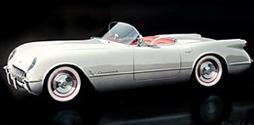
There, under the lights, sat a sports car
unlike anything that had ever been seen before. It was lean. Low to the
ground. Curvy. A toothy-grilled roadster with rocket-ship taillights and
just enough room in the open cockpit for two adults. It didn't have
exterior door handles; it didn't even have roll-up side windows. It
could have been another European bullet. But it wasn't. This sexy dream
machine was graciously named "Corvette" and had been presented by
Chevrolet.
That wasn't the only surprise. Not only
was this stunning roadster American, but also, it wasn't made of steel!
Instead, the elegant, flowing bodywork was sculpted in fiberglass
introducing significant advantages like light weight which would help
increase performance, and would dramatically lower cost. When it went
into production later in 1953, the Corvette became the country's
first-ever mass-produced fiberglass automobile.
Production of the 1953 Corvettes
began in June and they were mostly
built by hand in Flint, Michigan appearing almost identical to the Motorama car. They
were powered by the existing Chevrolet 235-cu.-in. 6-cylinder engine
that was modified with a three-carburetor design and dual exhaust to
give it more sports car-like performance. Named the Blue Flame Special,
this engine generated 150 horsepower, and it was teamed with a 2-speed
Powerglide automatic transmission.
300 1953 Corvettes were made. All of them
Polo White with red interiors. The base price for Chevy's new two-seater
when it finally went on sale in September of 1953 was $3498.
Even though the new Corvette
was a sensation, with sales of 3640 in 1954 in part helped by the new
color offerings; the powertrain, did not
live up to the performance expectations of sports car buyers.
Corvette's evolution into a
true sports car began in 1955 when a 265-cu.-in. V8 that generated 195
horsepower was offered. The V8 and Corvette would be together ever
since. By the end of the model year, a 3-speed manual transmission was
also available. In 1955, driving a prototype
V8-powered Corvette, Zora Arkus-Duntov set a new record in the Daytona
"Measured Mile" at just over 150 miles per hour. From now on,
the words "performance" and "Corvette' would become synonymous.
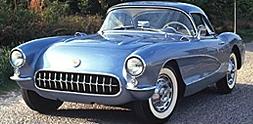
1956 was the first year a major styling update
was given. Changes included an all-new body
with "scooped out" sides, outside door handles, roll-up windows and an
optional removable hardtop. Power was now up to 240.
In 1957 the 283-cu.-in. V8
was modified with fuel injection to produce an unprecedented 283
horsepower, and a new 4-speed manual transmission was offered as an
option, making Corvette one of the first cars in the world to mate a
fuel-injected V8 engine with a 4-speed manual gearbox.
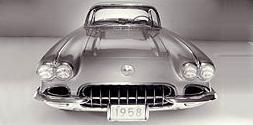 Only
two years had gone by since the latest body change, but in 1958 the "Vette"
gained 9 inches, a couple more of headlamps and another 7 ponies.
The Corvette didn't have significant changes to receive the sixties.
Less chrome and no more molded rear taillights were on the order. Only
two years had gone by since the latest body change, but in 1958 the "Vette"
gained 9 inches, a couple more of headlamps and another 7 ponies.
The Corvette didn't have significant changes to receive the sixties.
Less chrome and no more molded rear taillights were on the order.
In
1961 the big news was at the Corvette's tail. A new rear-end design
added four recessed taillights, starting a new styling tradition that continues to
this day.
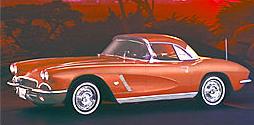 The
engine output climbed to 315 hp. The
engine output climbed to 315 hp.
The
1962 V8 displacement went up to 327 cubic inches, with a power bump of
45 horses. This was the end of the road for the first-generation
Corvette. But with sales over 14,500 units, it went out on a high note.
C2 -
A legend is born (1963 - 1967)
In 1963, Chevrolet
introduced
its all-new-second-generation model: the legendary Sting Ray. It came in
both Coupe and Convertible versions for the first time.
Both cars
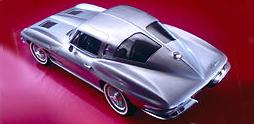 featured an all-new
body design that was significantly trimmer and more stylish than the
previous generation. It was also the first year for another tradition: concealed headlamps.
The chassis was all new as well, including an independent rear
suspension, as well as available air conditioning and leather. But the
most distinguishable feature of the 1963 Sting Ray was that its Coupe
version featured a split rear-window
design. featured an all-new
body design that was significantly trimmer and more stylish than the
previous generation. It was also the first year for another tradition: concealed headlamps.
The chassis was all new as well, including an independent rear
suspension, as well as available air conditioning and leather. But the
most distinguishable feature of the 1963 Sting Ray was that its Coupe
version featured a split rear-window
design.
With sales of the '63 model
over 21,500 units, Chevy didn't want to mess with its new success. So
the 1964 Sting Ray had only two major changes: more ponies to top out at
375 hp, and the Coupe rear window was replaced with a single-piece
because owners complained about visibility. This has made a split-window
Coupe an invaluable collectors item today.
With sales soaring, why
change the styling? So for 1965 they didn't, but this
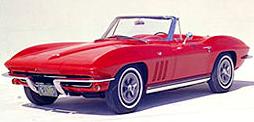 would
be the year in which the Corvette surpassed the 400 hp mark by offering
a big-block V-8, a monstrous 396-cubic-inch "Turbo Jet" good for 425
horsepower. Four-wheel disc brakes stepped up to the plate as well. would
be the year in which the Corvette surpassed the 400 hp mark by offering
a big-block V-8, a monstrous 396-cubic-inch "Turbo Jet" good for 425
horsepower. Four-wheel disc brakes stepped up to the plate as well.
1966 didn't bring any
styling changes either. The main change was that its optional big-block
engine got even bigger: displacement climbed to 427 cubic inches, and
max horsepower jumped to 450.
Chevrolet had planned to
unveil a new-generation C3 Corvette for '67, but the car was delayed.
Instead, the company unveiled one of the most awesome engine options in
Vette history: the '67 L88. Officially rated at 430 horsepower, the V-8
actually produced well over 500 hp. Only 20 of the beasts were built.
The C2 left, but not without
leaving its mark as the most legendary of them all.
C3
- Long live the King (1968 - 1982)
In the time during which the
Sting Ray was a hit, in the earlier 60's a car code named the Mako Shark
II made its debut as a show car. Being of the like of many, it was later
chosen as the base for the new C3. Its new styling was the first step
towards the Corvette we see in show rooms today.
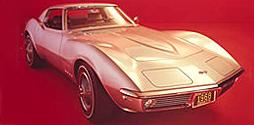 The
new-generation Corvette was lower and seven inches longer than its
predecessor. And another tradition was about to commence: the removable
T-tops. Hidden windshield wipers were also introduced. In 1968, Corvette production hit a new record of 28,566,
with its most radical styling change ever. This
basic body design would continue to evolve for 15 years. The
new-generation Corvette was lower and seven inches longer than its
predecessor. And another tradition was about to commence: the removable
T-tops. Hidden windshield wipers were also introduced. In 1968, Corvette production hit a new record of 28,566,
with its most radical styling change ever. This
basic body design would continue to evolve for 15 years.
It was July of 1969 and the
US was on top of the world by landing a man on the moon, and the
Corvette was on the top of the sports-car world. No significant changes
appeared. The only worthy-mentioning change was the reappearance of the
"Stingray", just the name though. By the end of the year, Chevrolet
produced its Corvette # 250,000.
The Corvette received few
styling changes in 1970. Under the hood, the big-block V-8 jumped from
427 cubic inches to 454, and was rated at 390 horsepower in the LS5
version. The original high-performance LT1 engine was introduced. It was
350-cu.-in. The "Small Block" generated 370 horsepower.
Around the time, outside
forces, such as the oil embargo and increasing government regulations,
were having an impact on Corvette performance. These were convulsive
times. The world would ever more environmentally conscious, so GM in
1971, mandated that all of its products would run on unleaded fuels. The
Corvette of this year was not an exception. In anticipation of meeting
that objective, the '71 Corvette offered engines designed to use
low-lead gasoline. Still, a special-purpose "Big Block" V8
was available that produced 425 horsepower. The bodywork carried on
unchanged.
1972 would have another
significant change, but rather than bringing a visual change, it would
be about how we talk. Horsepower ratings would change. The industry changed to a "net" rating
system that accounted for the exhaust system, vehicle accessories and
other components, rather than a "gross" measurement. It provided a truer measure of an engine's performance
and it is still used today. This way the max horsepower suddenly stepped
down to "only" 270, and it would need to start growing bigger all over
again for us to feel we were talking "big" numbers once again.
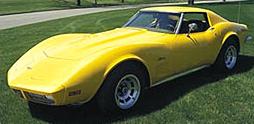 The
most noticeable change for '73 was the lack of a chrome front bumper.
The new nose, covered in body-color urethane, was designed to withstand
5-mph impacts without damage. Yes, the safety race was about to
commence. Chevy also added steel side-impact door beams and radial
tires. Max output, in the 454 V-8, climbed to 275 horsepower. The
most noticeable change for '73 was the lack of a chrome front bumper.
The new nose, covered in body-color urethane, was designed to withstand
5-mph impacts without damage. Yes, the safety race was about to
commence. Chevy also added steel side-impact door beams and radial
tires. Max output, in the 454 V-8, climbed to 275 horsepower.
1974 was the year in which
the chrome was finally gone. The Vette featured a molded-plastic rear
bumper to match the integrated front bumper introduced the year before.
This was also the last Corvette not to have a catalytic converter, and
the last year for the famed big-block V-8. Sales were strong: Chevy sold
more than 37,000 Corvettes.
The Convertible model was
dropped at the end of the 1975 model year. The next Corvette Convertible
would not be available until 1986. Output ranged from 165 horsepower to
205.
1976 showed sales of more
than 46,500 Corvettes. Some believe it was mostly due to the pride of
being an American in its bicentennial year. Regardless of the reason,
the love affair was stronger than ever.
The 500,000th Corvette
rolled off the assembly line in mid-March of 1977. Leather seats were
standard for the first time. And sales were through the roof: Chevy
produced 49,213 coupes establishing a new Corvette record.
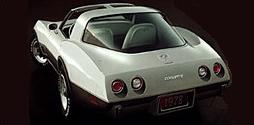 To
celebrate the Corvette's 25th Anniversary, Chevrolet unveiled the most
significant restyling since the '68 model, which included a new fastback
rear window. In recognition to its anniversary, it was selected to be
the Official Pace Car of the Indianapolis 500. A limited edition replica
of this car was sold to the public. The division also produced a Silver
Anniversary model. To
celebrate the Corvette's 25th Anniversary, Chevrolet unveiled the most
significant restyling since the '68 model, which included a new fastback
rear window. In recognition to its anniversary, it was selected to be
the Official Pace Car of the Indianapolis 500. A limited edition replica
of this car was sold to the public. The division also produced a Silver
Anniversary model.
With a record production of
53,807 coupes, the '79 ranks as the most popular Corvette ever built.
Power was up to 225 hp at its maximum.
Regulations, regulations.
The 1980 Corvettes received speedometers that read to a maximum of 85
mph (a new Federal requirement). Other rules: tightened emissions. You
couldn't buy a 350-cubic-inch V-8 in California. Golden State buyers had
to settle for got a 305 V-8 instead.
For 1981 the 350-cubic-inch
V-8 was back on sale in California, and the Computer Command Control
system used on 1980 California Vettes was now standard in all models.
1982 marked the last year of
the third-generation Corvettes, a design that lived the most of them
all: 15 consecutive years, making it the most-selling, longest-standing
model to date.
C4
- The world is at storm (1984 - 1996)
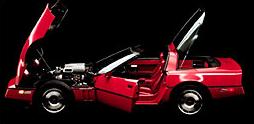 Chevrolet
unveiled perhaps the most radically new Corvette since the ’63 Sting
Ray: the all-new, 1984 C4. For rival automakers, it was future shock
come true, and for the public, well, they went wild, yet once again. In
addition to an all-new body design, its features included a new, highly
responsive suspension; a rear hatch window; a “4+3” manual transmission;
and advanced electronic instruments. The introduction of the 1984
Corvette was one of the most eagerly awaited vehicle announcements in
recent history, and it didn't disappoint anyone. Chevrolet
unveiled perhaps the most radically new Corvette since the ’63 Sting
Ray: the all-new, 1984 C4. For rival automakers, it was future shock
come true, and for the public, well, they went wild, yet once again. In
addition to an all-new body design, its features included a new, highly
responsive suspension; a rear hatch window; a “4+3” manual transmission;
and advanced electronic instruments. The introduction of the 1984
Corvette was one of the most eagerly awaited vehicle announcements in
recent history, and it didn't disappoint anyone.
For '85 the suspension was
revised for an improved ride, and the 350-cubic-inch V-8 received new
Bosch tuned-port fuel injection which helped to boost output from 205
horsepower to 230.
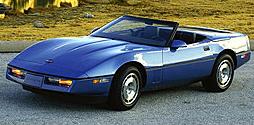 For 1986,
the Corvette Convertible was back! To celebrate the convertible's
return, Corvette again paced the Indy 500 and all convertibles were
designated Pace Car replicas. The evolution of Corvette as a world-class
performance car also continued with the addition of new standard 4-wheel
ABS and
continued suspension fine-tuning. For 1986,
the Corvette Convertible was back! To celebrate the convertible's
return, Corvette again paced the Indy 500 and all convertibles were
designated Pace Car replicas. The evolution of Corvette as a world-class
performance car also continued with the addition of new standard 4-wheel
ABS and
continued suspension fine-tuning.
Engine output increased 5
horsepower, to 240 in 1987, and electronic air conditioning was now
available on convertibles as well as coupes.
Chevrolet celebrated their
35th Anniversary with a Special Anniversary Edition Corvette. The 1988
package included a white exterior with black roof supports, a
white-leather interior, special emblems, and an anniversary plaque.
1989 was a GREAT year for
the Corvette as Chevrolet unveiled a six-speed manual transmission, and
making the Performance Handling Package standard equipment. So were
17-inch wheels and tires. The Selective Ride Control adjustable
suspension system was also introduced, allowing drivers to choose
between three different operating modes: "Touring," "Sport" and
"Performance." And to add more icing to the cake, a low-tire-pressure
warning system that alerted drivers whenever any tire’s pressure dropped
below a predetermined limit was made available.
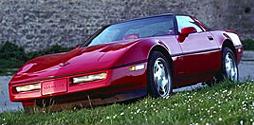 The
sports car was shocked in 1990 when Chevrolet released its awesome ZR-1
Corvette. Under the hood was the all-new LT5, an engine designed in
conjunction with Lotus and capable of 375 HP. The Corvette was now one
of the world's fastest cars. The maximum horsepower of the standard L98 engine was increased to 250. The
sports car was shocked in 1990 when Chevrolet released its awesome ZR-1
Corvette. Under the hood was the all-new LT5, an engine designed in
conjunction with Lotus and capable of 375 HP. The Corvette was now one
of the world's fastest cars. The maximum horsepower of the standard L98 engine was increased to 250.
For 1991 Chevrolet restyled
the "standard" Corvette so its rear fascia more closely resembled the
muscular tail of the high-output ZR-1. It included wrap-around front parking/cornering
lamps.
The Corvette reached another
milestone when, on July 2nd, 1992, the one millionth Vette rolled off
the assembly line. Performance continued to grow with the introduction
of the second-generation LT1, which achieved 300 horsepower for the base
Corvette once again. The engine was designated LT1 because it was the first Chevy "Small
Block" to surpass the horsepower of the original LT1 in 1970.
The 40th anniversary had
arrived and success was celebrated with a special 40th Anniversary
option available on all models which included a Ruby Red exterior and
same color leather seats. Horsepower in for the ZR-1 reached 405 HP
pushing the top speed to nearly 180 mph.
In '94 as in previous years,
no significant changes were seen. Some refinements in the engine as well
as in the interior were the focus.
It was the end of the road
for the ZR-1, and once again the Corvette served as the Official 1995
Indianapolis 500 Pace Car.
A high-compression version
of the small-block V-8 known as the LT4 was available in 1996. It
produced 330 horsepower. Two distinctive Corvettes are also part of the
final C4 lineup: the Grand Sport and Collector Edition. Both celebrate
the rich heritage of the Corvette, and mark the end of the fourth
generation.
The world would look at the
Corvette (and American car making for that matter) differently
afterwards.
C5
- Good turns great (1997 - 2004)
Raising an already high bar,
Chevrolet unveiled its all-new, fifth-generation
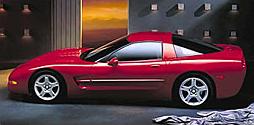 Corvette to an awestruck public, and offered it as a 1997 model year.
Stand-out features included an all-new 345-horsepower LS1 V-8 engine, a
lengthened wheelbase, and a dazzling new exterior with side coves
reminiscent of the Vettes of the Fifties.
Corvette to an awestruck public, and offered it as a 1997 model year.
Stand-out features included an all-new 345-horsepower LS1 V-8 engine, a
lengthened wheelbase, and a dazzling new exterior with side coves
reminiscent of the Vettes of the Fifties.
A year later, two notable
features reappeared: a convertible model and an exterior-access trunk
(the first since
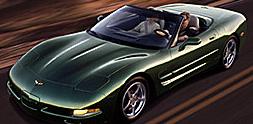 1962).
Chevy also introduced an Active Handling System that automatically
applied the appropriate brake(s) to enhance stability in slippery road
conditions. 1962).
Chevy also introduced an Active Handling System that automatically
applied the appropriate brake(s) to enhance stability in slippery road
conditions.
A new hardtop model joined
the targa-topped coupe and the convertible for '99; the hardtop was
available only with a manual transmission and was the Corvette price
leader. Also new as an optional Head Up Display that projected readouts
of the vital instruments onto the windshield for easy viewing.
Many upgrades carried the
Corvette across the threshold of 2000 and into the new century. Among
them: the Performance Handling Package received larger front and rear
stabilizer bars, wheel options were shuffled, the dual-zone
climate-control system was refined, and window seals were improved.
In 2001 the big news was the
revival of a name from the past: a Z06 performance model. Powered by a
thundering 385-horsepower LS6 engine, the Z06 featured a six-speed
manual transmission, a lightweight titanium exhaust system, a
high-performance FE4 suspension, and Goodyear Eagle F1 tires.
The muscular LS6 V-8 in the
high-performance 2002 Z06 model got even better with horsepower climbing
from 385 to 405, while torque jumped from 385 pound-feet to 400.
Chevrolet also sweetened the Z06 suspension, revising the rear shock
valving for an improved ride and even better handling control.
In a history where entered
the 20th century the automobile was still an uncommon sighting, to
achieve 50 years of winning the hearts of many and the
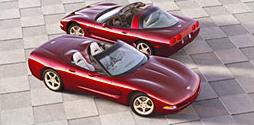 envy
of another respectable few; the Corvette against all belief at the time
when the journey started can now say: "have been there, done that", and
best of all in style and smoking its competitors while looking at them
through the rearview mirror. To celebrate, Chevy released a special 50th
Anniversary Edition,
featuring a special ruby-red
exterior, shale-colored leather, and embroidered interior logos. envy
of another respectable few; the Corvette against all belief at the time
when the journey started can now say: "have been there, done that", and
best of all in style and smoking its competitors while looking at them
through the rearview mirror. To celebrate, Chevy released a special 50th
Anniversary Edition,
featuring a special ruby-red
exterior, shale-colored leather, and embroidered interior logos.
2004 just brought more of
the same. And the same was good.
C6 -
The best ever (starting 2005)
Competitors were still
scratching their heads trying to understand what had happened. What had
they missed? How can they do this?
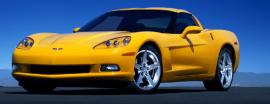 Chevrolet
calls it: the "all-new C6". Car and Driver ® called it C5 and 11/16ths,
and they argue that "there’s a lot of C5 under the new skin, which is no
insult, considering the C5’s merits". Why change an already great car?
Well actually Chevy didn't. They just made it better. It looks better.
It's faster, more refined, and electronically enhanced. The wheelbase
has been stretched 1.2 inches, enhancing ride quality, and overall
length has been trimmed 5.1 inches. The C5’s standard 350-hp, 5.7-liter
V-8 has been replaced by a 400-hp, 6.0-liter version. Mated with the
improved (shorter shift throws) six-speed manual, it scoots the C6 to 60
in 4.3 seconds. Only the C5 Z06 is quicker, and a big up tick (500
horsepower, 500 pound-feet) is expected on the Z06 front when the C6
edition debuts this month in Detroit. Chevrolet
calls it: the "all-new C6". Car and Driver ® called it C5 and 11/16ths,
and they argue that "there’s a lot of C5 under the new skin, which is no
insult, considering the C5’s merits". Why change an already great car?
Well actually Chevy didn't. They just made it better. It looks better.
It's faster, more refined, and electronically enhanced. The wheelbase
has been stretched 1.2 inches, enhancing ride quality, and overall
length has been trimmed 5.1 inches. The C5’s standard 350-hp, 5.7-liter
V-8 has been replaced by a 400-hp, 6.0-liter version. Mated with the
improved (shorter shift throws) six-speed manual, it scoots the C6 to 60
in 4.3 seconds. Only the C5 Z06 is quicker, and a big up tick (500
horsepower, 500 pound-feet) is expected on the Z06 front when the C6
edition debuts this month in Detroit.
The only survivor
If you read through this carefully,
you might have noticed that I skipped the year of 1983. Well, that was
on purpose. Officially, there were no 1983 Corvettes. 44 of them were
built, but they were never sold to the public. Since this was the
original year for the C4 to start sales and production was so late (and
the C3 was still selling well), Chevrolet decided to push back the C4
introduction to March of 1983 as an early 1984 model.
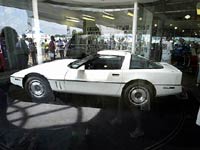 So
what happened to the 44 1983 Corvettes?
11
were retained for assembly process evaluations and other tests. The
remaining 33 went to engineering for crash tests and other engineering
appraisals. The cars also saw duty at the long lead press preview at
Riverside Raceway in December 1982. For these reasons, all but one of
the 44 1983 pilot cars were destroyed. Only serial number 23 was
retained by the assembly plant as a relic of the past. It resides today
at the National Corvette Museum in Bowling Green, KY. And the picture
shown here is a picture of it on display. So
what happened to the 44 1983 Corvettes?
11
were retained for assembly process evaluations and other tests. The
remaining 33 went to engineering for crash tests and other engineering
appraisals. The cars also saw duty at the long lead press preview at
Riverside Raceway in December 1982. For these reasons, all but one of
the 44 1983 pilot cars were destroyed. Only serial number 23 was
retained by the assembly plant as a relic of the past. It resides today
at the National Corvette Museum in Bowling Green, KY. And the picture
shown here is a picture of it on display.
The story
behind the logo
Just four days before the
new Corvette's introduction at the Motorama on
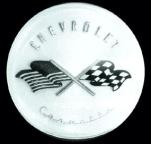 January
16th, 1953 the GM management team informed the styling team that
the front emblem (seen here)
and the horn button containing the likeness of the American flag had to
go. It just wasn't proper to have a country's flag in an automobile
emblem not to mention being against the law. Overnight, new emblems were
fabricated and installed on the Motorama car. When the first Corvette
was shown to the press at the Motorama in New York City, the front
emblems and horn button contained a black and white checkered flag and a
red Chevrolet bow-tie and fleur-de-lis. January
16th, 1953 the GM management team informed the styling team that
the front emblem (seen here)
and the horn button containing the likeness of the American flag had to
go. It just wasn't proper to have a country's flag in an automobile
emblem not to mention being against the law. Overnight, new emblems were
fabricated and installed on the Motorama car. When the first Corvette
was shown to the press at the Motorama in New York City, the front
emblems and horn button contained a black and white checkered flag and a
red Chevrolet bow-tie and fleur-de-lis.
Corvette related
links
Add text here.
|