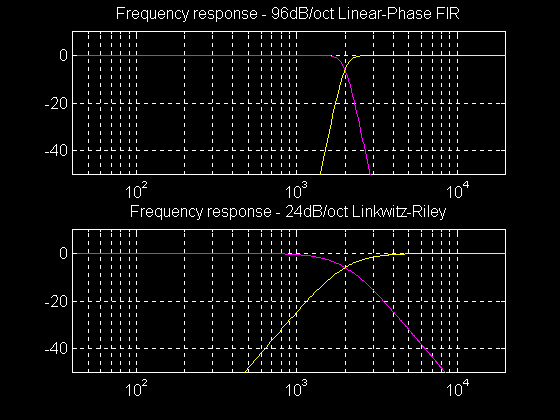
Linear-Phase FIR digital crossovers are one of only a few crossover alignments that can provide perfect transient response. Perfect transient response is necessary for a Loudspeaker to faithfully reproduce all of the timing information in music. It also means that the loudspeaker is capable of passing squarewaves without any distortion of their shape. Various crossover types have been proposed in the past to achieve this goal. Crossover allignments such as First-order, Constant-voltage, Filler-driver, and Overlap/Equalisation types can be implemented using analogue electronics to give perfect transient performance and acurate reproduction of square waves. However these crossovers invariably suffer compromises in Power-handling, Off-axis performance, and sensitivity to component tolerances. With a FIR digital crossover it is possible to combine perfect transient performance with very steep crossover slopes. This avoids the compromised power handling of analogue transient-perfect crossovers and allows improved off-axis frequency response.
When we consider off-axis frequency response on the vertical axis, we need to look at the phase response of the individual high pass and low filter sections. For optimised vertical dispersion, the acoustic output from each driver must sum perfectly in-phase at the intended listening position. This provides a vertical dispersion pattern that is symmetrical about the design axis, and results in minimal variations in frequency response within a range of listening positions. This highly desirable characteristic is a property of both Linear-Phase FIR crossovers and the Linkwitz-Riley analogue crossover alignment. The advantage of FIR crossovers is that steeper crossover slopes are usually possible. This restricts the variations in the off-axis response to a narrower range of frequencies.
Although the off-axis frequency response of FIR digital crossovers can be very good, digital crossovers using steep crossover slopes have some interesting aspects that show up in the off-axis Transient response. Like other transient perfect crossovers, the perfect On-axis Transient response cannot be replicated at vertically Off-axis positions. On this page I intend to explore some of these issues in relation to a Linear-Phase Digital Crossover using 96dB/ocatave slopes. I will contrast its characteristics with those of a common analogue crossover alignment.
The two types of crossover designs compared are:
1) Digital FIR crossover using 96dB/ocatve slopes. This uses Linear-Phase filters that have a symmetrical filter co-efficients array to provide zero phase shift and theoretically perfrect transient performance. The Frequency response prototype funcitons used have 6dB attenuation at the crossover frequency for both High-Pass and Low-pass sections.
2) Conventional 4th Order Linkwitz-Riley 24dB/octave crossover. This is probably one of the most popular alignements for high quality speakers. It has optimised on-axis frequency repsonse and a vertical dispersion pattern that is symmetrical about the listening axis. The 24dB/octave crossover slopes are steep enough to get good performance with a wide variety of drivers. However, those who believe in the audibilty of Phase distortion would probably criticise the use of this crossover.
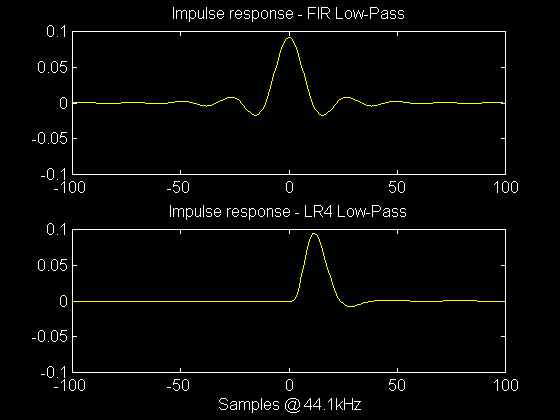
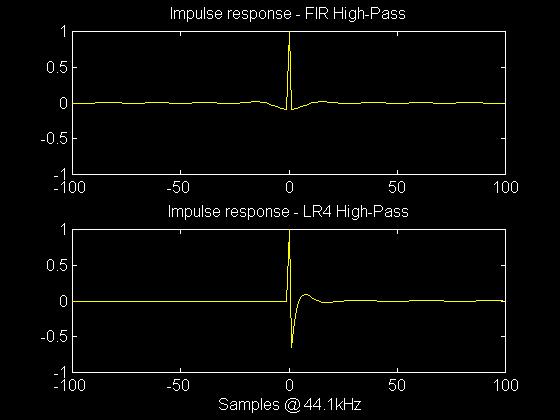
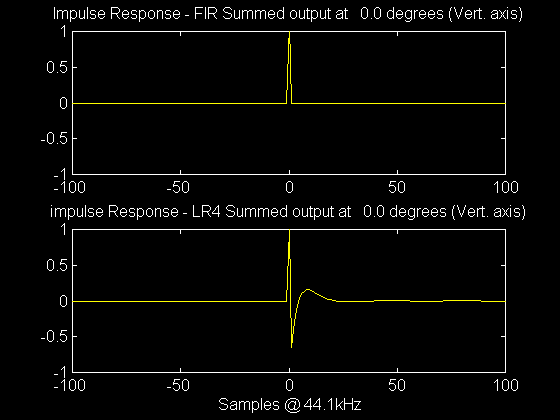
Although square waves are most commonly used to test transient response, other waveforms suchs as Tone-bursts, Step-function, and Group-Delay measurements are also useful.
Off-Axis Transient Response using 2kHz Tone-Burst signal
Off-Axis Transient Response using Pulse signal