The Significance of Impulse response
A very useful measurement for loudspeakers is the impulse response. The Impulse response is the output of the loudspeaker following a momentary impulse of energy. In theory this imulse should be of infinite power for an infinitely short duration. In practice Impulse response relates to the response of a device to a finite pulse of the shortest duration possible (This is 22.676us for a digital signal sampled at 44.1kHz such as a CD player output). The impulse response is useful because it completely specifies the amplitude response and phase response of the device being measured. It also gives a clear visual indication of the "Transient accuracy" of the component or system.
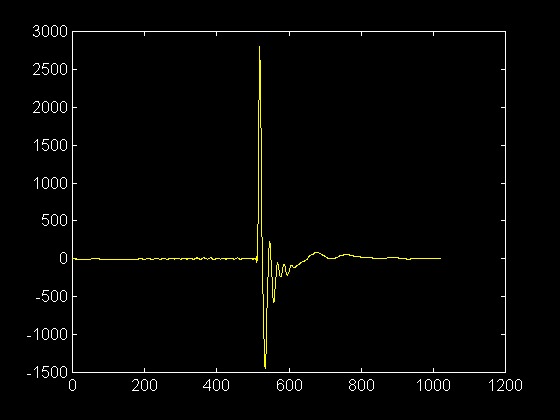
Below is my data for the impulse response of an Audax HM210Z0 8" Midbass driver in a 30 Litre closed box. Note the considerable amount of ringing following the initial impulse.
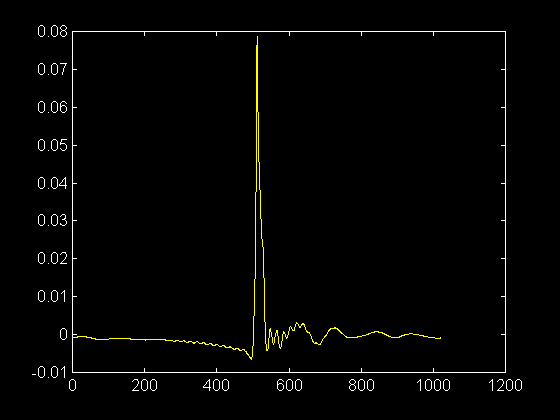
So far in my investigation I have come up with a filter to imponse my target frequency response on this driver. The Impulse response of my Filter is shown below.
The Impulse responses of the Driver and Filter shown above can be combined together using the mathematic process of Convolution. The result of this Convoution is the expected acoustic Impulse response of the Drive-unit / Filter combination. This result is shown below:
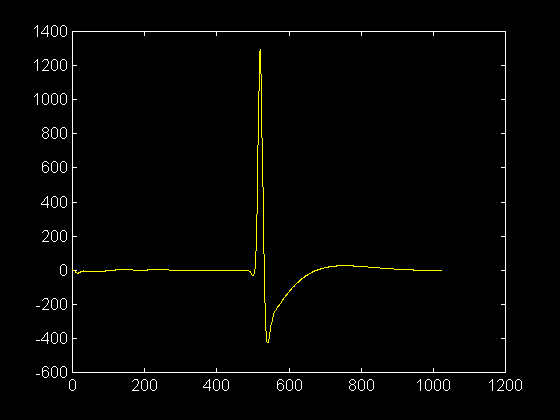
I think this smooth curve pretty much speaks for itself. If we compute the frequency response implied by this Impuse reponse, we find that it has a low-pass response with 24dB/octave slopes above 1.2kHz just like a fourth order Linkwitz-Riley response.
Later I will write more about the design proceedure used to produce this simulation, and eventually a fully worked design for a specific set of drive units including the Audax midbass driver shown here.