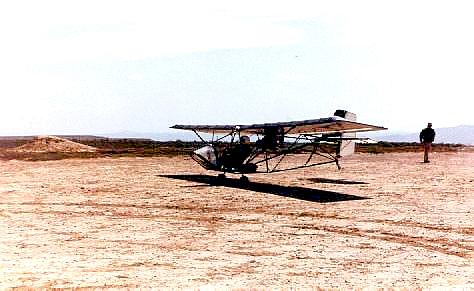
The Baja 1000 Challenge for Ultralights was oganized by NORRA (National Off-Road
Racing Asociation).
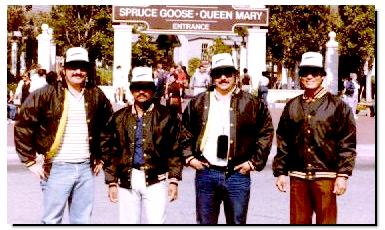
In the mexican team were Jose M. Salomon, Jorge Bazua, Miguel
Salomon and Javier Montoya and we use a Baby Terra for the race.
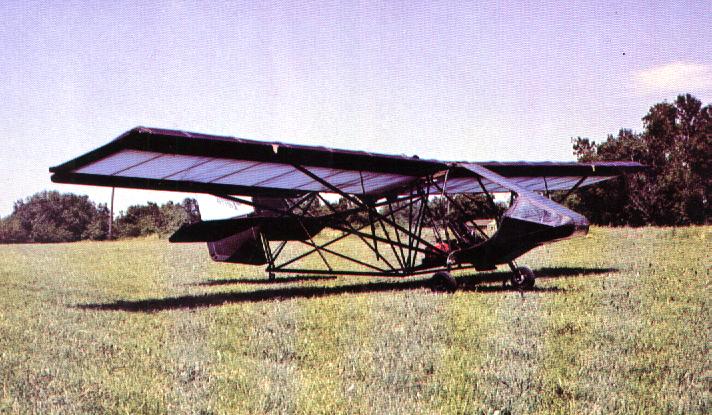
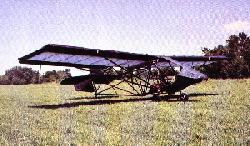 The Baby Terra is an conventional ultralight with three axes control, high wing and a closed cockpit
powered by a Rotax engine, 35 H.P. with a three blade pusher propeller. Air speed is around
60 M.P.H.
The Baby Terra is an conventional ultralight with three axes control, high wing and a closed cockpit
powered by a Rotax engine, 35 H.P. with a three blade pusher propeller. Air speed is around
60 M.P.H.
There where the folowing teams: Waikiki, with a Quicksilver MXL;
Weedhooper, with a Weedhooper Nova with a Rotax 503 engine; Newport, with a Robertson B1-RD and
Steve Ketlz from Tucson, AZ. with a Quickallver.
We named our group the "Teratorn Boys". We have some definite advantage here in Mexico,
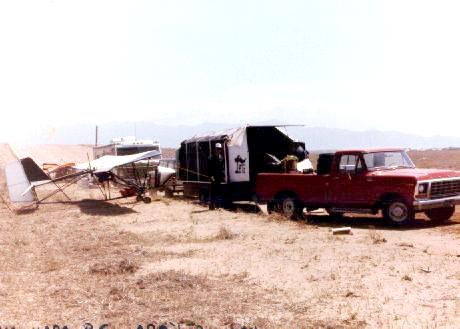
because we are mexicans. Our trailer held three Teratorns. One was flown the entire course while
the others were carried in the trailer until the last day.
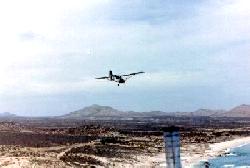
May 1, 1985, just after sunup, was the starting date. The four ultralights were lined up in the
cold morning chill, ready to head south. The first leg to Colnet was 74 miles. Following the road was the
rule, and everyone stuck to within gliding distance of it. Our plane suffered a tailwheel injury
when a stray rock appeared suddenly, but we replace it quickly.
The second leg give us and the other pilots a first taste of the wind. Our checkpoint at
El Rosario was a beautiful strip on the top of a huge mesa. The MXL flipped over at landing,
ending up inverted on the runway, and was destroyed. We flow the last leg of that day to
Santa Ynes.
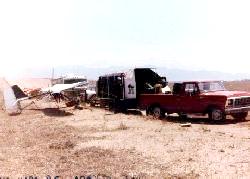 The next morning found a new attitud among the remaining three teams. We had all come to the
conclusion that we were not competing with one another, but with the Baja peninsula. We were
faster than either the Weedhopper or the B1-RD. The end of the second days was a real treat
as we flew into Guerrero Negro. On this leg, we make a checkpoint at Punta Prieta, fliyng
over the Chapalita dry lake. In two hours we see the big monument at paralel 28: The
division between the Baja California North, and Baja California Sur states, rigth a few
miles from the Guerrero Negro airport.
The next morning found a new attitud among the remaining three teams. We had all come to the
conclusion that we were not competing with one another, but with the Baja peninsula. We were
faster than either the Weedhopper or the B1-RD. The end of the second days was a real treat
as we flew into Guerrero Negro. On this leg, we make a checkpoint at Punta Prieta, fliyng
over the Chapalita dry lake. In two hours we see the big monument at paralel 28: The
division between the Baja California North, and Baja California Sur states, rigth a few
miles from the Guerrero Negro airport.
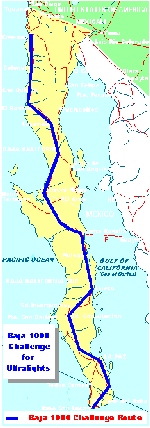 NORRA has alerted the locals. The mayor has let school out for our arrival.
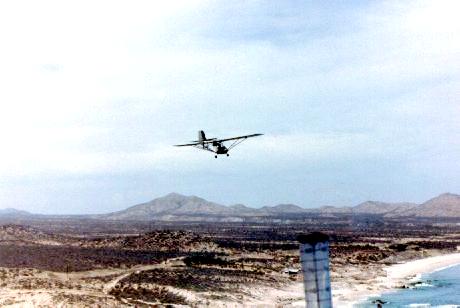
The fourth day start was an easy but a long way to Loreto. We cross the Baja from the
Pacific to the Cortez sea. Hundreds of miles of desert. The middle check point of this leg
was a San Ignacio, an Oasis in the middle of the desert. On the west side are the lagoons of
San Ignacio and Scammon with his whales. On the right side, just before Santa Rosalia, on the Cortez Sea, the
Tres Virgenes volcano was a heading point.
NORRA has alerted the locals. The mayor has let school out for our arrival.
The fourth day start was an easy but a long way to Loreto. We cross the Baja from the
Pacific to the Cortez sea. Hundreds of miles of desert. The middle check point of this leg
was a San Ignacio, an Oasis in the middle of the desert. On the west side are the lagoons of
San Ignacio and Scammon with his whales. On the right side, just before Santa Rosalia, on the Cortez Sea, the
Tres Virgenes volcano was a heading point.
Santa Rosalia was a cooper mining town and we flew over heading to the second check point at
Mulege before heading to Loreto.
From Loreto, after the Swiming Pool Voley-Ball Tournament, we head inland to Ciudad Constitucion,
the agricultural heart of Baja sur. Take off was delay because the fog, but a few hours ago, the
teams check Constitucion airport and take off to "El Cien", a made for landing strip at the
100 kilometeres mark of Mexico 1 highway and from there to La Paz, the state capital.
Long time ago, a mexican journalist call the Baja "El Otro Mexico" (The Other Mexico).
And he was right. Beautiful landscapes, white sand beaches, mountains, volcanoes, deserts;
From the air, is another perspective and another feeling. When we finished our leg, often we
stay a while, just digesting all the pictures and emotions from the flying. I learn a lot
about this part of my country, not only in the maps we use for the navigation, but from
the people living here, from the friends I made.
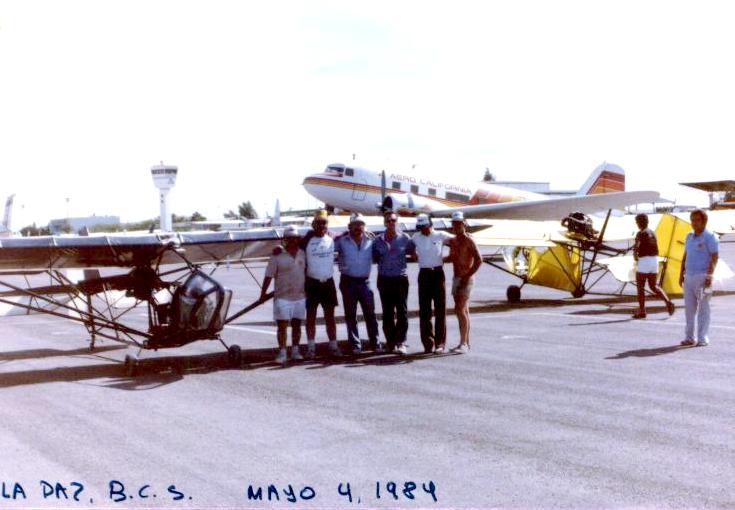
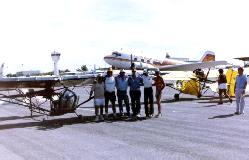 We set the Teratorn two-place for the last leg from La Paz to Los Cabos. At the finish
line, at Los Cabos, Champagne was the order or the day.
Hugs and handshakes. We had beaten the Baja: 1000 miles of dusted
enduro-flying were behind us. Having the Baja reach out and slap one of us had bonded the three
remaining teams together and it had paid off.
We set the Teratorn two-place for the last leg from La Paz to Los Cabos. At the finish
line, at Los Cabos, Champagne was the order or the day.
Hugs and handshakes. We had beaten the Baja: 1000 miles of dusted
enduro-flying were behind us. Having the Baja reach out and slap one of us had bonded the three
remaining teams together and it had paid off.
That evening at the Awards Banquet, each team received a first-place placque naming us
"Baja Conquistadores". NORRA also had special trophies for each team for their indivual
efforts. Although we were only a small group compared with the expected participation in
nexts year's event, we had something no one else could ever claim:
We were the first to meet
the Baja 1000 Challenge and that makes us alls winners.
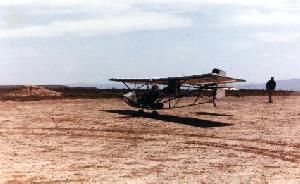
 More pictures at the Photo Album.