| Tanzania |
| Kilimanjaro Diary Day 1: Moshi - Mandara (2720 m) So, this was the big day! Nervousness all around, as we embarked on our major climb. The preparations all went very smoothly, although we had to use three different credit cards to get enough money out. A bit of a bottle neck at the entrance of Kilimanjaro National Park, as all the porters were queueing up to have their load weighed. Today's hike took us 700m up through beautiful rainforest. The trail was very neat and not steep at all, so we strolled our way up at a leisurely pace. It started raining half an hour before we arrived at the Mandara hut, but the sky cleared again for a beautiful evening. We climbed another 100m higher to a crater with beautiful views in the evening sunshine. We both have a slight headache, as if someone is touching our forehead, but this will surely get worse: we're not even at an altitude where you are allowed to get sick. Day 2: Mandara - Horombo (3720 m) Had a bad night's sleep. Went to bed too early, at 8pm, so I was awake for many hours. The other mistake was to stop drinking. In order to avoid getting up too many times, I dried myself out. So got a headache all night long. In the morning I took an aspirin. I got better straight away. Had a smooth hiking day, going up very, very slowly. So slowly, we got bored. Fortunately, the trail did not go up and down, so every step up was a step closer to the top. The view was pretty boring as well, fog all around. We drank our due amount of water and peed our due quantities along the trail. We arrived safely at Horombo camp and got put in a hut with only one other person, Bob the Birder. We went another 100m up and that was it for the day. Meriel got a bit of a headache, but the good old aspirin solved that. Day 3: Horombo (3720) So far, so good! We passed our day of acclimatisation, reached 4300m and still feel great. Obviously, the most difficult bit is still to come, but at least we got this far safely. Meriel had a pretty bad headache during the night, made worse by banging her head twice against the sloping roofwall. We slept from 8pm until 8am, on and off and felt pretty rested. We walked with Bob to the Saddle (4300m), very slowly and got there without a headache. We could see Kibo Hut in the distance and the trail climbing up the mountain. When we set off for our descent, it started to rain and we were drenched by the time we got back to our hut. We lazed around in the afternoon, in our sleeping bags, chatting with our hutmate Bob, which was very cosy. Tomorrow we'll set off at 7.30 am to pre-empt the rain. We're both nervous, as the margin for error becomes pretty slim, but somehow we feel we should be able to get to Kibu without trouble and then, anything is possible ... Day 4: Horombo - Kibo (4700m) Acclimatisation over, time for action now. We moved up from 3700 to 4700m along a gradually climbing trail through Alpine desert. Since we didn't have waterproof trousers, we really wanted to avoid the daily early afternoon dowpour. So we set off at 7.45 am, but still got harrassed by hail drizzle. Kibo, at the foot of Kilimanjaro, was captured in the mist. We selected our beds in the 12 bed dorms and went straight for a nap. Action will start at midnight tonight, so sleep will be scarce. After an early dinner, we will try to get some more sleep from 6pm until 11pm, when our guide Alfred will wake us up for the big chukka! Day 5: Kibu - Kilimanjaro Summit (5895m) - Horombo What a surreal and eventful day! We spent 16 hours hiking after a night with no sleep. I couldn't sleep at all, a combination of anxiety and noise. Lots of our companion climbers suffered from leaking bladders, so there was a lot of getting up and running around in the dorm. We set off at midnight with our guide Alfred and assistant guide Ernest, torches in hand. We crawled up the steep mountainside, slowly, very slowly. It took us 8 hours to ascend 900 meters! It was pitch dark and the only thing you could see were the torch lights higher up the mountain from our fellow summitters. Meriel was really suffering and what should have taken us 6 hours, took us 8. She suffered from stomach pains and nausea and got really tired. At the last stretch of near-vertical rocks, we almost came to a halt. Five steps, rest, five steps, rest. Alfred and Ernest had to push and pull Meriel over the rocks. The sun had already risen by now. We decided that Alfred and I would climb ahead and cover the remaining 400m to the summit. Meriel and Ernest would finish at 5600m at the lower peak, Gilman's Point and then return. From Gilman's Point, it took me only one and a half hours to get to Uhuru, the peak of Kilimanjaro. The views were astonishing. Large ice masses covered the slope of the mountain. The mountain jumped out of the landscape and you can look far ahead across the flat lands. Once I arrived at the summit at 9am, I realised I had developed a banging headache, so I looked forward to a quick descent and to catching up with Meriel. How amazed I was, when I bumped into Meriel after 10 minutes' down my descent. She had recovered from the dead and decided to carry on. She actually made it to the summit, arm in arm with Alfred and Ernest. The descent was steep and quick. During the night walk we hadn't realised how long and awfully steep the ascent was. Once in Kibu, we still had another 3 hours to descend a further 1000m to Horombo. Absolutely exhausted we were, but what an achievement, particularly for Meriel. |
| Detailed Trip Schedule |
 |
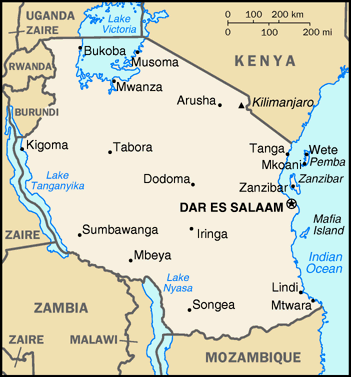
| Map of Tanzania |
| 10 February: Johannesburg - Dar es Salaam 11 February: Dar es Salaam - Moshi 12 February: Moshi - Mandara 13 February: Mandara - Horombo 14 February: Horombo 15 February: Horombo - Kibo 16 February: Kibo - Horombo 17 February: Horombo - Arusha 18 February: Arusha 19 February: Arusha - Lake Manyara 20 February: Lake Manyara - Serengeti 21 February: Serengeti - Ngorongoro Crater 22 February: Ngorongoro Crater - Tarangire 23 February: Tarangire - Arusha 24 February: Arusha 25 February: Arusha 26 February: Arusha - Nairobi 27 February: Nairobi 28 February: Nairobi - London |
| Safari |
 |
| After our exploits on Kilimanjaro, we were very much looking forward to a real safari, i.e. one where you are driven around in a 4x4 vehicle over bumpy tracks as opposed to one where you drive around in your own car over civilised gravel roads. We signed up with Victoria Expeditions in Arusha for a five day safari together with an American girl and another Belgian. In order to keep costs down - park fees in Tanzania are very high - we opted for camping. Day 1: Lake Manyara Lake Manyara National Park lies between 900 and 1800m above sea level, bordered by the escarpment of the Rift Valley. Depending on the season, about two-thirds of the park's total area of 330 sq km is covered by the lake. We did a late-afternoon drive through the park. Since this was our first safari day, we stopped literally for every animal, including the ugliest and commonest baboon. We got really close to elephants a number of times, so close even that I could take a close-up photo of a hairy elephant eye. Day 2 and 3: Serengeti Serengeti, which covers 14,763 sq km and is adjacent to the Masai Mara National Reserve in Kenya, is Tanzania's largest national park. One of the main attractions of the Serengeti is the annual migration of wildebeest herds to the Masai Mara. At this time of the year, the millions of wildebeest were gathered just south on the way to the Serengeti park. Endless numbers of wildebeest as far as the eye could see, interspersed with the odd zebra. When we entered the Serengeti on the evening of day 2, the park looked void of animals. That was clearly deceptive, as on our next morning drive, we bumped into a wandering pregnant lioness, a lion family with five cubs as well as a leopard. Leopards are very difficult to spot, but this one was very easy, as we headed straight to a collection of safari jeeps in the distance. It is by far the most beautiful mammal around. Day 4: Ngorongoro Crater The Ngorongoro Crater is one of the natural wonders of Africa. Not only is the crater very scenic when looked at from its rim, it is also one of the best wildlife viewing areas around. The crater is about 20 km wide and animals are attracted by the abundant water and grazing opportunities. On the morning of our 4th day, we managed to see all of the Big 5 within a few hours: lion, leopard, elephant, black rhino and buffalo. The leopard was difficult to see, but the lion sightings were spectacular. First, we caught a lion and lioness mating. Then, further on, two male lion subadults had just killed a wildebeest and were busy keeping tens of hyenas at bay. When we drove on, we crossed the path of the two lions and they lay down against our jeep. It was very scary, as the roof of our jeep was open, but the lions had just filled their tummies, so they were not too interested in us. We also witnessed their synchronised charge against the threatening hyenas, when they shot off with a roar towards their harassers. After the lion adventure, we crossed the path of two grazing black rhinos. Day 5: Tarangire After the excitement of the previous day, our visit to Tarangire was a bit of an anti-climax. We saw hundreds of elephants, scattered all over the place, but safari fatigue was getting the upper hand. Things got a bit hairy, at one point, when we got too close to two female elephants who were supervising the bathing of a little one. One of the adults started to charge, but backed off as soon as we reversed ten metres. |