


|
|
|
| Portfolio of crystallographic structures: ("...always under construction...")
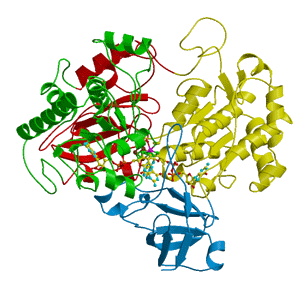
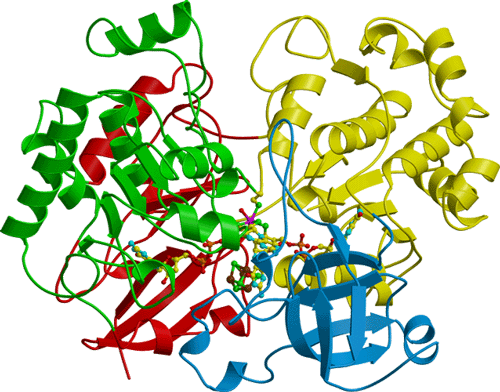
The periplasmic nitrate reductase (NAP) from Desulfovibrio (D.) desulfuricans ATCC27774 is induced by growth on nitrate. The enzyme catalyses the reduction of nitrate to nitrite for respiration. NAP is a molybdenum-containing enzyme with two molybdopterin guanine dinucleotide cofactors (MGD) and one [4Fe-4S] cluster in a single polypeptide of 723 amino acid residues. The enzyme was crystallised in space group P3121, with unit cell dimensions of a=b=106.14 Å and c=134.84 Å. These crystals diffract to beyond 1.8 Å with synchrotron radiation. The three-dimensional structure of the oxidised form of the enzyme was solved by the MAD method as single phasing information, using the anomalous scattering of the iron atoms, and was refined at 1.9 Å, to a crystallographic R-factor of 21.2 %, and R-free of 26.0 %. The structure of NAP is folded in four domains, with an alpha/beta type topology. All four domains are involved in cofactor binding. The [4Fe-4S] centre is located at the periphery of the molecule in domain I, the bis-MGD molybdenum cofactor extends across the interior of the molecule and interacts with residues from all four domains. The molybdenum atom is located at the bottom of a 15 Å deep crevice, and 12 Å distant from the closest Fe atom of the [4Fe-4S] cluster. The crystal structure of this first nitrate reductase in the oxidized form reveals the details of the catalytic molybdenum site, co-ordinated to two MGD cofactors, to Cys 140 and to a water molecule. A facile electron transfer pathway through bonds connects the molybdenum and the [4Fe-4S] cluster. The polypeptide fold and arrangement of the cofactors is related to E. coli formate dehydrogenase and distantly resembles dimethylsulfoxide reductase. - João M. Dias, S. Bursakov, C. Carneiro, J. Moura, I. Moura & M. J. Romão, (1999): "Crystallization and Preliminary X-Ray Analysis of a Nitrate Reductase from Desulfovibrio desulfuricans ATCC 27774", Acta Cryst, D55, 877-879. (reprint) - João M. Dias, M. Than, A. Humm, R. Huber, G. Bourenkov, H. Bartunik, S. Bursakov, J. Calvete, J. Caldeira, C. Carneiro, J. J.G. Moura, I. Moura & M. J. Romão, (1999): "Crystal Structure of the first Dissimilatory Nitrate Reductase (NAP) at 1.9 Å solved by MAD", Structure Fold Des, 7, 65-79. (reprint) - M. J. Romão, João M. Dias & I. Moura, (2001): "Dissimilatory Nitrate Reductase", in A. Messerschmidt, R. Huber, T. Poulos & K. Wieghardt (eds), Handbook of Metalloproteins, John Wiley and Sons, Chichester, Inglaterra, 1075-1085. (reprint)
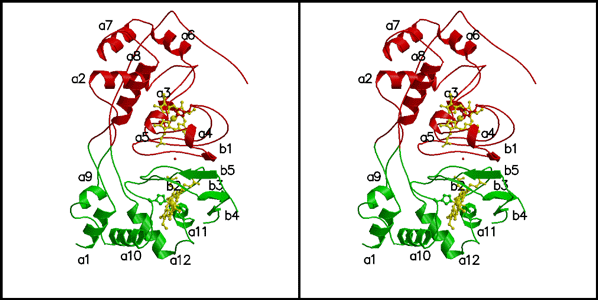
Cytochrome c peroxidase (CCP) catalyses the reduction of H2O2 to H2O, an important step in the cellular detoxification process. The crystal structure of the di-heme CCP from Pseudomonas nautica 617 was obtained in two different conformations in a redox state with the electron transfer heme reduced. Form IN obtained at pH 4.0 does not contain Ca2+ and was refined at 2.2 Å resolution. This inactive form presents a closed conformation where the peroxidatic heme adopts a six ligand coordination, hindering the peroxidatic reaction to take place. Form OUT is Ca2+ dependent and was crystallized at pH 5.3 and refined at 2.4 Å resolution. This active form shows an open conformation, with release of the distal histidine (His71) ligand, providing peroxide access to the active site. This activated form contains a bound Ca2+ ion essential for enzymatic activation and it shows several conformational changes, which allow a glimpse at the calcium activation mechanism. - João M. Dias, T. Alves, C. Bonifácio, A. Pereira, J. Trincão, D. Bourgeois, I. Moura & M.J. Romão (2003): "Structural basis for the mechanism of Ca2+ activation of the di-heme cytochrome c peroxidase from Pseudomonas nautica 617.", Structure, vol, pag-pag. (reprint). J. Biol. Chem., 278 (19), 17455-17465. (reprint) - João M. Dias, C.. Bonifácio, T. Alves, J.J.G. Moura, I. Moura & M.J. Romão (2002): "Crystallization and preliminary X-ray analysis of two pH-dependent forms of a di-haem cytochrome c peroxidase from Pseudomonas nautica", Acta Cryst, D58, 697-699. (reprint)
This page was last updated on 31 August 2004. |