 Babies are the Number One subject of photographs the world
over! And why not. They are cute, they are cuddly, they are
unselfconscious, they are unpredictable. Especially.. when they
are ours!
Babies are the Number One subject of photographs the world
over! And why not. They are cute, they are cuddly, they are
unselfconscious, they are unpredictable. Especially.. when they
are ours!Unfortunately, Moms and Dads don't do that as religiously. I mean they do photographs their children but don't do special portraits. I don't mean portraits for commercial use or modeling portfolios but portraits for your home, taken at home.. doing something they really love and having that as memories.
Well, photographing children is quite difficult but enormously rewarding. I have photographed countless children and it is hard work, to being allowed into their world and gaining their trust. Once you do that and you get down to their level, then their world is yours. To photograph a child, you have to be a child yourself first and always remember, there is a child in everyone's heart. Most difficult task I face while I photographs children is that you can't ask them to do that and do this. That's why you must have heck lot of patience. If you don't have patience forget about becoming a Child photographer. Interesting part of child photography is to wait for the wonderful expression on their sweet little faces and being ready to click the right frame at the right time of pick emotion. It's tremendous feeling when you are able to to freeze their beautiful smile and innocent acts.
I think children are the most incredible subjects. When they fantasize and when they dress up they actually believe that they are super heroes or angels. It is truly exciting to see children come to life and believing in themselves and their world so completely.
Ok now let me share you my experiences on Child photography. WARNING!! before you go photographing children. Think safety first! Always employ complete and thought-out safety precautions before posing a child anywhere other than in some loving adult's competent arms. Never pose a child or use props that are in anyway disrespectful of the innocence of children or put them at any sort of risk.
Good baby pictures occur only when the child is well-rested, comfortable, and secure. To this end, never try to take pictures when Baby is tired or cranky or wet. And don't forget that babies are most secure when a parent is around. Even if you're photographing the baby alone in the frame, things will go better if Mom or Dad is close at hand.
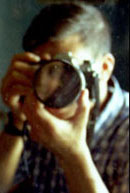
Also remembering that, to a baby, that person behind the camera can look pretty scary. You're not going to get a good pictures if Baby is afraid of you. So it's a good idea to put the camera down every now and then, and play with the child in some foolish way that will reassure Baby that you're not a monster.
Consider the stage of Baby's development. Don't expect babies -- even yours ! - to do things they're too young to do. For example, don't expect them to hold their heads up or stand up if they haven't reach that stage of development yet. When you photograph Baby, take his or her stage of development into consideration. From a photographic viewpoint, we can divide development into roughly four stages before Baby reaches the age of two.
First, from birth to three months, Baby is little more than a tiny object. Whether photography starts in the delivery room or shortly thereafter, you will mostly have a tiny, swaddled, sleeping baby as your subject. Never use any sort of flash to take picture of baby who is younger than a month. A lot happens during the first week of birth, the changes can be photographed almost hourly. After this the times between the intersting events will be longer. As children get older the intervals lengthen. Shots in available light create a more authentic effect.
The second stage of development (from the photographic viewpoint) is from about three months to nine months. Baby is starting to move. At this stage babies can locate their hands and feet, show interest in objects near them and as weeks and months pass, start to roll over, sit up, and perform all sorts of simple antics that are a joy to photograph. They're aware of you and the camera, and while they won't perform for the camera, they also won't be self-conscious in front of the lens as happens when kids get older. That means you can get in close and photograph the child as he or she starts to reach out to the world around them.
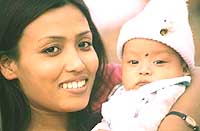
At this stage, you can get wonderful pictures of Baby with Mom or Dad or Both. The key to successful pictures of parents and children (or any group, for the matter) is to show relationship. This can be done easily by having your subject at each other, or look in the same direction. It isn't necessary, and often doesn't work with little babies, try to get both Mom and Baby to look directly into the camera. The easiest approach to natural looking photographs is to have Baby look at some prop you hold that makes noise. It may be a squeaky toy or anything in bright color that can become a "eye catchy". You make some noise or flick.. and the child looks up with riveted attention. Direct the parent to look at the same object, or to look at the child. Either way works. And you go click.
The third stage of development is from nine months to around fifteen months. Baby is now on the move.. or, at least, on the crawl. Some start earlier than others, but somewhere in this period you will encounter crawling, then using a walker, then Baby's first steps, and finally toddling about with ever-greater breakneck speed. At this stage we suggest you get down low to get a child's-eye view of the world - and to make the child look large in the world he or she inhabits. At this stage you may have to work fast to keep up with Baby.
Finally, the fourth stage of development is from about fifteen
months to twenty- four months. Now Baby is on the go. Discovery
of the physical world is no longer subject to mobility limitations,
and Baby wants to go everywhere and your camera ready for anything,
and shoot a lot of never-to-be-repeated moments.
You often regret the chances you've missed. If only you'd
photographed this or that, made a record or just a few shots
of specially nice moments. Pictures of the first few hours after
birth become more valuable and expressive as time passes. Other
individual pictures can eventually make up a sequence. For shots
of new-born babies the available light is best, not flash light.
They will be dazzled by the really quite powerful output of even a
small computer flash. It is better to hve faster films in your
camera.
Main | Jolly G10 | Self Portrait | Photo Gallery | Friendship | Humour