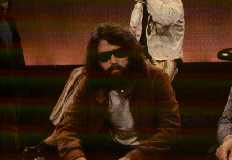
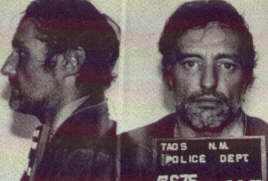
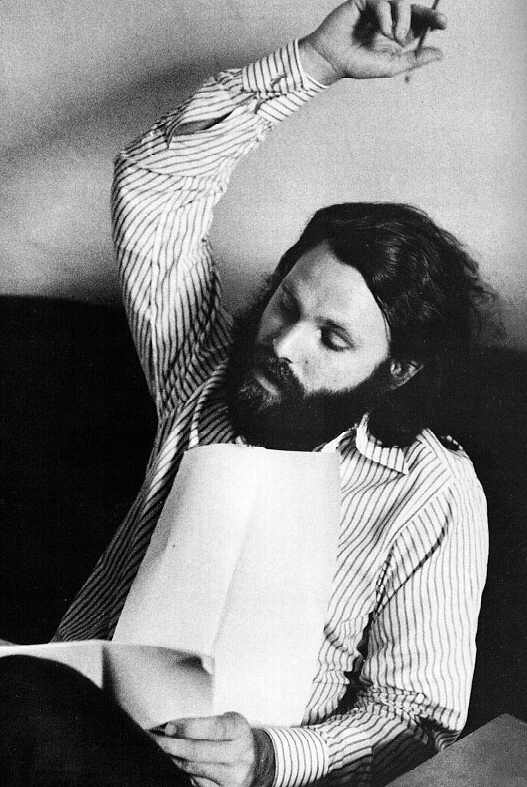
One man in his time plays
many parts. So said sagacious Shakespeare: internationally recognised clever
clogs on many subjects and never more insightful than when musing on the
human condition. The bard’s assertion is very true in the case of James
Douglas Morrison, who, in his brief and turbulent public life, played many
parts and donned many masks; he was a sometime student, satyr, counter
cultural pedagogue, musician, lysergic picaroon, dramatist, bard/mystic,
mental patient, alcoholic, street corner bum, film maker, soap box Jeremiah
and intoxicated visionary priest/poet. He deranged his senses protractedly
after the example of Rimbaud; pursued an erratic lifestyle whilst collaborating
with his fellow musicians in The Doors; took risks and behaved foolishly;
wrote well and wrote badly: sometimes awesome work was produced, sometimes
an unintentionally funny and pretentious cacology; like many another erratic
creative personality, he became addicted to the alcohol and drugs that
are, at first, so deeply calming and inspiring to the mind of the sensitive
artist. The one part/role/mask that Morrison never successfully managed
to don was that of movie actor; though for a short while in 1970, he attempted
to immerse himself in the world of film acting.
The
previous year, Morrison had met Orson Welles briefly. Welles was planning
on making a western: a version of Oedipus Rex. Welles had asked Morrison
to be in it. The lizard king, planning on relocating to Europe anyway,
was delighted some eight months after the original conversation, to receive
a message from Welles to make his way to a back water area of Spain, where
shooting would take place.
Morrison got stoned
and watched Citizen Kane at an art house cinema. He sat in the dark and
watched the impossibly gifted Welles on the screen; this amazing twenty
five-year-old actor and director’s charisma and all round talent beamed
out at the small audience, undimmed nearly thirty years on. Morrison knew
the film well and he noticed it hadn’t lost its vitality like many other
left field masterpieces.
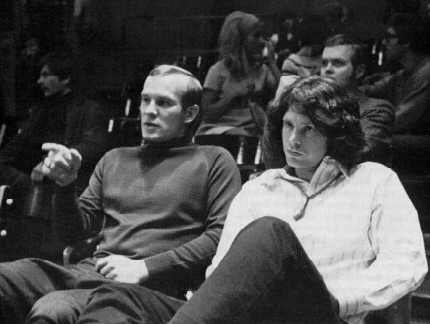
After Charles Foster
Kane’s sled was fed to the fire, the credits had gone up and the sundry
other connoisseurs and students filed out, Morrison sat alone staring ahead
at the blank screen, chewing gum slowly, his eyes unfocused and reddened,
his brain lost in a reverie of Welles’ images and of his forthcoming adventure.
After a while he got up and went out into the street, lit a cigarette and
looked up at the stars. He smiled. The people he’d known at film school
would be pretty amazed when they saw that Orson Welles’ latest film featured
an old alumnus of theirs. Especially since he’d abandoned film for rock
and roll, and was now heavily bearded and in a state of public semi disgrace
after his obscenity trial. He smiled. He wasn’t at all fond of the clichés
of show business but he had to admit, in his position, to play a leading
part in a movie- an Orson Welles movie to boot, had to be construed as
some sort of comeback.
A small, scruffy Indian
raiding party sat atop their horses on a low dusty hill overlooking the
unfinished set; a ramshackle western town, which shimmered in the morning
sun. They were all Spanish sailors and all grinning at each other. They
were in movies.
In the distance,
beyond the town, a red flag was raised. It was the signal for action. They
trotted forward; adjusting their headdress and wigs and throwing their
cigarette butts to the ground. They started to canter towards the town,
gradually building to a gallop. From where the second camera was positioned,
on top of the baroque fronted saloon, the shot was good: a small party
of Indians approaching a sinister, empty town; likewise from camera number
one, set up on the ground, further up the street.
The raiding party had just reached the outskirts of town when a dusty Citroen
light 15 veered into shot and across their paths, horn blaring; the horses
scattered and the old car zoomed up the main street, a huge billowing cloud
of dust rising behind it. It roared past the saloon and out the other end
of the town.
Orson Welles, who was
taking breakfast- smoked herrings on lavishly buttered baguette, an enormous
steak and onion omelette, pot of coffee and an assortment of Portuguese
pastries- at a small table underneath a Martini umbrella (filched from
a café in a nearby town) and was watching proceedings, growled.
His shot had been ruined and, more importantly, his breakfast had been
ruined.
“God damn it. That was
the last slab of Aberdeen Angus in the refrigerator. Pedro, inform the
chef, tell him to make a collect call to Madrid…”
A blizzard of dust particles
had isolated him in a temporary fog; now, as it began to clear, he stared
down at his omelette; it was smothered in dust and sand.
“ Pedro, who the hell
is that?” he asked his assistant director who was standing nearby with
a megaphone in his hand and his mouth hanging open.
“I’ve have no idea,”
replied Pedro, a young Spaniard, “but he has cost you a lot of money senor.”
Welles’ later productions,
famously moveable feasts, didn’t always conform to the dictums of a commercial
shoot: the script was often rewritten on a whim; actors appeared and disappeared
according to other commitments; money would dry up; Welles himself might
fly off to appear in a film or advertisement, in order to vouchsafe
some more cash to keep the project rolling. When there was film in the
camera, Welles couldn’t afford to waste it. He looked down sadly at the
omelette, then rose and walked out onto the main street of the set. He
was impressed by the work of the motley band of set builders, and his own
handiwork- he’d painted a Lautrec-esque mural on the exterior of the saloon,
for want of something else to do before the cameras arrived. The frontages
were built to the specification he’d sketched on a legal pad in a hotel
room in Madrid at Christmas; tall and sinister in the southern gothic manner,
their porches, colonnades and verandas created sinister shadows and nooks;
their massive, crudely painted signboards advertised a gaudy Americana.
Welles stood in the middle of the street, enormous yet distinguished in
a stained linen suit, and heard the car somewhere in the distance. He lit
a cigar. His crew fussed around the two cameras- he was impressed with
them, an efficient international skeleton crew, sporting bandannas, and
scuzzy beards, they treated Welles as the master artist, grinning broadly
and saying ‘si senor’ repeatedly.
He’d gathered
together a war chest of production money from a number of sources, and
was hoping to work quickly and actually finish the project and release
the film- he fancied the Venice film festival the following year. He had
felt slightly rebuffed by some of his old friends not making themselves
available: Joseph Cotton was tied up making a horror film in England, Dietrich
sulking in Paris, Ray Collins and Everett Sloane were dead, Rita Hayworth
attempting a stage career; Chuck Heston still involved in making ape movies.
In some ways this pleased Welles- it added to his sense of being a wandering
comi-tragedian, a Falstaffian cinematic freebooter, free to pick up strolling
players along the way.
The Citroen came into view again at the other end of town, and tore up
the street, dust cloud billowing behind it. The crew and extras began to
shout and jeer, and also to shout warnings at Welles who wasn’t moving
out of the way.
“Senor! Senor! The car!”
Welles stared forward
at the oncoming vehicle, puffing meditatively on his cigar. It slammed
its brakes on and came to a sliding halt two feet from Welles. For a few
seconds everyone was enveloped in the car’s dust cloud; there was much
spluttering, spitting and curses in Spanish.
The Citroen was
smothered in dust, its windows caked with fine grey powder, squashed flies
and other wind-born detritus; the grubby semi circle where the window wiper
did its work only marginally less filthy. Suddenly a great hissing started
under the bonnet, and steam began to escape, further blanching the hot
morning air. Welles puffed on his cigar.
The
rear door opened and a diminutive bearded man wearing dusty goggles fell
out. He rolled over on to his stomach, clutching a dusty wine bottle, and
dragged his knees up underneath him.
“…. Goddamn….”
The crew came over and
looked down at the man. Welles grinned. Dennis Hopper stood up slowly and
unsteadily. He pushed up the goggles and focused his inebriated disc eyes
on his immediate surroundings. Finally he saw Welles. He giggled.
“O-Orson. Good morning
sir.”
“Mr Hopper, I see you’ve
had a bibulous breakfast.”
“Well, I can’t deny that
sir. But I will say it is an honour…. An honour and a privilege….”
Hopper collapsed backwards.
“Catch him someone” Welles
rumbled, “and who else is in here?”
There was a noise in
the front seat, followed by some incomprehensible moaning.
“…Uhhhhhuhhhhhuhhh death………death
and my cock… Are the world.”
Welles laughed. A deep
rumble.
“Mr Morrison, good morning,
‘Death and my cock are the world’ eh? A first class piece of dialogue for
this film. I’d use it if I thought I could get away with it.”
Morrison was slumped
over the wheel; luggage piled on the seat beside him.
“Uhhhhhhhhhhhghghghg….”
Welles turned to the
crew.
“Could you get Mr Morrison
to a trailer, and ply him with black coffee. Thank you. ‘Death and my cock
are the world’. Hmmm. I think Mr Morrison is ready for Sophocles, Pedro.”
“Si Amigo,” said the
assistant director, grinning round his cigarette “but is Sophocles ready
for Senor Morrison?”
Several hours later,
in an aluminium trailer, one of a cluster near the set, Dennis Hopper sat
at a folding table, blinking repeatedly and licking his lips. His mooneyes
darting neurotically up at a demoralised squadron of blown flies, which
glided on a Gulf Stream of fetid boozy air, stirred by a droning fan. He
unscrewed the lid of a small bottle of pills and extracted two, banging
them down with a hit of rough Spanish wine. Morrison, sprawled on the floor,
stirred and coughed violently.
“Dennis? Dennis?”
“Sshshshhhhhh!”
“What?”
“We arrived man.”
“What?”
“Quiet!”
“Why?”
“Can you remember arriving?”
“Not really. What did
we do?”
“Peyote, a little acid…”
“That big bottle of Jack
Daniel’s.”
“Yeah,” giggled Hopper,
“when I woke up I thought I was back in Peru making my goddam movie!”
“You seen Orson?”
“I dunno, I’ve just done
some speed and some downers, up and down, y’know? I’m gonna get a little
loaded…”
Morrison got to his feet.
He was still dressed in a bottle green corduroy three -piece suit that
he’d bought on Rodeo Drive- he thought it made him look like a serious
young intellectual. He’d remained straight for the flight- foregoing complimentary
alcohol, and gnawing the in-flight chicken until he heard a small commotion
three seats ahead- Dennis Hopper was on the plane. The actor had recently
returned in triumph to Hollywood; making Easy Rider for a pittance and
showing jaded studio execs that there was money in countercultural movies.
He’d then de-camped for Mexico- with a great deal of studio money- to make
The Last Movie, a drug addled fiasco, which ruined his newly established
reputation. Storm battered Hopper responded to Welles’ offer with alacrity.
“Oedipus Rex man…” said
Morrison.
“Yeah,” said Hopper,
“It’s gonna rock!”
“I’m keen on improvising.”
Hopper grinned.
“For me, there is only
improvising.”
“You think Orson will
agree?”
“I got a lot of respect
for Orson. The most. But, he’s got to understand, films are evolving, and
he’s got to evolve with them.”
“Supposing he doesn’t?”
“Then we gonna have to
get him high. Is all.”
Welles was shooting crazy
tracking shots; the crew watched fascinated, this was not the like the
westerns they usually worked on. Having given instructions to the crew
for the next set up, he sat down at a small trestle table in the middle
of the street, and started to tap at a typewriter. Hopper and Morrison
came round the corner. Welles looked up.
“Good afternoon. We didn’t
wake you for lunch….”
“Hello Orson.”
“Mr Morrison. Dennis.”
“ Look,” said Hopper,
“We’re real sorry about… anything that happened.”
Morrison put his hands
up.
“..Yeah, I mean, we don’t
know what happened, if anything did happen.”
Welles laughed.
“Orson, what’s your stance
on improvising? Are you interested in it?”
Welles puffed on his
cigar and said nothing. Hopper jumped up and down.
“I am. ‘All the world’s
a stage’ huh Orson?”
Welles grinned.
“Shakespeare. Who wrote
his own scripts. Now get over to wardrobe, and remember, this town is under
pestilence.”
Morrison and Hopper walked
away.
“Pestilence man? What
the fuck does pestilence mean?”
“Dennis,” said Morrison,
“Have you read Oedipus Rex?”
Morrison came through
the doors of the saloon. It was raining hard; the street a quagmire, through
which the townspeople staggered towards him. He looked up at the sky, allowing
the rain to pelt his bearded face.
“Why?” he bellowed, “Whyyyyyyyyyyyyyyy?”
The various townspeople
stared at him through the rain. He began to beat his breast, ape like.
“Whyyyyyyyyyyyyyyyyyyyyyyyy?
Why have you forsaken this town? Why have you left us alone! Alone!”
Welles, seated next to
the camera, underneath a large umbrella, stood up.
“Cut.”
The water hoses were
turned off and the extras relaxed. Welles walked up to Morrison, standing
under the dripping colonnade.
“Jim, you’re giving me
way too much. Just give me much less.”
Morrison flicked his
eyes up at Welles.
“Orson, this is a pretty
dangerous situation though isn’t it?”
“Desperate, lad, desperate.
But you’re the Sheriff; you have to be more…..saturnine.”
Hopper, dressed for his
role as the town’s eccentric, whisky-soused dentist and soothsayer, was
watching proceedings out of shot, on horseback. He trotted up to Welles.
“Hey, Orson, why don’t
you get him to look up at the sky and say ‘Thanks. Thanks for nothing you
ever did for me.”
Welles sat down again
next to the camera without looking at Hopper; he puffed on his cigar.
“Mr Hopper,” he rumbled
“Mr Hopper, you’re aware that we’re making a tragic drama here. Not ‘I
was a teenage Oedipus’?’ Action.”
The hoses began to rain
again, catching Hopper, who trotted out of the way, crestfallen and offended.
“Action.”
Morrison sat on the veranda
strumming a guitar.
“This is the end. Beeeeeeeeeeeyooooooootiful
friend, the end.”
Hopper appeared he wore
a black top hat decorated with feathers. He sat down next to Morrison.
“Hey.”
Morrison stopped strumming.
Hopper continued.
“It’s you. It’s you.”
“….me?”
“You killed the old sheriff,
on the forked road near Sweetwater. I didn’t want you to, ….you know maaaan
I..”
“Cut.”
Hopper looked round.
“Mr Hopper, can you try
and stay within the boundaries of the….historical context.”
“How so?”
“Can you not say ‘man’?
It’s totally anomalous to the idiolect of this character. Besides which,
it’s not even in the script.”
“Action.”
“You killed the old sheriff,
at Sweetwater. You. He was your Father. Your real father. You weren’t born
in St Louis, you were born here, here in Slaughter.”
“I don’t believe you;
you lie man I..”
“Cut! You’re saying it
now!”
“Sorry Orson, it’s like
a habit we got.”
“Is it a habit or like
a habit? People don’t know how to speak English anymore. Pedro, lets break
for lunch. Did the steak come through from Madrid?.”
That evening Morrison
and Hopper shared a bottle of wine and a joint. They sat at a table outside
their trailer, watching the sunset.
“You know Jim, this movie
isn’t gonna work.”
Hopper’s mind, full of
speed, wine and paranoia was revving itself up for action.
Morrison was feeling
stupefied by the heat, the grass, the wine and the chore of learning tomorrow’s
dialogue. He looked up from his script.
“Why do you think that
Dennis?”
“Because it’s not loose
enough. Orson seems to be stiffening up.”
“I don’t think so, you
see those tracking shots he’s doing? I can’t wait to see the rushes. I
think it’s gonna be wild.”
“Sure the tracking shots,
sure. But look at his approach to dialogue; jeez man, the kids want to
see characters they can empathise with. Easy Rider proved that. Also I
thought he was experimental; when I suggested using some of Hitler’s speeches
for the sheriff he laughed in my face.”
“Yeah, but even I thought
that was left field.”
“Something’s gotta give.”
“I know what you mean,
but, hell, it’s not your movie.”
Hopper looked round at
him, his face was running with sweat in spite of the red bandanna on his
head; flies ran across his forehead; his eyes stared at Morrison, smoke
dribbling out of his nostrils.
“Not my movie. Not my
goddamn movie? It’s everybody’s movie Jim. We have to consider ourselves.
I have to consider my international reputation.”
Morrison ran his hands
across his face.
“Dennis, we’re talking
about Orson Welles here. Not some TV director.”
“Art is about art Jim.
It’s about what you’re doing now, not what you did yesterday.”
“Dennis…”
“I think I’m gonna take
over. You gonna help me?”
Hopper looked wired,
he sat there, blinking.
“You want me to help
you, take over the film?”
“We’re in a unique situation
Morrison, we’re out here; his producers are, well, what are they? They’re
not here, they’re wiring him money from Hollywood and Rome. He’s making
this goddamn movie via Western Union.”
“How do you intend taking
over?”
Hopper leaned across
the table, waving the flies away and taking a big hit off the joint.
“Right, we get him juiced.
Start smoking with him, somehow we’ve got to get rid of him, get him to
crack or something. This film has to be finished. He’s on a time limit,
he fucks up and bingo, Dennis Hopper, internationally esteemed film director
takes over the reins. Pure and simple.”
“You’re talking about
poisoning Orson Welles?”
“I’m not talking about
poisoning Orson, I’m talking about saving everybody on the film from being
in the sort of ….desiccated turkey that gets shown once at the Cannes film
festival. I just got panned around the world for The Last Movie. Last thing
I need right now is to have this movie turn into an obscure bomb.”
Morrison stared off into
the distance.
“Desiccated is a good
word Dennis.”
“Exactly. Look at you
trying to learn that script. You do realise that if I take over, strict
adherence to the script goes out the window. You realise that?”
Morrison smiled.
“Dennis. Dennis. You’re
fucking insane.”
“Insane? Insane? That’s
what everybody said when I started shooting Easy Rider for 400 grand. They
weren’t saying that when it made 19 million dollars.”
“Dennis, it’s not about
dollars though, this is Art.”
“It’s a goddamn movie.
You can’t learn your lines, Orson’s crazy, making a sterile film. Didn’t
you have ambitions for film making?”
“Yeah, sure, but not
strolling onto a Welles film and….. trashing it.”
Hopper was leaning forward,
staring, intense.
“Wanna co-direct? I’ll
give you co-director, you can have your name next to mine. You wanna do
this right? You wanna escape from rock music? You want to expand?”
“Yeah man, but..”
Hopper banged his fist
on the table.
“There you go then man.
Let me tell you something about life, in the world of art, or the world
of entertainment, you gotta grab man, grab what you can get. You wanna
get somewhere you grab it. This is you. That song The End. Its perfect.
It’s more than perfect, it’s the film. He ain’t gonna use that. He’s lined
up some French singer. You’re gonna be dubbed.”
“What?”
“Didn’t want to tell
you, but, that’s how things go in movies. You do something brilliant, it
ends up on the cutting room floor.”
“I’ll speak to him.”
“Hah! Speak away. He’ll
tell you different for sure. He’ll tell you anything. Anything at all.
He’s like me, he’s a pirate.”
Morrison puffed on the
joint. He squinted at Hopper.
“Shit. Okay okay okay,
I’m game. What are we going to do?”
“Orson, would you like
another drink?”
Hopper, Morrison and
Welles were seated outside Welles’ trailer.
“I think I will, this
Margaux has travelled exceptionally well.”
“It’s a rocker Ors’”
giggled Hopper.
Morrison was slightly
scared. Hopper wasn’t just slightly crazy in the usual excessive recreational
drug abuse way; he seemed to be full blown insane. His eyes were constantly
on patrol, moving right and left with a paranoid sheen on them. He kept
looking up and winking at Morrison.
Welles’ great face looked
up into the crepuscular eternity.
“What an evening.”
Hopper winked again at
Morrison. Welles continued.
“Look at the stars… God…”
Hopper had been spiking
Welles’ wine with LSD and downers. Welles’ head dropped back and he stared
up above.
“…..Jeeeeeesus….”
Hopper grinned at Morrison.
A few moments passed. Welles breathing became regular. He was unconscious.
Morrison stood up.
“You fucking idiot Dennis!”
Hopper was on his feet,
adjusting Welles’ head to one side. He turned to Morrison.
“Don’t fucking start
getting feared out on me man! You’re in on this too!”
“What if he dies?”
“Call Pedro and shut
you’re fucking mouth.”
The Citroen light 15 was
commandeered as a makeshift ambulance and Welles was loaded into the rear
by the crew, who struggled under his great bulk. Morrison helped; he felt
ashamed; Hopper, meanwhile was using the only telephone on the set. Standing
in the tiny production office, he held a small bottle of pills up in front
of his face as he waited to be connected through to Morry Kreinstein, a
financier who had the lion share of investment in the film; he counted
the pills, mouthing the numbers. He was aware of sweat creeping down the
side of his face.
“Hello! Morry Kreinstein?
Yeah, it’s Dennis, Orson’s not well man! I dunno, I dunno, they’ve taken
him away to hospital, he’s collapsed! Listen, I can take over, I can finish
the movie, we got a shooting script………drugs?… you’ve have to be joking.
I’m a movie director. Over budget?…… come on, don’t you think I learned
my lesson on The Last Movie? Morry, you wait for Welles you’ll lose me
and Morrison and money. The kids will turn out in droves for anything I
do…That was last year Morry, what? All I want is an extra ten grand on
my salary. A deal? You sure? Okay Morry, get the contract telexed out here
or something.” He put the phone down, slugged back some wine and pills
and headed for the set. Round the corner came Pedro, who walked into the
office and closed the door. He dialled a telephone number.
“Action, man”
“Death and my cock are
the world.”
Morrison stood outside
the saloon.
“My motherwife hangs
from the beams of this saloon. I am son and husband.”
Morrison dropped to his
knees, flinging his stovepipe hat onto the veranda. The townspeople stared
at him. Hopper, sitting forward in the director’s chair, was smoking a
slow joint.
Morrison opened and shut
his eyes.
“This is the end. Beeeeeeeyoooootiful
friend, the end.
This is the end”
“Cut.”
Morrison’s eyes flicked
up.
“Hey, Dennis, what the
fuck are you doing?”
Hopper’s red eyes stared
back at him.
“I-I kinda think that
maybe we have to change the ending.”
There was a murmur among
the crew and extras.
“What?”
“The ending man, it’s
kinda metaphorical, I’m for doing something a little visceral.”
Morrison sat back on
his haunches and scratched his beard, his brow knitted.
“Dennis, how could it
get more visceral, I blind myself.”
“Yeah, yeah I know, but….you
just blind yourself”
“That’s just what Sophocles
wrote.”
“Well, how about….. er..how
about you run back in there, get her body down and have rampant sex? Then
you blind yourself.”
Since he was now improvising
dialogue around the script’s intentions, Morrison had no need to learn
his lines, so he’d began to smoke grass again heavily. This made him a
little confused. Was Dennis joking?
“Dennis, are you….out
of your mind.”
Hopper was standing up,
a big sloppy demented grin on his face.
“No man, you gotta do
this, I’ll dub your song ‘the end’ on to the scene! We’ll play it as you’re
doing the scene!”
“I don’t know Dennis,
it’s…”
“Over the top! Over the
top is what it is. Look at you, with your music! You’re performances! You
wanna play Sophocles like a school production?”
“Action.”
Morrison had his trousers
down and was thrusting away at the corpse of his wife/mother, patiently
played by an unknown Spanish actress.
Hopper stood near the
camera grinning.
“Sing it…” he whispered,
“sing it…”
Morrison threw his head
back.
“This is the end, beeeeeeeeeeeeeeyyyyyyyoooooooootiful
friend….”
Hopper leant over to
Pedro.
“Hehe, is this gonna
out Pasolini Pasolini or what!”
“Si Senor.”
Outside in the late afternoon
sunshine, several official looking cars pulled up, plus a lorry with some
soldiers. Two men got out of the leading car and trooped up the steps and
into the saloon.
Morrison was know actually
having sex with the actress; the crew were silent and dazed, having had
their lunch heavily spiked with cannabis; Hopper stood near Morrison, ready
to snap an amyl nitrate phial under his nose. He whirled around at the
noise of the intruders.
“Hey hey fucko! Waddaya
think you’re doing?”
“Senor Hopper? I’m am
afraid this film is being shut down by orders of General Franco, it is
contravening our moral code.”
The speaker was a middle
aged Spaniard who’s brow and eyes were furrowed with that mixture of spleen
and guile which marks out the long serving continental policeman; next
to him stood a lieutenant, ready with a his revolver.
Hopper stood there, dazed,
dressed in a long cattle coat and top hat. He looked at Morrison who was
in orgasmic rapture.
“This is theeee end!”
he cried.
Hopper grabbed the camera
and pulled it around.
“Start fucking filming
them, this is an international incident!”
Morrison stood up, pulling
the actress to her feet.
“Fuck’s going on?”
“It’s an international
incident; they’re closing down the film! We’ll film them. It’ll be intrusive
on the film! A post-Brechtian alienation technique! Jesus, this’ll win
us the palme d’or at Cannes.”
The crew were only too
ready to surrender, they immediately began to laugh and joke, lighting
cigarettes. They all thought Hopper a lunatic and downright rude after
the urbane Welles. His brain was racing with paranoia, here was his film,
about to be impounded in a fascist country. He threw himself through a
door and saw his salvation, three barrels of gasoline, which the special
effects department- a man called Juan- intended to use to torch the town
for the climax of the film. He unscrewed the top of one and threw it over,
gallons of gasoline flooding out over the floor. He looked through at the
police and Morrison.
“Now you tell Pedro to
get all the film together,” he moved forward, producing a lighter from
his pocket, “or we’re all gonna go up together. I fucking mean it man!”
Morrison though he was
having some sort of extra ding ding dong acid flashback.
“Dennis?”
“Shut up Morrison. You’re
fuckin’ collaborating with them.”
“Senor Hopper…”
“Shut it! You shut the
fuck up! Start getting the film cans together Pedro. You do it or…” he
span the lighter, a small flame flickered; there was a gasp.
“I’ll drop it…. I ‘ll
drop the motherfucking lighter….we’ll blow, I’ll drop it…I’ll drop it man…I
mean it….”
Hopper sneezed and dropped
it.
Everything seemed frozen
for a long second. Then everyone threw themselves towards the door; the
crew, the police, Morrison, the actress and Hopper. The gasoline licked
into flame and, as they tumbled onto the veranda, rolling and tumbling
over each other, the flames reached the other barrels. They all scrambled
down the steps and hit the ground.
The explosion
smashed out the windows and turned the saloon into a fireball, which, in
the absence of any real fire fighting equipment, began to destroy
the town. In the dry atmosphere it moved quickly destroying trailers and
running down power cables.
Hopper was
being restrained from trying to save the cans of exposed film that were
in a nearby burning trailer; two soldiers had him firmly by the arms.
“My film! Take your fucking
hands off of me!”
Morrison, exhausted and
stoned strolled past, he had his arm around the actress and in his other
hand he had a small transistor radio, he held it up to Hopper’s face.
“Come on baby light my
fire, come on baby light my fire. Try to set the night on fiiiiiiiiiiiiiiiiire.”
“You tryin’ be funny
Morrison?”
“It’s Karma Dennis, you
fucked up through bad Karma.”
“You’re wrong singer
boy. This is what it takes to be a fucking artist!”
They locked eyes. Crazy
eyes.
“This is what it takes
to be an artist Morrison! One day you’ll realise that you cocksucker, or
maybe you won’t.”
Morrison walked off and
Hopper stared at the collapsing set.
“It’s like the burning
of Atlanta goddamnit. They should be filming it. Fuckin’ fascists ain’t
you heard of freedom of speech! Fuckin’ Fascists!”
|