Palm Pipes
When Jack visited Colorado State University in Fort Collins, CO, he saw a great demonstration of sound resonance using "palm pipes". These are played by holding the pipe in the middle with one hand and banging it into the palm of the other hand. Different length pipes play different notes. A coordinated group can play tunes. An uncoordinated group can make a lot of racket.

Jack made his set of palm pipes from Schedule 200, thin-wall, 1" PVC pipe. Notice that each different length is distinguishable by color and/or stripes of black tape. Of course, Jack has about six of each length so that a medium size group can participate. If you are really clever, you may have noticed that this particular set is cut in the key of white. If you are somewhat clever, you may have noticed that the same color tubes are "almost" either half or twice as long as each other. Otherwise, you probably noticed that the background is just an old white sheet.
 Here's
the basic principle. When the pipe hits your palm, a standing wave is formed
that has a node at your palm and an anti-node at the open end. The frequency
of the standing wave in the tube is determined by the the speed of sound
(which incidentally, varies as a function of temperature and atmospheric
pressure) and the length of the tube. The length of the tube is 1/4 of
the wavelength. Well, almost. The air actually thinks that the tube is
about 1/4 of its diameter longer than it really is. Therefore, you have
figure out how long the tube should be and then shorten it by 1/4
of its inside diameter. The formula for wavelength is (wavelength) = (speed
of sound) ÷ (frequency). If you want to make some of these for yourself,
our recommendation is that you figure everything out yourself. That way,
you will understand it. If you don't want to do that, you can use the handy
table that is calculated for 1" thin-wall PVC pipe. If you don't want to
do that, and you have some money, we could probably hire
some of our neighborhood kids to make some for you.
Here's
the basic principle. When the pipe hits your palm, a standing wave is formed
that has a node at your palm and an anti-node at the open end. The frequency
of the standing wave in the tube is determined by the the speed of sound
(which incidentally, varies as a function of temperature and atmospheric
pressure) and the length of the tube. The length of the tube is 1/4 of
the wavelength. Well, almost. The air actually thinks that the tube is
about 1/4 of its diameter longer than it really is. Therefore, you have
figure out how long the tube should be and then shorten it by 1/4
of its inside diameter. The formula for wavelength is (wavelength) = (speed
of sound) ÷ (frequency). If you want to make some of these for yourself,
our recommendation is that you figure everything out yourself. That way,
you will understand it. If you don't want to do that, you can use the handy
table that is calculated for 1" thin-wall PVC pipe. If you don't want to
do that, and you have some money, we could probably hire
some of our neighborhood kids to make some for you.
Here are some tunes that are already worked out that you can play in a group.
Twinkle, twinkle little star
Row, row, row your boat
Chopsticks
Jesus loves me
For God so loved us
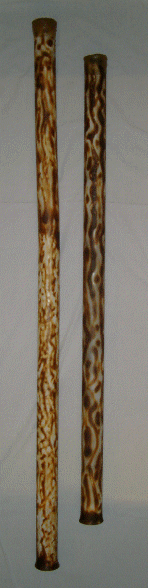
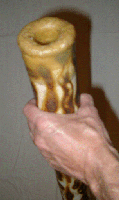
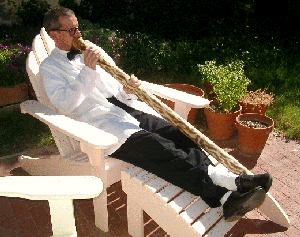
Jack got a little carried away with this idea and decided to make some didgeridoos out of 2" PVC pipe. The mouth pieces are made from real beeswax from the Jemez Canyon Honey Farm (internationally renowned, beekeeper extraordinaire, Laura Mijares), and they are decorated using an authentic aboriginal propane torch. The longer one is an A and the shorter one is a C (well, close). The surprising thing is that they actually work.
Click on the picture of Jack playing the didgeridoo to
hear what it sounds like.
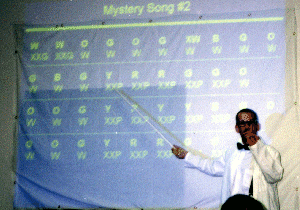
This is a scanned photograph of Jack trying to coordinate
a group of palm pipers in a tune that has both soprano and alto parts.
Extra for Experts:
This is the Excel spreadsheet that Jack uses to calculate the lengths of palm pipes and didgeridoos. See if you can figure out the details of the calculations by looking at the formulae in the different cells.