|
|
Focke-Wulf
190
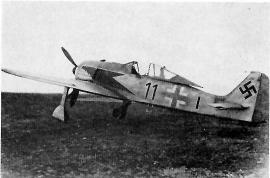
Plans
Type: Fighter
Weight:
Empty: 3,273 kg.
Take-off: 3,989 kg.
Length: 8.860m.
Wingspan: 10.520 m.
Wing area: 18.609 sq. m.
Engine: BMW801D-2.
Power:
Indicated: ? HP;
Take-off: 1,780 HP
Speed:
Sea level: 520 km/h.
At 6,000 m: 625 km/h.
Turn time at 1,000 m: 23-24 sec.
Climb to 5,000 m: 6.8 min.
Climb in a combat turn: 700-750 m.
Service ceiling: 10,500 m.
Range: 983 km.
Armament:
2x20 mm (MG FF) + 2x20 mm (MG 151): in the wing.
2x7.9 mm (MG 17).
In 1937 the Bf-109 aircraft developed by Messerschmitt was adopted
as the main Luftwaffe fighter. The Reich Ministry of Aviation’s
technical department developed a new specification for fighter
development so as not to confine itself to just one fighter type.
Focke-Wulf was one of the numerous companies that received the
specification and set to work on the new fighter immediately.
A radial BMW 139 engine (rated at 1,550 HP) was chosen for the new
plane. The design was entrusted to a team of developers led by chief
engineer R. Blazer and started in mid-1938. In the spring of 1939, a
first prototype -the FW-190V-1 - was assembled. It made its first
flight on July 1 1939. After test flights, the prototype was handed
over to the Luftwaffe research centre for full-scale trials. In the
course of the tests, the FW-190V-1 displayed excellent flight
characteristics, good stability and simple controls; furthermore,
the plane distinguished itself with its high landing stability
thanks to solid gear with a wide track. Among the shortcomings
discovered when testing were bad field of vision at taxiing caused
by a cumbersome radial engine and constant engine overheating which
led to a temperature increase in the cabin. The cooling system was
re-designed and the aircraft went through further tests. After that,
the construction of the first pre-serial FW-190V-0 was ordered.
Despite the agreement reached, production of the pre-serial FW-190
aircraft was postponed. This was due to the fact that MW had stopped
producing the BMW 139 engines intended for the FW-190. In
consequence, a new version of the fighter was developed - the
FW-190V5. The modernized aircraft came with a BMW 801C-0 engine
(1,560 HP) which was much heavier than the previous engine, and
involved strengthening the under-engine frame. To make up for the
heavy engine, the cockpit was moved almost 30cm back, thereby
improving the field of vision and reducing overheating from the
engine. The armament of the new fighter consisted of two 7.9mm MG 17
machine-guns, two 20mm MG FF wing cannons and two 7.9mm MG 17
machine-guns above the engine. Wingspan was increased.
In 1941, the FW-190V5 underwent successful flight tests in this
configuration, with some minor improvements, and serial production
began in the spring. It was marked FW-190A-1.
In August 1941, production of a new improved FW-190A-2 modification
started. The armament of the modified fighter consisted of two 20mm
MG FF cannons, two 20mm MG 151/20 machine guns in the wing and two
7.9mm MG 17 machine-guns above the engine. The system of weapons
selection meant that any pair of cannons or machine-guns could be
used separately or simultaneously. The aircraft came with an
improved BMW801C-2 (rated 1,600 HP at take-off). Armor consisted of
armored glass, a 14mm headrest, an 8mm armored back and small 8mm
tiles above, below and on the sides of the armored back.
The next FW-190 modification was the FW-190A-3 aircraft that
appeared in 1942. The plane was equipped with a new BMW801D-2 engine
(rated 1,724 HP at take-off). Among the typical external features,
one should mention the introduction of vent slots for cooled air on
the side panels behind the engine.
In the course of 1942, the FW-190A-3 was gradually replaced on
factory production lines by a new FW-190A-4 modification.
The FW-190A-4 was used for the first time on the Russian front in
the winter of 1942-43.
Advantages: One of the best serial
front-line fighters. Good flight characteristics. Simple and
comfortable to control and maintain. Strong firepower. Good field of
vision from the cockpit. Reliability. Good armor for the crew and
power plant.
Disadvantages: Insufficient field of
vision from the cockpit at taxiing. |
|
