BASIC COCHLEA SYSTEM
Cochlea Structure [2]
The human cochlea is in the shape of a 2 and 1/2-turn spiral. The total length of the spiral is 35mm. The basilar membrane separates cochlea into two chambers, called ducts. There is one column of inner hair cells (IHCs) and three columns of outer hair cells (OHCs), as the cross section implies. Each column has 3000 hair cells along the 35mm of cochlea length. There are two windows. One is called oval window for coupling sound signal into cochlea and the other is called round window for balancing sound pressure. The cochlea cross structure is showed in the figure 1.
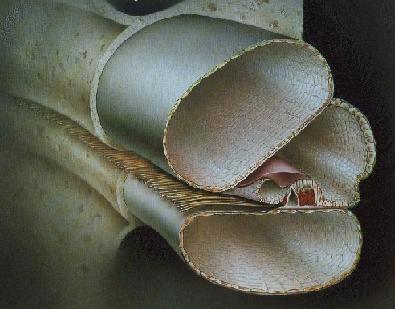
Cochlea Function [2]
The cochlea is a mechanical filter that separates a incoming sound into its frequency components, arranging from around 20 to 15000 Hz. When the sound is coupled into oval window, it causes that basilar membrane vibrates and propagates the sound from base to apex. At the base, the basilar membrane is most sensitive to high frequencies and most sensitive to low frequencies at the apex. In between, the best sensitive of frequency decreases exponentially with distance along the basilar membrane. So the basilar membrane functions low-pass filter. The inner hair cells detect the vibration of basilar membrane and convert the sound signal into neural system signal.
Traveling wave in cochlea [1]
In the cochlea, the physical properties of the partition are not constant with x, but instead change radically from base to apex. The changing parameters lead to the desirable behavior of sorting out sounds by their frequencies or time scales.
We can expressed wave propagating in a basilar membrane as

Scaling[1]
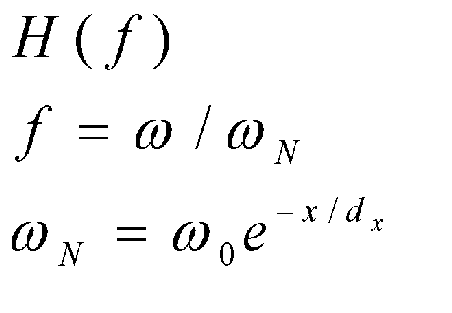
The response of cochlea are scaled by exponential slowing of the wave-propagation velocity with the distance x. The response for all places can be specified as a single transfer function Hn(f)
Where
Last page
Next page