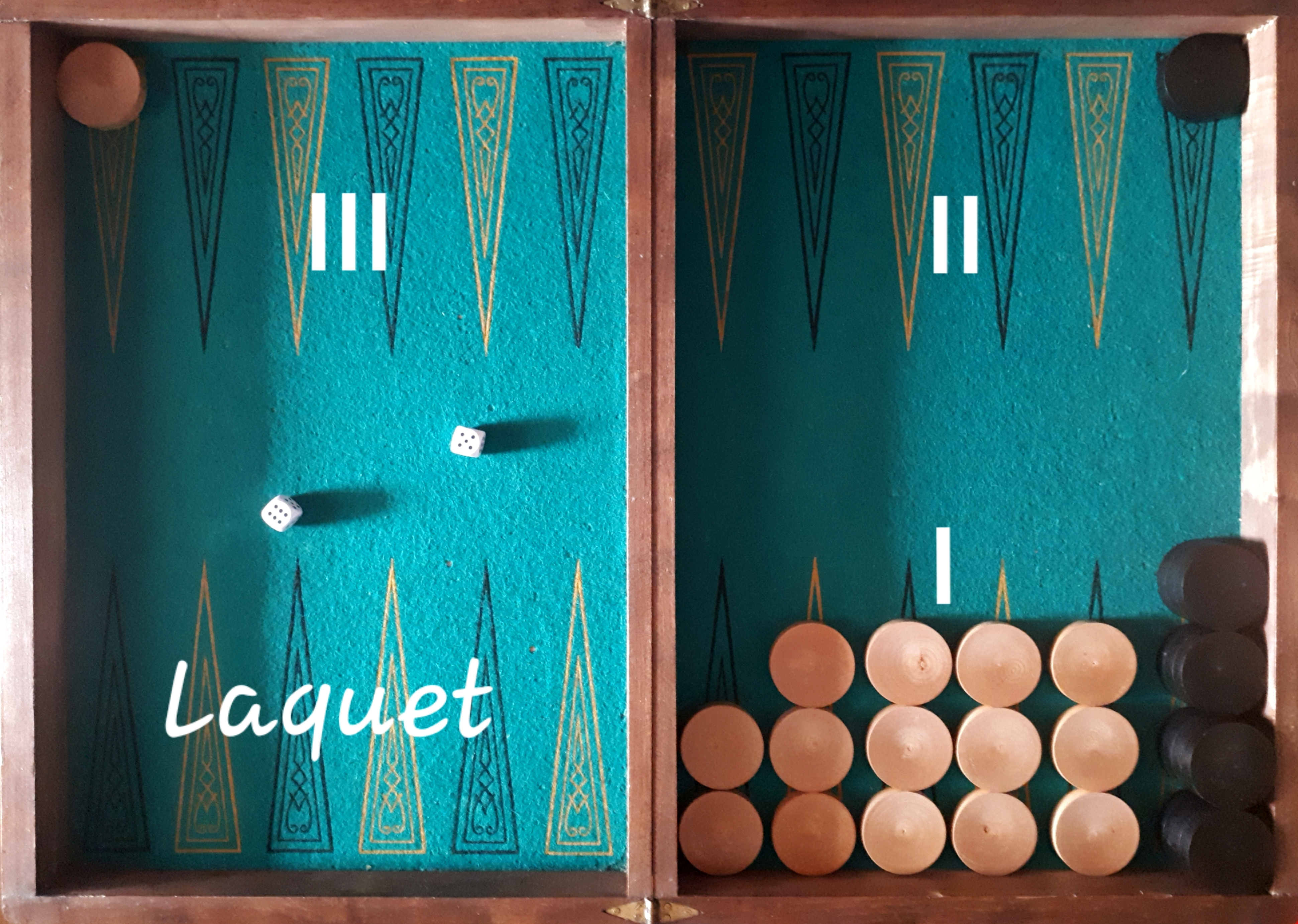
The
player with the white checkers sits on side I, and the one with
the black checkers on side II-III. The quadrant marked Laquet
is never used to play checkers on.
3. Circuit
of the checkers
The
white and black checkers follow the circuit shown in the illustration.
Moving counter-clockwise, they pass from quadrant I,
to quadrant II, then to quadrant III.
Thus,
it can be noted that each player has one checker ahead of the other 14. This
feature of Laquet is comparable to that of Jacquet
where the first checker played by each of the two players must
be ahead of the other 14, which cannot be moved
until the first has reached the bearing-off quadrant.
In
Laquet as in Jacquet, the black and white checkers move
in the same direction.
The
direction in which the checkers move is not specified in the Libro
de los juegos, but quadrant III is implicitly indicated as
being the quadrant from which the checkers are borne off. Any other way of moving
the checkers renders the game unplayable, creating
a great imbalance in favour of one or the other of the two players.
4. Object
of the game
To bring
all one's checkers into quadrant III, and be the first to bear them
off the board.
5. Priority
of the dice
The
player with the white checkers, although occupying a point in the bearing-off quadrant,
is at a disadvantage compared to the player with the
black checkers, who could easily block their opponent in quadrant
II by playing first. Therefore, White will always play first.
This
priority is not specified in the Libro de los juegos,
however in the rule for another table game, Cab e
quinal, which has a similar starting position, this is
the author's choice, for the sake of fairness.
6.
Validity of the dice
-
if on a roll of the dice, at least one of them goes off the board or
ends up on one of the borders, the roll must be
made again entirely;
- if a die ends up tilted and the players
cannot agree on the value shown, the roll must be made again
entirely. If one of the players maintains that the die is valid, they may
carry out a test consisting of placing another die on the die
being tested : if the test die slides off, the dice must be
re-rolled, otherwise the roll is deemed valid. This test may
only be carried out by the player asserting that the die is valid, and not by
the one disputing it;
- dice that land flat
on top of checkers are valid.
These
rules concerning the validity of the dice come from those
of the game of Trictrac.
7. Moving
the checkers
- checkers
are moved according to the result of the roll of the
dice. It is thus possible to move one or two checkers;
- doubles
are played as simple rolls, each die being
taken independently of the other;
- it is forbidden to
place one of one's checkers on a point occupied by at least one enemy checker,
nor to stop there if one is moving a single checker for a combined roll.
8. Obligation
to play the higher die
The
Libro de los Juegos specifies nothing on this subject.
- it
is mandatory to play both dice if it is possible to do so,
otherwise one plays whichever of the two dice is more advantageous;
-
if a player cannot play a complete move, their opponent plays in their
place the die or dice that were not played, if able to do so.
9. Bearing
off the checkers
Once
all 15 checkers have entered the last quadrant (no. III), checkers are
borne off the board following these rules :
- in
this phase, the outer edge of the board is treated as an additional
point;
- any checker that can be brought there
is borne off the board, unless one can play a checker within the board and
prefers to do so in order to hinder the movement of the opponent's
checkers;
- if a die shows a number higher
than the rank of the point furthest from the outer edge
occupied by one or more of one's own checkers, one bears off one of these checkers
(using the excess pips of the die);
- during the bearing-off
phase, the rules on moving checkers, and the one concerning
the higher die, remain applicable.
Comparison
of Laquet and Jacquet
Common
points
- the white and black checkers move in the same
direction;
- play is with two dice;
- the first
of a player's 15 checkers is arbitrarily ahead of the other 14. In Laquet,
it is placed ahead right from the start, whereas in Jacquet,
it must reach the last quadrant before the others can
be moved;
- opposing checkers cannot be sent back
to the start.
Differing
points
- the starting position is different,
being asymmetrical in Laquet and symmetrical in Jacquet;
- play
takes place over 3 quadrants in Laquet, and 4 in Jacquet;
- in Laquet, the
black and white checkers bear off from the same quadrant, whereas in Jacquet,
they bear off from diametrically opposite quadrants;
- in
Jacquet, doubles are played twice, but not in Laquet;
- in
Laquet, dice that cannot be used are played
by the opponent. This is not the case in Jacquet.
Etymology
of the name Laquet
In
volume 4 of Godefroy's Dictionnaire de l'ancienne langue française et de tous
ses dialectes du IXe au XVe siècle, an
inventory is made of the use of the word laquais (lackey) and its various
spellings, including that of laquet.
It
emerges from this that the name laquet was originally given,
before 1500, to a kind of adventurer-soldier travelling on foot behind
or ahead of his captain.
This
definition of laquet would be consistent with the name
of the game, in the sense that it would apply to each
player's checker placed, at the start, ahead of the other fourteen.
 This page is a translated archive of the original Académie des jeux oubliés, created on July 1, 2026, from the French original at salondesjeux.fr.

