This page is a translated archive of the original Académie des jeux oubliés, created on July 1, 2026, from the French original at salondesjeux.fr.
|
This page is a translated archive of the original Académie des jeux oubliés, created on July 1, 2026, from the French original at salondesjeux.fr.
|
The Game of Jacquet The
oldest known rules in French for the game of Jacquet are
no earlier than the beginning of the 19th century — the
oldest known rule set dates from 1818, appended
to the treatise on Trictrac entitled Cours complet de trictrac... by
P.M.M. Lepeintre —, which does not rule out that it may have been played
earlier. From 1800 onward, however, one can observe through
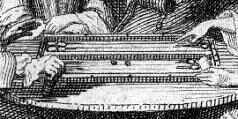
literature and pictorial representations that Jacquet
becomes the reference game of table games in France, while
Trictrac, the emblematic game of the Ancien Régime,
far more complex, is in decline. Trictrac had all but died out
by the end of the 19th century despite a resurgence during the
Restoration. Jacquet remained popular into the
1960s. It resembles the Turkish Moultezim, as well
as the Greek fevga.
The board is called a tablier in the sense that it holds the tables (an old name for checkers). The game of Jacquet is thus part of the family of table games.
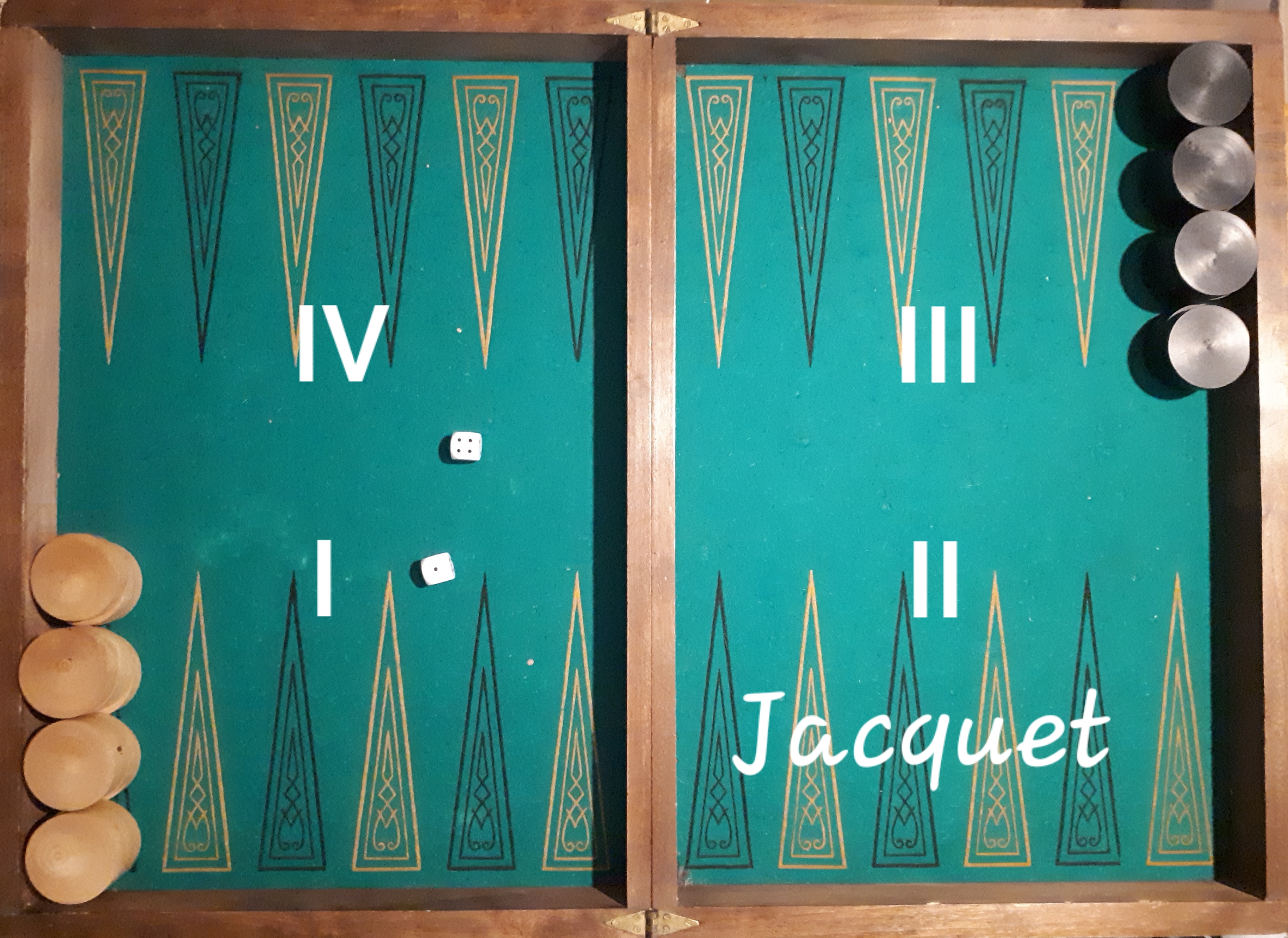
2. Starting Position Each
player places their checkers as shown in the figure below:
3. Movement of the Checkers 4. Object of the Game 5. Priority for the Dice To
determine which player will throw the dice for the first move of the game
-
dice that land flat on top of checkers are good. 7. Moving the Checkers a) On a simple throw (the 2 dice show different numbers) one may: - either move one checker by the value of one die and a second checker by the value of the other die; -
or move a single checker by the value of one of the two dice, then
from that resting position move the same
checker again by the value of the second die. It is essential to mark
a brief pause on the intermediate point. b) On a double (the value of each of the two dice is the same) - one plays the value of one die 4 times, which allows moving anywhere from one to four checkers; -
if one moves a single checker by 2 to 4 times the value of a die,
one must always mark a brief pause on each intermediate point. c) « Checker touched: checker played » - a player who, after throwing the dice, takes it upon themselves to touch at least one of their checkers may be forced by their opponent to play it, if it can legally be played; - however, one may touch one of one's checkers without being obliged to play it, if one has beforehand announced « j'adoube! » ("I adjust!"). One may, however, only use this to arrange one's checkers and in no way to try out a possible move.
Old-time
players used to announce doubles as follows
: 9. Obligation to Play the Higher Die - if one can play either of the two dice, but not both, one is required, if possible, to play the higher one. This is why, after the dice are thrown, one must announce the dice starting with the higher one (for example « 4 and 2 » and not « 2 and 4 »). Note in passing that "1" is not called « one » but « Ace ». -
in the case of a double one must play as many points as possible (while
remaining, of course, within a whole multiple of the value of one die). 10. Movement of the First of the Fifteen Checkers - the first of each player's fifteen checkers must travel by landing on each point along the way; - once this first checker has entered the last quadrant, it is placed at the base of the point it has reached; -
the fourteen other checkers of each player are not required to travel
by landing on each point along the way. 11. Restriction on Moving the Checkers - a checker may neither stop nor even rest (which is why one marks a pause without letting go of the checker) on a point occupied by at least one of the opponent's checkers. It may, however, do so on a point that is empty or occupied by one or more checkers of one's own colour; - as long as a player has not brought the first of their fifteen checkers into the last quadrant of their circuit, they may not play any of their 14 other checkers. This
first checker bore no particular name in the earliest
rules written at the start of the 19th century. It was only
later, after 1850, that players gave it the name courrier ("courier")
or, more often, that of postillon ("postilion"). These were
terms from players' slang. 12. Bearing Off the Checkers Once all 15 checkers have entered the last quadrant, they are borne off the board following these rules: - the constraints of the general rules for moving checkers, and that of having to play the higher die, still apply; - in this phase, the outer border of the board is treated as an additional point; - any checker that reaches the outer border by the value of the dice (either one or the sum of both) is borne off the board; - it is not, however, forbidden to move another checker within the board if it is to one's advantage (generally to hinder the passage of a delayed opposing checker); - in
the case where the value of a die is greater than the
furthest position of one's checkers from the outer border,
one bears off one of the furthest checkers (for example if the value
of the die is 5, and one has no checker at a distance of either 6 or
5, one bears off a checker at a distance of 4 or, failing that, 3, and so on) 13. Blocking the Opponent's Checkers When
one occupies six adjacent points, one creates a block that completely
halts the progress of the opponent's trailing checkers.
In the oldest rules of the game, no ban on
blocking is mentioned. 14. Winning the Game - the player who has borne off all 15 checkers while their opponent had begun to bear off theirs scores 1 point; - the player who has borne off all 15 checkers while their opponent had not yet begun to bear off theirs scores 2 points.
 II. Advanced Rules
The following rules were introduced to speed up the flow of the game and give it a greater tactical interest.
1. Forbidden Blocks - a complete block (with six consecutive points occupied) of the postilion's path is forbidden; - a complete block of the path of the opponent's other checkers by occupying the six points of the first quadrant, including the talon, is forbidden until one has succeeded in bringing at least one of one's own checkers to the last point of the last quadrant of the circuit, and even then, but this must be the subject of an agreement between the two players before starting the game, another checker on the second-to-last point. Note that J. Léchalet (see references at the bottom of the page) strongly recommends adopting this option in order to encourage a better dynamic in the game.
- the same rules are followed as in the original version, but the checkers, instead of being placed outside the board, are stored on the opponent's starting point (the location of their talon); - as a result, as long as the opponent has left even a single one of their checkers on their talon, one cannot bear off any checker, even if it reaches the side border, which is no longer considered an additional point for bearing off checkers; - during this blockage, it can happen that one is unable to play the dice rolled. One then passes one's turn, as with any blockage.
The player who has borne off their 15 checkers first wins: - 1 point if their opponent had begun to bear off at least one of their checkers; But if the opponent had begun to bear off their checkers: - 2 points, if they have all their checkers in their fourth quadrant; - 3 points, if they still have checkers in their third quadrant, but none in the second or the first; - 4 points, if they still have checkers in their second quadrant, but not in the first; - 5
points, if they still have checkers in their first quadrant (that of their talon). This system helps preserve interest in the game right to the end, by giving the losing player the chance to minimize their losses. One may, however, stick to the original system, limited to winning a single or double game. In players' slang, the checkers not borne off by the loser were called the little pigs.
III.
The Moultezim This Turkish table game, bearing the name once given in Turkey to the collectors, usually usurers, of land taxes, closely resembles the game of Jacquet. It differs only in the two points that follow.
In Jacquet, it must have reached the fourth quadrant before the other checkers can be played. In Moultezim, this same checker need only reach the third quadrant for the other checkers to be able to be played.
In modern Jacquet, this block is conditional (one checker brought to the last point and, optionally, another on the second-to-last point). In Moultezim, blocking in the first quadrant is always forbidden (one must permanently leave one of one's first six points free for the passage of the opponent's checkers).
References P.M.
Lepeintre, Cours complet de Trictrac avec un abrégé du Gammon,
du Jacquet et du Garanguet, chez Guillaume, Paris, 1818. Information about this page Published
online on 19 August 2003 Author : Philippe LALANNE Le Salon des jeux - Académie des jeux oubliés
|