This page is a translated archive of the original Académie des jeux oubliés, created on July 1, 2026, from the French original at salondesjeux.fr.  


Home

Le Garanguet

Information, references

Le Garanguet is a very little-known backgammon-family game whose rules first appeared in 1818 as an addition to P.M. Lepeintre's treatise on Trictrac, titled Cours complet de Trictrac... It is played, broadly speaking, in the same way as Jacquet, but without the "postillon" rule, and the starting position of the checkers is that of Trictrac. The essential particularity of this race game lies in the use of three dice instead of two.


1. Equipment

- a board with 24 points, called squares, grouped into four quadrants of 6 points;
- 15 dark checkers and 15 light checkers;
- 3 dice (the players use the same dice);
- 2 dice cups (one per player) for rolling the dice.

The board is called a tablier in the sense that it holds the tables (an old name for checkers). The game of Garanguet is thus part of the family of table games. A Jacquet set will do.

2. Starting position

Each player places his checkers as shown in the figure below:
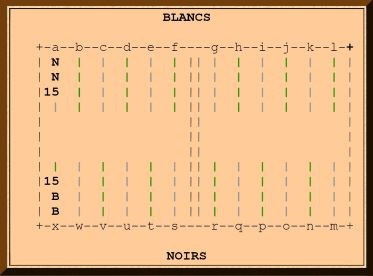

The dotted lines represent the points, and the number "15" corresponds to the total number of checkers on that point (including the two checkers marked "N" or "B")
The 15 checkers on their starting square make up the "Stack". The Whites' stack is at "a", and the Blacks' stack is at "x".

Checkers' path:

For the Blacks: from "a" to "l", then continuing from "m" to "x".
For the Whites: from "x" to "m", then continuing from "l " to "a".

Object of the game:

Bring all 15 of one's checkers into the fourth quadrant of the path: the zone from "s" to "x" for the Blacks, and from "f" to "a" for the Whites.
Then be the first to bear off all 15 of one's checkers from the board.

Priority of the dice:

To determine which player will roll the dice for the first turn of the game:
each player rolls one die,
whoever scored the higher number takes up that die again and rolls it together with the other two, in order to start the game.

Validity of the dice:

If on a roll of the dice at least one of them falls off the board or ends up on one of the rims, the roll must be made again in full.
If a die ends up tilted and the players cannot agree on the value showing, the roll must be made again in full. If one of the players maintains that the die is valid, he may carry out a test consisting of placing another die on top of the die being tested: if the test die slides off, the dice must be rerolled; otherwise the roll is deemed valid. This test may only be carried out by the player claiming that the die is valid, and not by the one disputing it.
Dice lying flat on top of checkers are valid.

Moving the checkers:

1.      On a simple roll (the 3 dice show different numbers) one may:
either move three checkers, each by the value of a different die;
or move a single checker by the value of one of the three dice, then from that resting position move that same checker again by the value of the second die (it is essential to mark a brief pause on the intermediate point), and finally move a second checker by the value of the third die;
or move a single checker by the value of one die, then by the value of the second die, and finally by that of the third die. There are two pauses to be marked.

2.      On a double (two of the dice show the same value, and the last die shows a different value):
if the odd die out has a value higher than that of the doubled dice, the roll is played as a simple roll;
if it has a lower value, one plays 4 times the value of the doubled dice and once the value of the odd die out. The intermediate positions must be marked briefly while moving the checkers.

3.     On a triple (all three dice show the same value):
one plays 6 times the value of a die, which allows playing between one and six checkers.
if one plays a single checker for 2 to 6 times the value of a die, the intermediate positions must be marked with a brief pause.

4.      "Touch a checker, move a checker"
A player who, after rolling the dice, sees fit to touch at least one of his checkers may be forced by his opponent to play it if it can legally be played.
One may, however, touch one of one's checkers without being obliged to move it, if one has previously announced "I adjust!". One may only "adjust" in order to arrange one's checkers, but never in order to make a move.

Names given to doubles:

In the old days, players used to announce doubles as follows:
Double of:
6: "Sonnés" ("chimed")
5: "Quines"
4: "Carmes"
3: "Ternes"
2: "Double two"
Ace: "Bezas"

For the sake of clarity, doubles will only be announced this way if they are usable, that is, if the third die has the lowest value.

Obligation to play the highest die:

If one cannot play all three dice, one is required, if possible, to play the maximum number of dice possible, and the highest dice.
In the case of a double or a triple, one must play the maximum number of points possible (while of course, staying within a whole multiple of the value of one die).

Restriction on moving checkers:

A checker may neither stop nor even pause (which is why a brief pause is marked when moving a checker) on a point occupied by at least one of the opponent's checkers. However, one may do so on a point that is empty or occupied by one or more checkers of one's own colour.

Bearing off the checkers:

Once all 15 checkers have entered the last quadrant, one bears the checkers off the board following these rules:
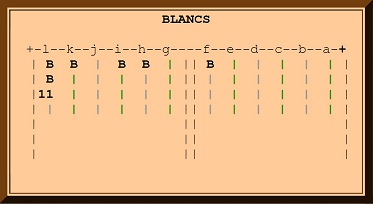
In this phase, the outer rim of the board is treated as an additional point.
One is required to play one's checkers, if possible, on the points of the last quadrant, including the side rim.
If it is impossible to play as described above, one plays with the checkers furthest from the rim, bringing them off the board.

The Whites, having brought the checker at "f" into the last quadrant, may begin bearing checkers off the board.

Examples

The Whites roll "3, 2 and Ace"

They play the checker from "f" to "j" for the 3 and the Ace, then bear off the checker at "k" for the "2".
They could instead have played the checkers at "h", "i" and "k" for the 3, the 2 and the Ace, without bearing off any checker, since the one at "f" had not yet entered the last quadrant.
and so on...

The Whites roll "Sonnés and 5"

They play the 5 from "f" to "k", thereby bringing in the last checker, then bear off the checker at "h" for one 6, the one at "i" for another 6, and the ones at "k" for the last two 6's.
and so on...

The Whites roll "Triple 5"

They play the checker at "f" to "k" for a 5, then bear off the checkers at "h" and "i" for a second and third 5, the two checkers at "k" for a fourth and fifth 5, and finally a checker at "l" for the sixth and last 5.

Blocking the opponent's checkers' passage :

When a player occupies six adjacent points, this creates a block that completely halts the advance of any of the opponent's checkers still behind it. This block can be built anywhere on the board and is intended to slow the opponent's advance, but it can also slow the game of the player who builds it. It is the main tactical element of this game, to be used with caution.

Winning the game:

A player who has borne off all 15 of his checkers while his opponent had already begun bearing off his own scores 1 point.
A player who has borne off all 15 of his checkers while his opponent had not yet begun bearing off his own scores 2 points.

  
Top of page


References

P.M. Lepeintre, Cours complet de Trictrac avec un abrégé du Gammon, du Jacquet et du Garanguet, chez Guillaume, Paris, 1818


Information about this page

Put online on 16 July 2004
Proofread and reformatted on 14 December 2021

Author : Philippe LALANNE

Le Salon des jeux - Académie des jeux oubliés


Top of page