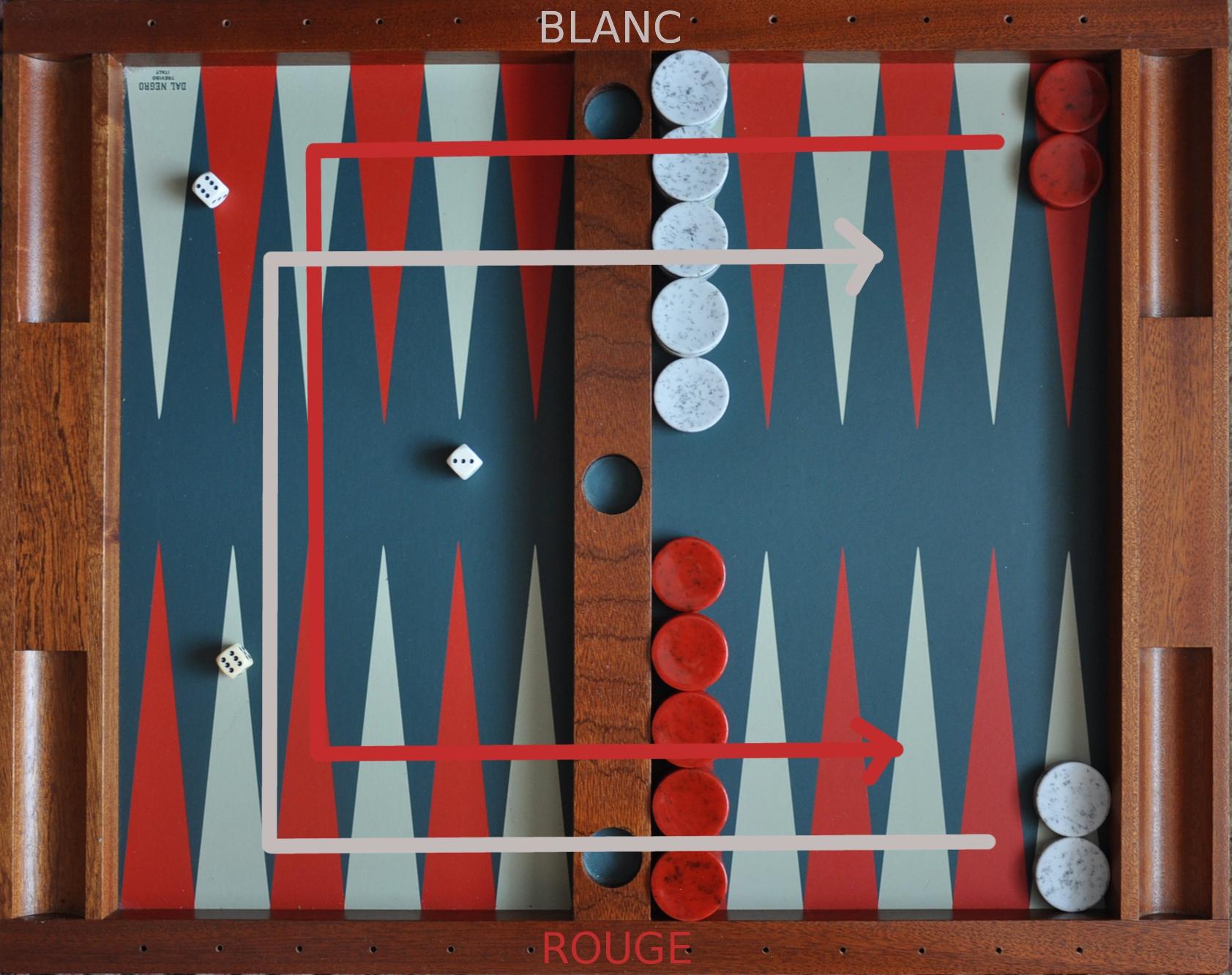
3.
Path of the checkers
The
checkers follow the path shown in the illustration
4. Object of the game
To
prevent the opponent from being able to play all the points shown by
the three dice or, failing that, to bring his 15 checkers into the quadrant
where his 13 checkers were placed at the start, and then be the
first to bear them off the board.
5.
Priority for the dice
To
determine which player will roll the dice for the first move of the game, each player
rolls one die, and the one who scores the most points rolls the three dice
to start the game.
6.
Validity of the dice
If,
on a roll of the dice, at least one of them lands outside the board or
ends up on one of the rails, the roll must be completely
redone.
If
a die ends up tilted and the players cannot agree on
the value shown, the roll must be completely redone.
If one of the players maintains that the die is good, he may carry out a test
consisting of placing another die on top of the die being tested:
if the test die slides off, the dice must be re-rolled; otherwise the
roll is deemed valid. This test may only be carried out
by the player claiming the die is good, and not by the one disputing it.
Dice
that land flat on top of checkers are valid.
This
is not specified in the Libro de los juegos, but is
a rule in particular in Trictrac
or Jacquet.
7.
Moving the checkers
The
checkers are moved according to the result of the dice roll. It is thus possible to move one, two, or
three checkers.
Doubles
or triples are played as simple moves, each die
being taken independently of the others.
It
is forbidden to place one of your checkers on a point occupied by more than one
opposing checker.
If
a checker lands on a point occupied by a single opposing checker, it hits it
and takes its place. The checker thus hit must re-enter
at the start of the path before another checker already
on the board can be played.
8.
Obligation to play all the dice
If
a player cannot play all three dice, he has lost the game.
9.
Bearing off the checkers
Once
all 15 checkers have entered the last quadrant, the checkers are borne off
the board following these rules:
- in this phase,
the outer rail of the board is treated as an additional point
-
any checker that can be brought there is borne off, unless, if possible,
the player prefers to play another checker on the board instead
- if no
checker can be brought to the rail, and no move can be made
in the board, one of the checkers is borne off from the farthest point
whose number is lower than the value of the die.
 This page is a translated archive of the original Académie des jeux oubliés, created on July 1, 2026, from the French original at salondesjeux.fr.