This page is a translated archive of the original Académie des jeux oubliés, created on July 1, 2026, from the French original at salondesjeux.fr.
|
This page is a translated archive of the original Académie des jeux oubliés, created on July 1, 2026, from the French original at salondesjeux.fr.
|
Domino
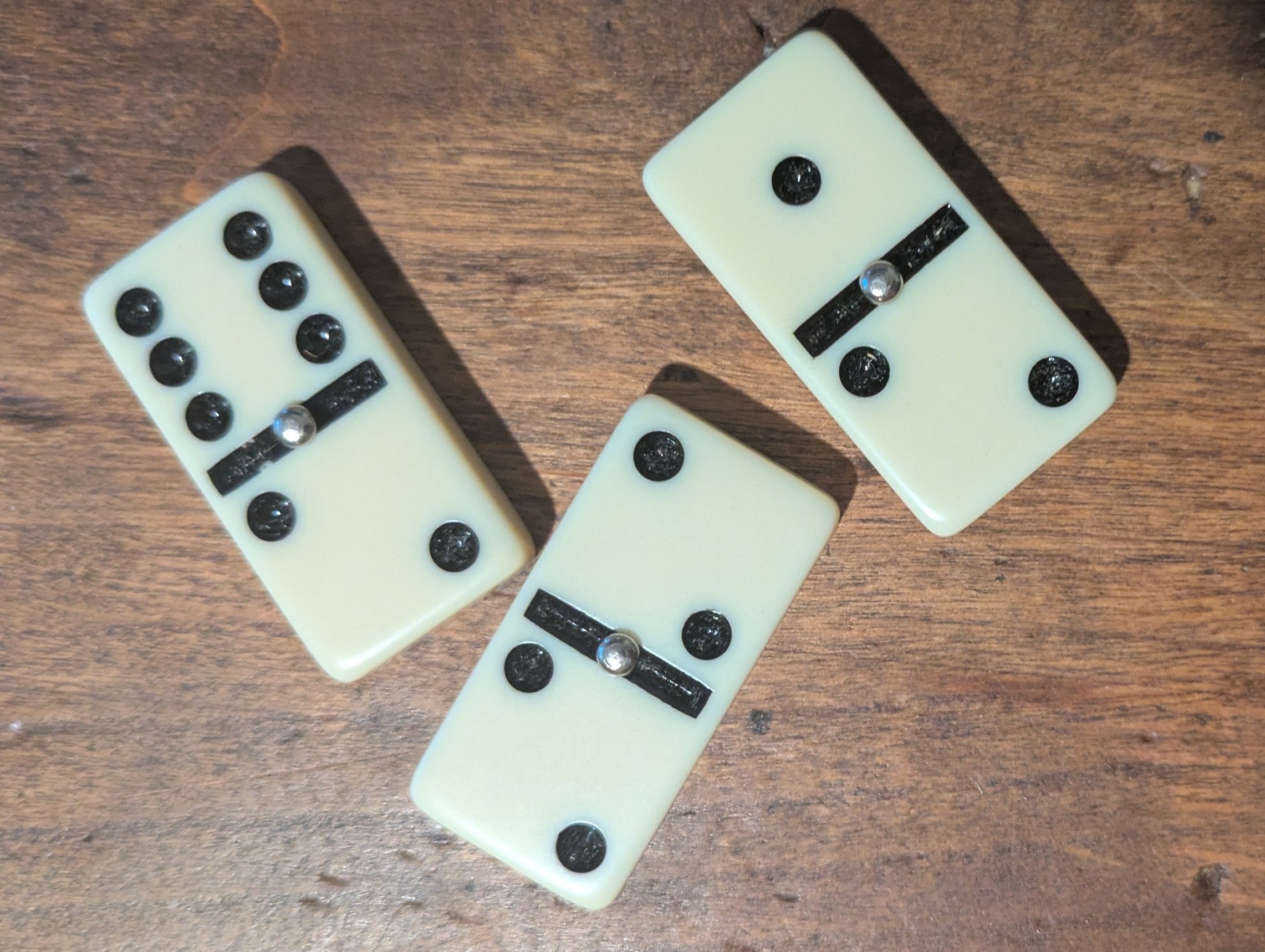
Domino is a game using long rectangular pieces marked on one side with the result of a throw of two dice such as those used, for example, in Trictrac. The pieces are thus called dice. The object of the game is to get rid of one's dice before the other player or players. To do this, players take turns placing one of their dice on the table, joining one of its two ends to one of the two ends of the chain of dice already placed by the players, in such a way that the two adjoining ends (that of the placed die and that of the chain) show the same number of points. The game of Domino originated in France. It was first played there during the Carnival of 1762. Its name is related to this festive period. It was only later that the pieces would, by metonymy, come to be called dominoes, and in doing so that we now speak of the game of dominoes. First played with 21 dice (representing the 15 visible outcomes of single throws, and the 6 doubles from a throw of two six- sided dice), it was very soon played with 28 dice, which is still the most popular set today. The 7 additional dice come from adding, to the point values from 1 to 6, a blank showing no point at all. On each new die marked from 1 to 6 on one side, one then finds a blank, and the double-blank makes up the seventh die. However, prior to the addition of the blank, the number of dice was increased by adding the values 7, then 8, and 9. After the addition of the blank, the six-point set with the blank remained the most widely played. To indicate which set is being used (with blanks), it is named after its highest double. Thus one plays double-six, double-seven, double-eight, or double-nine. Other, higher sets exist as well, such as double-twelve... In
this article we will look at the origin of the game of Domino, its development
in its early days, and its first rule
with 21 dice.
In 1762, the game of Domino made its very first appearance there.
2. The game was initially called « Le Domino » and not « Les Dominos ». Inspired by a hood reaching down to the shoulders worn by clergymen, the domino was at the time a loose garment reaching to the feet and topped with an equally loose hood concealing the face. This domino costume was very fashionable for concealing one's identity at Carnival festivities. The domino was an emblem of the Carnival of that era. 3. During the Carnival of 1762, Domino was played with cards representing the dice. Turners very quickly began making the dice from small ivory slips. The game of Domino appears to have been launched as a commercial product, taking advantage of the Carnival season, so favorable to games, and giving it the emblematic name of the garment. The name of the game has no connection with the dice themselves. The black-and-white dice, reminiscent of the habit worn by Dominican friars, were made later, and are not the origin of the game's name. 4. The other parlor game that L'Avantcoureur is referring to is none other than Nain Jaune, also revealed by the same newspaper in 1760.
Notes on this text : 1. The author of this text is Manoury, a renowned expert in the game of 100-square draughts. At the time he was a coffee-house keeper (selling coffee, chocolate, ices, and various beverages). 2. Manoury was, at the time, preparing to publish that same year his Essai sur le jeu de dames à la polonoise, the first book written on this game. However, his treatise does not include the game's history. So Manoury takes advantage of the question in an attempt to answer it. 3. In his answer, Manoury presumes that Polish draughts dates from around 1727, though without much conviction. Hence the comparison he draws with Domino, which likewise has no known author, despite both games having appeared recently in Paris. 4. Manoury tells us that the game of Domino is very widely played in the cafés of Paris, and has been for five or six years. This brings us back to 1764, which is consistent with the article in L'Avantcoureur precisely placing the appearance of the game of Domino at the Carnival of 1762. 5. The use of the singular is worth noting in the naming of the game. Domino is first the name of the game, and it is only later that the pieces will be named dominoes by metonymy, the carnival origin of the game seeming by then to be lost.
Notes on this text : 1. This definition of Domino is new. It is its first occurrence in a dictionary, that is, nine years after the creation of the game of Domino as revealed by L'Avantcoureur in 1762. 2. One can observe that the dice used may include the 7, the 8, and even the 9, and are therefore not limited to 6 as in 1762. However, blanks are not yet mentioned.
Notes on this text and on the rules proposed : 1. In his notice, the author informs the reader of his approach, which can be understood as the wish to establish, in a way, a standardization of the rules of Domino. He specifies that it is one of the games allowed in public, played for low stakes. 2. In the rules, the pieces are still called dice. The dice are generally of ivory or bone, but those mounted on a blackened wood backing are described there as being best suited to the game, notably because of their ergonomics. 3. As the Mercure de France had mentioned in 1770, the dice can be far more numerous than twenty-one (including the 7, the 8, and up to the 9). 4. In these 1780 rules, we see the blank appear alongside the base set, adding six extra dice to bring the total to twenty-eight without having to use the 7. This should probably be seen as a more convenient way of playing, since the 7 is not a value produced by six-sided dice. 5. The rules presented are still those practiced today, but the possibility of drawing from the stock does not exist. A player who cannot play always simply passes. 6. It is worth noting that the four-player game formed of two crossed teams (as in Whist, for example) is described here under the name Piquet voleur. It would not be until the early 19th century that its name would be replaced by Domino voleur. This renaming came about because, at the same time, Piquet players took over this format under the name Piquet voleur. There could not be two different games under the same name !
Domino
appeared in Paris during the Carnival of 1762. The following rule
of the game was included with the article of 1 March revealing
the game. 1 2. Number of dice : 21, from the double-one to the double-six ; blanks did not exist. 5. The player chosen by lot to be the first to play turns this last die face up. He then places one of his dice as is proper in Domino 6. The next player, seated to his right, does the same, and play continues in this way counterclockwise. 7. When a player cannot place any die, he passes his turn. 8. The first to place his last die wins the hand and receives from each of the other players a number of counters equal to that of the dice remaining in his hand. 9.

References L'Avantcoureur, weekly journal, of 1 March 1762 Le Mercure de France, dedicated to the King by a society of men of letters, August 1770 Dictionnaire universel Français et Latin, known as the Dictionnaire de Trévoux, 1771 Règles
et Principes sur le jeu de Domino, published by Fournier, 1780
Information about this page Published
online on 24 June 2025 Author :
Philippe LALANNE
|