This page is a translated archive of the original Académie des jeux oubliés, created on July 1, 2026, from the French original at salondesjeux.fr.
|
This page is a translated archive of the original Académie des jeux oubliés, created on July 1, 2026, from the French original at salondesjeux.fr.
|
Bezique
Bezique is a nineteenth-century card game, descended from Brisque and Briscan. Its name comes from a specific marriage consisting of the union of the jack of diamonds and the queen of spades. It is often said to originate from the Limousin or Angoumois region, where it was supposedly first called "Besi". As for its history in Paris, the earliest rules do not seem to be any older than around 1850. Méry, in his Arbitre des jeux, published in 1847, writes that it is a new game. Its success was considerable, and several versions emerged. To increase the possibilities for making declarations, the players notably changed the number of decks of cards used together, bringing it to two, then three, or even four. Versions for three and four players also exist. The rules presented here are the oldest ones written down, using a single 32-card deck for two players. See also: The Brusquembille family
1. Principle Bezique is based on Brisque and Briscan. While Briscan has too many ways of scoring points, it introduces improvements to the game of Brisque. Bezique carries these improvements over to Brisque, and adds a few more.
On these points, Bezique follows Brisque exactly: Bezique is played by two, with a 32-card deck. Each player receives six cards from the dealer, chosen at random by drawing the highest card from the pack. The thirteenth card is turned over by the dealer, who places it, partly face up, under the stock. This turn-up card indicates the trump by its suit — spades, hearts, diamonds, or clubs.
Unlike Brisque, and even Briscan, the turn-up card can only be exchanged for the seven of trumps before the first card of the hand is played. After playing his first card, the player who was dealt the seven of trumps is no longer allowed to make the exchange. Exchanging the turn-up for the seven of trumps immediately earns 10 points regardless of the type of the turn-up card, whereas in Briscan the turn-up must be a scoring card.
Bezique considerably reduces the list of declarations found in Briscan and returns almost to the level of Brisque. Furthermore, in Bezique, only the player who has just taken a trick may make a declaration. He does so under the following constraints: — he
must make it by showing the cards concerned before drawing the top card
of the stock; As always, declarations are not compulsory.
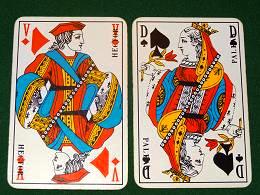
As in Brisque and Briscan, marriages score points. However, in Bezique, chance marriages formed simply by the fall of the cards do not score any points. Furthermore, Bezique introduces another type of marriage, formed by the union in a player's hand of the jack of diamonds and the queen of spades. This marriage is called a bezique. It is easy to remember the two cards that form the bezique: indeed, among the jacks and queens in a deck of cards, only the jack of diamonds and the queen of spades are shown in full profile. The choice of this type of marriage, as well as its name, are probably linked to this feature. One turning his face to the right and the other to the left, they face each other and look at one another. Now, "besi" in Occitan comes from the verb veser, meaning "to see" in French. According to this etymology, Bezique only makes full sense when played with a deck of cards using the French court-card design:
The points awarded depend on the type of marriage:
Only the top sequence counts, that is, the highest sequence in the same suit: 10-jack-queen-king-ace. The points awarded depend on the suit of the top sequence:
The fact that players only have five cards in hand when making their declaration makes a sequence declaration very rare. Since the game is played to 500 points, a top sequence in trumps wins the game outright. Unlike in Briscan, a card that has been used to declare a marriage can no longer be used to declare a sequence, and vice versa.
As in Briscan, having in hand four cards of the same rank — nowadays commonly called a "four of a kind" — may be declared, except for the lowest ones, which are the sevens, eights, and nines. In Bezique, four tens score no points. The points awarded, depending on the rank of the four cards declared, are set out in the table below:
Cards that have already been used for a sequence or a marriage may be used to declare four of a kind.
Bezique is played in the same way as Briscan: — as
long as there are cards in the stock, the play of the cards is that of
Brusquembille; As a reminder: — it
is always the player who played the highest trump who takes the trick,
and failing a trump being played, it is the one who played the
highest card of the suit led.
As in Brisque and Briscan, whoever takes the last trick scores 10 points.
A game of Bezique is played to 500 points. At the start of the game, one player is responsible for recording the points of the two players in a table with two columns. Points for declarations, as well as for the turn-up, are recorded immediately. As a reminder, when counting trick points, the ace is worth 11 points, the ten is worth 10, the king 4, the queen 3, and the jack 2. The other cards are worth no points. The total number of points contained in the 32 cards therefore comes to 120. As long as a player has not reached or passed 400 points after possibly counting the 10 points for the turn-up, he may only count his trick points at the end of the hand. Otherwise, he counts his points as tricks are taken, and as soon as he reaches or passes 500 points, he wins the game without needing to finish the hand. Following the same principle, both players may find themselves able to count their trick points during the hand, and whichever one first reaches 500 points wins the game. If
neither player is in a position to count trick points and both
reach or pass 500 points at the end of the hand, whoever
has scored the most points wins. In the event of a tie,
an additional hand is played to determine the winner.
Reference Joseph Méry, L'Arbitre des jeux, de Gonet, Paris, 1847
Information about this page Published
on 1 November 2011 Author: Philippe LALANNE Le Salon des jeux - Académie des jeux oubliés
|