|
|
||
 |
||
|
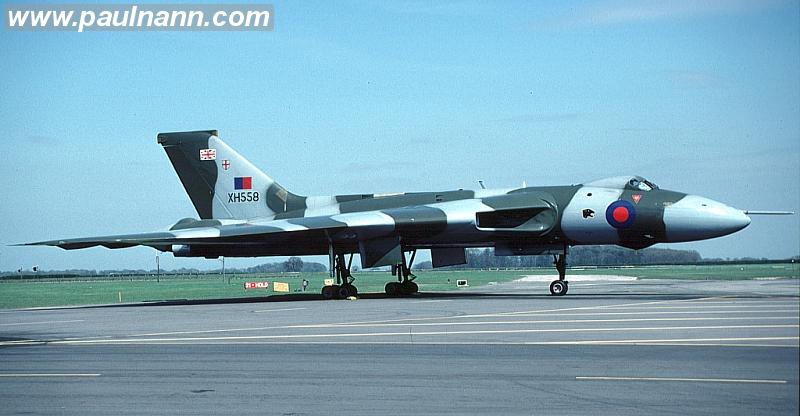
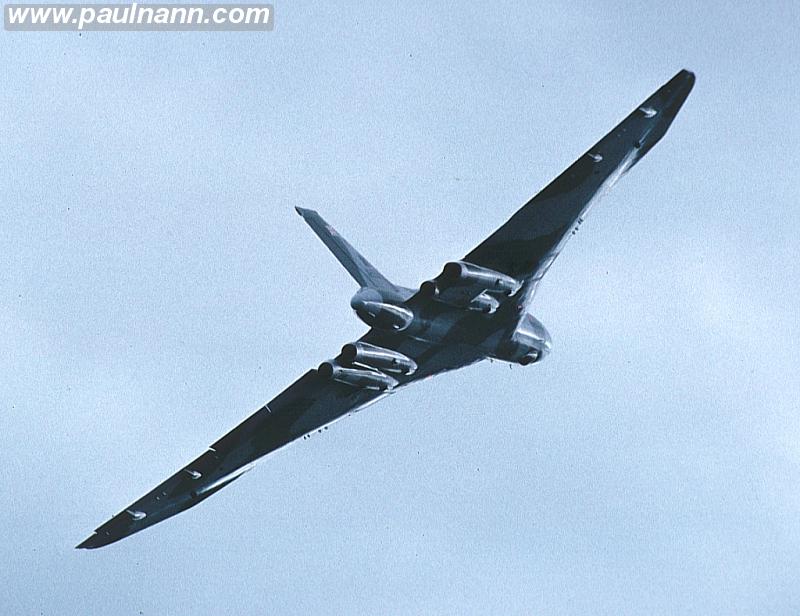
The Avro Vulcan was the most important V-Bomber. The first Avro 707 (a scaled-down prototype version of the Vulcan) made its first flight in August 1949. Three years later on the 30th of August 1952, the Vulcan itself took to the skies in prototype form. The test-pilot for the Vulcan was Roly Falk, who also flew the aircraft at the 1955 Farnborough Air Show, where the Vulcan made its first roll. Two Vulcans were sent to No.230 OCU for flight crew training, & the Vulcan entered service with No.83 Squadron at Waddington in May 1957. The initial production Vulcans were B.Mk1s with straight wing leading edges which gave the Vulcan a 'triangular' appearance. These were joined in service in 1960 by the improved B.Mk2, which had IFR equipment & was modified to be able to carry the Blue Steel or American Skybolt nuclear stand-off weapons. After the B.Mk2 came the B.Mk2A, which was a low-level penetration bomber (the Vulcan had been withdrawn from nuclear duty & replaced by Polaris equipped submarines). The Vulcan B.Mk2A could carry up to twenty-one 1,000lb bombs or 21,454kg (47,198lbs) of other weapons. Nearly all of the RAF's Vulcans were retired during the early 1980s, but several survived to be converted into tankers, designated Vulcan K.Mk2s. These served until 1984, & had only one hose unit. |
||
|
Vulcan B.Mk2 Type: Long-range strategic bomber Powerplant: four 7,711kg (17,000lb) Rolls-Royce Olympus 201 turbojets Performance: Max. speed 1,038km/h (645mph); Service ceiling 19,810m (65,000ft); Range with bomb load 7,403km (4,600 miles) Dimensions: Wingspan 33.83m (111ft); Length 30.45m (99ft 11in); Height 8.28m (27ft 2in); Wing area 368.26m2 (3,964ft2) Weights: Max. take-off weight 113,398kg (250,000lb) Armament: Internal bomb bay for up to 21,454kg (47,198lb) of bombs |
||
|
[Back to V-Bombers] [Home] [Jet Net UK Warzone] [Jet Net UK Photo] [Contact Jet Net UK] |
||
