
Time to grow healthy fry! Once the male has been removed it is now up to you to be a continuous source of food for the baby bettas. Raising fry is not as difficult as many make it out to be if you know the main two reasons why fry don't survive into adulthood. The main two reasons you will lose your tank of fry are as follows:
1. Starvation- occurs when you are feeding the wrong type of food. Fry must be feed microscopic food that is easy for them to eat. They cannot eat food that is bigger than their tiny mouths. The other reason starvation occurs is when you are not feeding ENOUGH food for the amount of fry in your spawn. If you are feeding bbs, there should be approx. 4 nauplii per fry while they are still small. This number must increase as they get bigger. Make sure not to overfeed them though.
2. Polluted Water- usually arises from over-feeding and not adding fresh water every couple of days.
Now that you know this, you can take the steps necessary to protect the fry.
NUTRITION
It is crutial to have your fry food prepared BEFORE you spawn your bettas. The best live food to use when they are newly freeswimming is microworms or vinegar eels. You can purchase a culture on aquabid.com very easily for just a few dollars. It takes 3 to 4 days before you can use your micro-worm culture to feed your fry with, so have it ready before you spawn bettas. For the first day we add a drop of Liqui-Fry in the morning and then once at night. There after we feed them microworms until they are large enough for bbs.Then by day 6 they are usually large enough to be fed bbs (baby brine shrimp). I have never tried Mike Reed's No BBS, but I have heard only good things about it. I think I may try it soon. It is good to use a combination of food and do small multiple feedings during the day. The first few weeks we do about 4 small feedings per day and then as the fry get older we go down to feeding them twice a day.
WATER QUALITY
Having clean water is vital for your fry. We start doing small water changes with a turkey baster 4 days from the time the fry hatch out. We just careful suck the gunk from the bottom of the tank with the turkey baster and squeeze it out into a clear container. No matter how hard you try not to, some of the fry will be suctioned into the container. Wait until the water settles in the container, and then using the turkey baster, suck out the fry and put them back in the fry tank. They usually are fine and seem to suffer no ill effects from the experience. After you put the fry back, float a container of water (with the same chemystry as the water you took out) in the tank for about an hour. We do water changes every to every other day until the fry are seperated. We find that frequent water changes elimates the problem of missing ventrals when the fry get bigger. It is important NOT to overfeed! The main reason for polluted water is uneaten food. Keep your water temperature stable at about 82 degrees until you are ready to separate the fry.
SEPARATION
At about 4 weeks you will start to notice a few of the fry are bigger than the others. This is a good time to start the separation process. By taking out the bigger fry you give the smaller fry a chance to eat more food and grow. By 7 weeks it is time to separate the rest of the fry male and female. We separate the females too because they will nip at each other. Put all of them in their separate containers next to each other so they can see one another. It is not recommended to use gravel because it takes extra time to clean during water changes. We do recommend a small piece of java fern or moss in each container. You will notice the fish will usually sleep next to the plant at night and use it to hide in on occasion. By this time you should cut down to feeding only twice per day. Now is the time to be diligent in keeping their water clean. Remember the smaller the container, the more water changes you will have to make. Be careful when feeding, not to dip your toothpick or fingers into each container. By doing this you could spread disease and lose your whole spawn. By 12 weeks your fry should be ready to go to new homes.
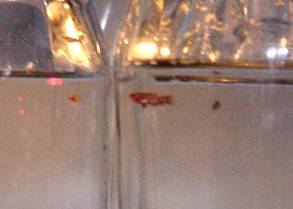
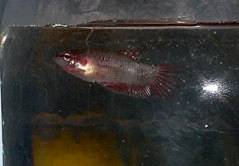
Day 1 - Add one drop Interpet Liqui-Fry #1 once in the morning and once at night.
Day 2 - Feed microworms in the morning and one drop of Liqui-Fry at night.
Day 3 - Feed just microworms (morning and evening)
Day 4 - Carefully do a water change with a turkey baster.
Day 6 - start feeding live bbs along with microworms. Do another water change.
Day 7 - Continue doing water changes every day to every other.
Day 10 - Labyrinth organs starts to develope.
Week 2 - Continue feeding bbs and every day water changes.
Week 5 - Start to seperate the larger fry.
Week 6 - Increase water changes to 25-30%
Week 10 - Start weening them onto Frozen and dry foods