| Where Does Summer Come From? An Exploration of Earth-Sun Geometry |
| The following are excerpts from an educational science text that explores and explains actions of the Earth's motion and orbit including day and night, the solar year, the seasons, the analemma, and the Milankovitch cycles. (Don't know what an analemma is -- or the Milankovitch cycles? Read on!) |
 |
| Everyone experiences summer, fall, winter, and spring -- the "four seasons" that come and go with such perfect regularity that most of us barely bother to give any thought to how the seasons happen. The Introduction questions why we rarely wonder about the mechanics behind the changing seasons, and prepares the reader to start thinking about the natural world rather than just experiencing it. |
| The "envisioning exercise" in this section explains rotation, revolution, and the solar year by having the reader imagine the movements and positions of a Styrofoam ball (representing the Earth) with a pencil stuck through its center (representing the Earth's axis and poles). |
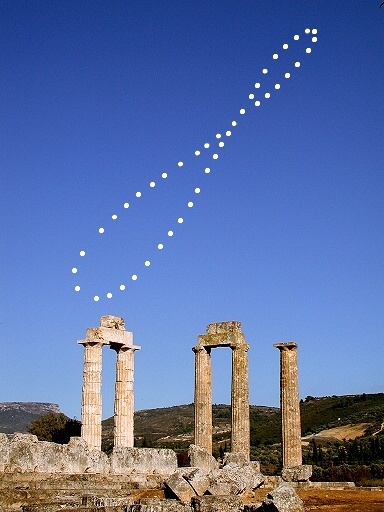
| This section explains the mechanics of the seasons and the analemma (pictured below), the graceful figure eight-shaped path in the sky that the Sun follows over the course of the year. |
| Section three explains the Milankovitch cycles, three incredibly slow-acting irregularities of Earth movement that some scientists believe help cause profound climate change over centuries and millennia. |
| So we've learned a lot of stuff about the Earth and Sun -- how might what we've learned change the way that we view the world around us? |
 |
| This section lists sources for in-text citations and graphics. |