 |
|
|
|
|
|
|
|
|
|
|
|
|
|
|
|
|
|
|
|
|
|
|
|
|
|
|
|
|
|
|
|
|
|
|
|
 |
|
|
 |
|
|
|
|
Alacrity website |
|
|
 |
|
|
|
|
|
Dan McEachern's Alacrity restoring project
- tips on fiberglass repairs |
|
|
|
|
|
|
|
|
I use a disposable paintbrush and just get the resin on. I use the paint brush to push the resin into the MAT and to push the MAT around until I get it into the place I need it saturated. Lay your CLOTH over the wet MAT. I then use a special roller that pushes the cloth into the wet mat. You can use the tip of your paintbrush to push the cloth into the mat. Make sure the CLOTH is saturated and all wrinkles removed. The roller I use has 1/8 inch ridges that presses the cloth into the mat ensuring a good bond, without squeezing out all the resin. Make sure you remove any air bubbles and wrinkles as these will torture you later. If the surface is a little rough don't worry. Now if you are going to build up an area, remember to alternate MAT and CLOTH in layers. CLOTH to CLOTH will not bond using fiberglass resin. If you allow your layers to dry completely, lightly sand between layers. After you are done with your layups and everything is dry, use a good marine grade fiberglass filled filler. Also use it to feather any edges. Don't get it too thick or unless you enjoy sanding! It is also great for gelcoat repairs that reveal the mat underneath, but you will need to add a topcoat like gelcoat or good quality polyester primer and paint for a final finish. |
|
|
|
 |
|
|
|
|
|
|
|
|
|
|
|
|
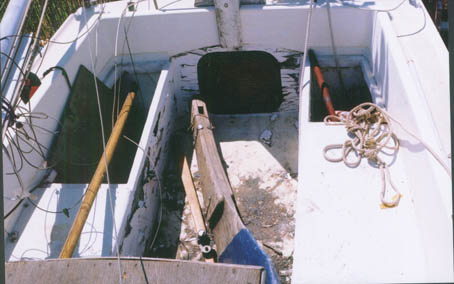
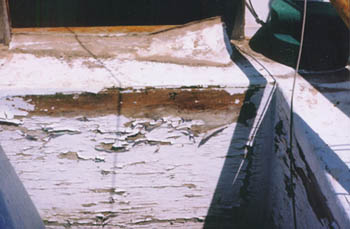
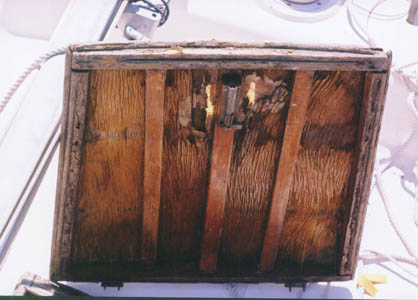
A tip for those thinking of doing their own fiberglass repair. Please don't make the mistake that the previous owner of this boat did. He applied fiberglass CLOTH directly to the wood and existing fiberglass in the cockpit, and to the keels. It all delaminated and peeled off as the wood dried and shrank. CLOTH applied to wood or fiberglass will work short term only. Always, always, did I say always? use fiberglass MAT first against wood or existing fiberglass. Find a fiberglass shop in your area and get good quality resin. The resin I use is specifically made for laminating, and dries hard in 48 hours with no need for another chemical to harden the surface. (Some fiberglass resins stay tacky until you apply a finishing product that hardens the surface. Read the lable and ask lots of questions!) Here's how I do my layups:
On very dry wood, clean up loose paint, remove as much loose wood by sanding to 80 grit and repair or attach loose pieces using stainless steel hardware. Sand existing gelcoat to 80 grit. Don't sand through the gelcoat! Cut a piece of MAT and a slightly smaller matching piece of CLOTH for the area you are repairing. Place your MAT over the repair area and quickly get your resin mix applied. If you mixed your resin correctly you should have about 15 minutes to work, so don't do too large an area. I work in 1 to 2 square foot sections. |
|
|
|
|
|
|
|
|
|
|
|
|
|
 |
|
|
|
|
|
|
|
|
|
|
|
|
|
|
|
Webmaster's note: Fiberglass repairs are, though not very difficult to do, something discussed quite often. The most common topic of disagreement is wheter to use polyester or epoxy resins. I won't comment on that here, as I myself do not have a clear answer. However, I used epoxy this fall, mostly because it works in lower temperatures, something Dan clearly does not have to worry about... |
|
|
|
|
|
|
|
 |
|
|
|
|
|
|
|
|
|
|
|
Back to Pictures Page
Back to Main Page
Back to Tips and Tricks Page |
|
|
|
|
|
|
|
|
|
|
 |
|
|
|
|
|
|
|
|
|
|
|
|
|
|
|
|
|
|
|
|
|
|
|
|
|
|