
|
| Electricity |
 |
 |
| (Electric potential is measured in Volts.) |
 |
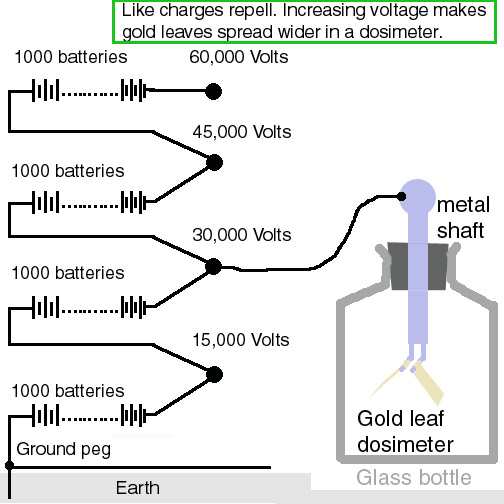
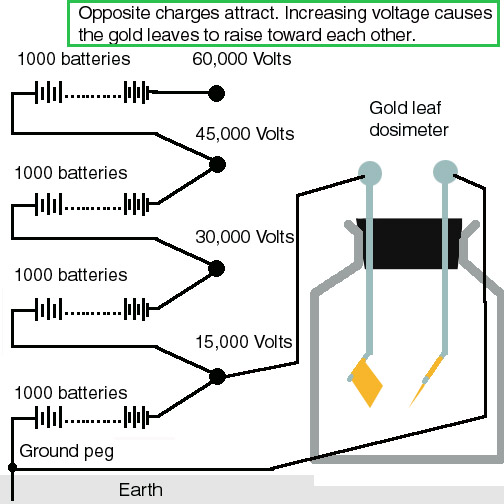
| Most folks know about static-cling. Somtimes static electricity can also?? be seen repelling small granules or hairs. Static presents a force field. The force is a measure of the voltage that is present. Humans only notice this force when thousands of Volts are present. Researchers at Teledyne-CME measured voltages generated by household items. Peeling Scotch brand tape from the roll developed 5,000 Volts. Scuffing across the carpet generated 20,000 Volts. Results varied with humidity. They used a special non-contact voltmeter to take the measurements. Static electricity is defined by stored charge which is captive. In technical terms, we would say there's no discharge path. |
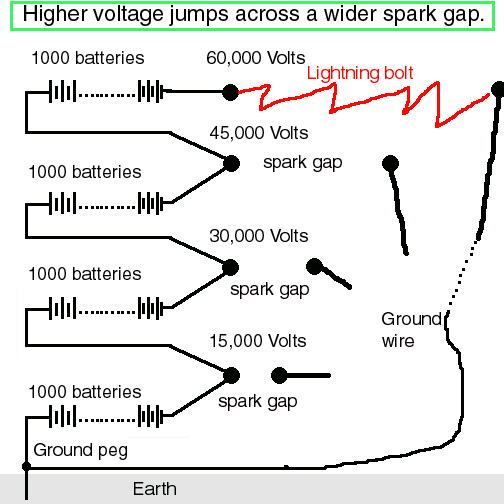
| Another measure of Voltage is lightning-bolt length.This varies unexpectedly and is effected by environmental conditions. The sketch to the right depicts 60,000 Volts jumping five inches. The next day the same gap may hold-off 70,000 Volts, without breaking down. Relative humidity, atmospheric pressure, cosmic rays, ionizing radiation, electrode size, shape, and electrode material-type can all effect arc length. Insulation can be substituted for the air for increased holdoff voltage. Some types of insulation can withstand high-voltage better than others. Some types of insulation break down and recover fully. Others are degraded by the discharge. Many insulation types become shorted when gnarled by voltage-breakdown (ending up fouled by carbon residue from fire). |
| Voltage has two effects: Insulation breakdown Electrostatic force |
| 10,000 |
| 10,000 |
| 10,000 |
| 10,000 |
| 10,000 |
| 10,000 |
| 10,000 |
| 10,000 |
| 10,000 |
| 10,000 |
| 10,000 |
| 10,000 |
| The three milestones of electronics: 1) You are amazed it works. 2) You believe you can do it again. 3) You proclaim victory in advance and can still succeed. |