| DC stands for direct current. DC has clearly-marked positive and negative source terminals. AC stands for alternating current. AC reverses polarity regularly. Each reversal resembles a tide turning. Each incoming surge slows to a stop. Then the tide turns. The flow starts going out again, slowly at first. It picks up speed until it's rushing outward. Then the outward flow slows to a stop. This cycle repeats itself, over and over, 60 times a second (in the USA). Commercial power delivery systems usually provide AC power. By one estimate, electrons travel 400 miles forward in a powerline before doubling-back (to once-again travel 400 miles, but this time in the other direction). Strangely, the same electrons travel to and fro, never to leave the 400-mile line segment. |
| Bulk transfers of electrons are measued in Coulombs. |

|
| ElectricityCont'd |
| Exessive current makes a wire run too hot. Bad connections can get hot when normal current flows. Current is measured in Amperage (or Amp's, for short). Electrons were designated as having negative polarity, by Ben Franklin. This leads to a rather counterintuitive norm: flow emerges from the negative connection on the battery. The positive battery terminal sucks-in electrons. This becomes confusing at times. Schematic symbols often have arrows implying direction of electricity throughput. The arrows imply delivery of positivity. So all arrows really point backwards. We could say, electrons secretly go backwards. This backwards-aspect only reveals itself when we use devices that pass-electrons in an obvious manner. These situations are rare today. But keep this contradiction in mind, in case you find yourself confronted by the reality. This intuitive paradox especially stands-out whenever a schematic shows a solid-state diode in-line with the main current-flow-path of a vacuum-tube. |
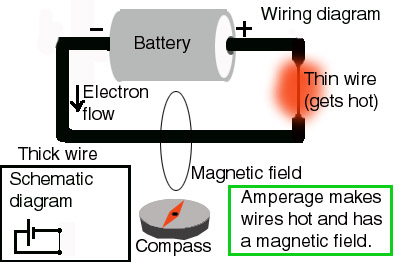 |
| Note: Never short out a battery. It is a waste of battery life. The "thin wire" in a typical circuit might be a flashlight bulb fillament, a glow-plug, some Nicrome wire, etc. These are actually resistors. Resistors limit current. Some batteries explode when shorted. Some will vaporize any metal that imposes a short circuit. |
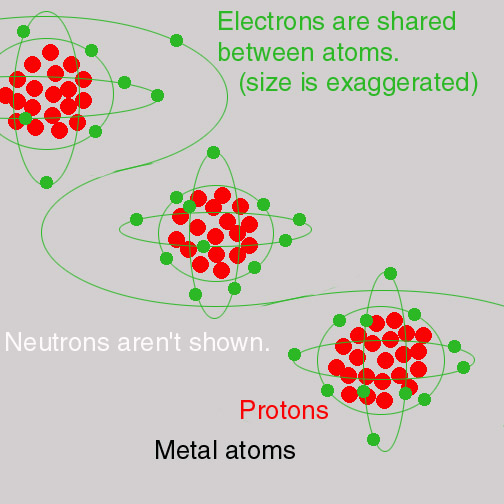 |
| Metal atoms share their outer electrons. This bonds metal atoms together. An electron can enter metal at one end, wander through, and exit from the other end. This represents conduction and current flow. |
| If you force an electron into one end of a metal conductor, an electron will become available for departure at the other end. It looks like the electron went through the metal at the speed of light. However, electron-speed in wires remains unknown. The metal can be thought of like a pipe full of ping-pong balls. If you push a ball into one end, another ball pushes out of the other end--with insignificant delay. It's a shock-wave that travels quickly from one end to the other. We won't so soon receive our original ball or electron. Our original is still clear back at the input-end, where we put it. Then you get into electron transit time. There are no easy answers for how to measure that. |
| Electric current has two side effects: Heating Magnetism |
| It is fairly easy to calculate how many electrons are contained within a metal conductor. Rate of electron entry into one end, and exodus from the other, is measurable. Some sense of electron speed within the conductor can be deduced. |
| Electric Current |