| Richard Ziskowski made the 2 KV swing grid-box pass a foil-test by increasing output-resistance; and by decreasing bias-rail bypass-capacitance. With an output-resistor IR-loss of 330 Volts, quasi-peak-volt-metering was necessitated and born. Known output IR drop is subtracted and the pulse top meter comes to reflect true delivered output. |
| Ken Lillis and Daniel Goluzek were upgrading the grid-box to 3 KV swing. The 330 Volt loss at the output resistor was killing them. The stock transformer is 3.3 KV. With the old choke "jumped," they were still running out of raw supply. And the HP-2611 opto-isolator is overstressed by common-mode dV/dT imposed by the design. Along this line, the decreasing of resistive-losses offered us our last bounty. |
| I always loved detailing early ETM's. There was an air of mystery about the early forays. It's fun to see early methods for vanquishing natural scourges. Some needed updating. Mop-up outlay proves inconcequential beside the result. A new machine is born. |
| Ron Harriot, of Group 14 at Litton, wanted 30 KV, 21 KV, 12 KV, and 8 KV variable supplies, grouped with grid and heater supplies to power a coupled-cavity TWT. Ron got a hipotter, some oil-capacitors, and some Ohmweve resistors. He foil tested with down to 10 Ohms series-resistance, up to half a Microfarad, and up to 50 KV. He wasn't blowing holes in the foil. The arc drop is low compared to resistor drop. The resistor bears the brunt of the energy dump. Crowbarring wasn't necessary for protection of foil. Fast power interuption in conjunction with traditional output-cap/resistor archetecture could be soft: crowbarless. So Ron specified his systems crowbarless. Eventually the lineage was extended to meet 40 KV and 60 KV specifications. |
| ETM duds bounced back occasionally. One such unit was a cute little single-bay 15 KV 1A beam supply. It just showed up, nobody knew why it was rejected. It was crowbarless. It was produced in an era when crowbarless meant blowing dime-sized holes in foil. We'd done 30 KV crowbarless, no holes. So I made the existing peak-overcurrent comparator trigger a 1-second one-shot: faulting long-enough to drop-out the relay logic, contactor, and shorting relay. Then I wired the fault to gate pass-tube conduction off. Now it doesn't blow holes, even when the pass-tube arcs. Upon installation, I found lack of an output capacitor on the 24 V supply causing the real grief. Whenever the operator pushed the "High Voltage Applied" button, EMP from the snapping of the vacuum-relay glitched the 24 V regulator; which blew it out once a week. The maintainence guy, J. D. Smith, laughed when it came back as bad as ever. Then I added the capacitor. The operator congratulated me. |
| Richard Ziskowski used 330 Ohms series-resistance to soften the first ETM solid-state modulator output. But I occasionally needed five Amp peak grid-drive for switch tubes. With losses problematic, I'd been envisioning interuption of bias-rail FET-switches for short-circuits; while leaving pulldown-resistance to softly apply bias. So now, FET-switches see one-second interuption, whenever peak-bias-load creates a bias-undervoltage condition. Instantaneous crowbar-signaling couples out via fiber optic. Everyone was stumped when Crane called out a 5 microsecond bias-undervoltage crowbar-discharge specification. Under voltage faults were traditionally slow, poised to measure the sluggish response of a hefty rail-capacitor. That point is a-resistance-away from the output shorts. Everyone scoffed at the requirement. ETM'ers commonly ignored such oddities. Six months later, it dawned on me I'd beat that spec the prior year, with the bias-switch gating research. The nature of the bias-overcurrent trip-threshold is such that it embeds Richard Zyskowski's quasi-peak-volt-metering philosophy for instantaneous undervoltage detection. It needed Harvey's nulling circuit too. |
| The quest for grid-box softness |
| Tweaking the 2 KV grid box to do 3 KV |
| Crowbar elimination drove one man tirelessly . . . |
| Resistive softening yields to gated switching |
| ETM Archeology |
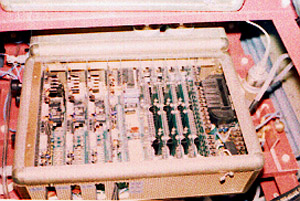 |
| Low noise tri-state grid modulator |
| Featuring quasi-peak-volt metering |
| Innards from a TekTronix 40 KV probe are mounted at the output terminal on the right. My prototype multi-output low-capacitance transformer, in the upper right, shipped with this unit, SN 804. |
| Gating retrofitted |