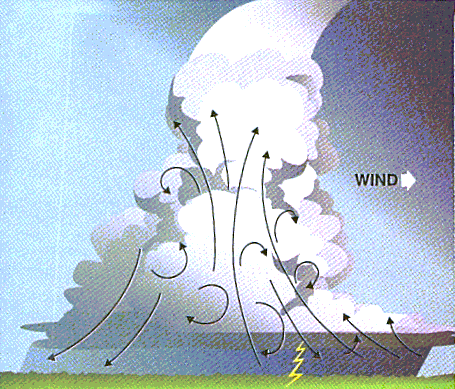
The dissipating stage of the storm begins as the downdrafts begin to spread out in the cell and replace the weakning updrafts. As this occurs the vertical development of the storm begins to stop and the release of latent heat is also stopped. Because of this, the storm begins to diminish in size and strength and the once strong updrafts are no longer present. They have now been replaced by downdrafts and the once great cloud begins to fall from the sky in the form of high wind.
There are two major classifications of thunderstorms, airmass and severe thunderstorms. Airmass thunderstorms tend to be of a lesser intensity than Sever thunderstorms. The difference comes in how they are formed. Airmass thunderstorms are formed in an area of moist unstable air. This moist airmass is lifted by convection on warm summer days or in some cases mountain peaks. Airmass thunderstorms tend to be widely scattered and of shorter duration than severe thunderstorms.
Severe thunderstorms are usually associated with fronts, converging winds, or troughs. Because of the greater energy available for lifting, these storms grow to enormous size. The duration of severe thunderstorms can be less than an hour for single cell storms or more than 2 hours for supercell storms. Severe thunderstorms usually contain winds greater than 50 knots and hail greater than 3/4 of an inch in diameter.
Obviously, thunderstorm avoidance is crucial for your continued existance as a pilot. The best rule of thumb for flying when thunderstorms are in the area is not to. Thunderstorms are often embedded in large layers of clouds making them very hard to see. If you find yourself in the same piece of sky as a thunderstorm due to a bad weather briefing, give the thunderstorm plenty of respect by staying at least 20 miles away. Often wind, turbulance, and giant hail stones, are encountered within 20 miles of a storm. If you end up inside of a Thunderstorm good luck!! About all you can do is set your power and trim to maintain an airspeed below Va, hold the wings level and accept variations in altitude. Hold your course because this should get you out the other side in the shortest time. |