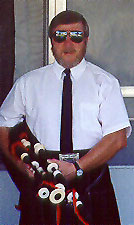
Well folks it's been a long time since I've put digit to keyboard for our
illustrious little Celtic rag. But July's article by our esteemed then-president,
Derek Fasking, entitled "Celtic Serendipity" has energized me to get off my
dufus and write a kind of rebuttal, this time from the point of view of the
piper. I enjoyed reading his article and immediately related it to my limited
experiences as a piper.
I still have a long way to go before I feel I've earned the term "piper" in it's
true sense of being proficient at the instrument. That, of course, may never
ever happen. I started way too late in life, and the everyday business of life,
work, family, etc., tends to eat away at what little spare time one has left.
There is an old saying: "seven years in the learning, seven years in the
practicing, and seven years in the playing, to make a piper." I don't think I
have that long! So unlike Mr. Stewart Liddell, a true master of the pipes, I
just don't seem to be able to find five hours each day to practice my chanter,
so a master piper I shall not be.
I am, however, an avid fan of the Great Highland Bagpipe, and have been
listening to them since I was just a nipper up in Scotland. However, at an
early age I was told by my "elders and betters" that "ye'll never mak a piper
looney -- ye're ower wee ye ken." I took that as gospel, and never even
thought of learning the instrument, that it was beyond me. Well, with that and
the mystique of the pipes, I just put it behind me. I suppose I was about 11
when all that happened. It wasn't �'til thirty-eight years later my wife had
ideas about me needing a hobby. She signed me up for Pipey Skinner's piping
lessons, and I've been playing ever since -- and having a helluva fun time with
it, too!
So with the history lesson behind us, let's talk of POP, the Power of Pipes, and
what it seems to do to folks. When one learns the pipes, one starts off on the
practice chanter, an instrument that looks like a recorder and is very quiet to
play; hence you can practice indoors and not disturb anyone. You learn all the
fingering techniques and all the exercises and tunes (a modest 2000) on the
practice chanter. One never finishes playing the practice chanter; it is your
soulmate; you are always practicing on it: scales, doublings, gracings, grips,
shakes and a myriad of finger techniques and movements, as well as the tunes
you need to know for the pipe band, weddings, funerals, memorials, parties and
rock bands! The practice chanter becomes a part of you -- leastwise if you're
serious about being a better piper. It is with you all the time.
When your teacher feels you've reached a certain mastery of that instrument,
you'll be informed that you're ready to buy, beg, borrow or steal (just
kidding) or if really lucky, inherit a stand of pipes and transfer all you have
learned on the practice chanter to the Great Highland Pipes. Depending on
your abilities and musical talent (I had very little), one can be on the pipes
within six months -- more for some, less for others. This process never stops;
one is always learning new techniques and mastering old techniques, and the
younger you are the easier it is. Youth has its advantages and the Shasta
Scots Pipe Band [former name of the Jefferson Pipe Band] is lucky to have
two young men learning the pipes. The Scots
Guards recommend that pipers be recruited at the age of sixteen because
youth learns quicker and doesn't have bad habits. One of our young students
is a natural musician, already playing several other instruments, and will be a
master piper one day if he keeps piping. He will be a real asset to the band,
and hopefully we older pipers will in turn learn from him as he masters more
advanced techniques. Both young men have the advantage of supple non
arthritic fingers, and minds like sponges, so for them it's easier to pick it up.
For older folks like me, we have to unlearn a lot of bad habits, and will never
have the fluidity of fingering the younger pipers have.
Now as many of you already know, the pipes are an instrument of one volume
-- loud. Not as loud as an amplifiedd guitar of course, but loud nonetheless. So
most folks I know who play pipes, usually, but not always, play outside and
away from their place of abode, in order: A) not to disturb their neighbors,
B) not to have the sheriff called on them for inhumane treatment to animals,
and C) not to get shot at! I jest of course, except for "A." Personally, I like
to go out, and up to a little place above the Sacramento River trail where only
the wee wild beasties suffer my exertions of transference from chanter to
pipes. Incidentally, I've named this wee glen Boreag Beg after the famous
McCrimmon family piping school at Boreag on the Isle of Skye. I visited
Boreag back in the sixties and a more wind-swept, beautiful place I've never
seen. Of course, it didn't have any manzanita like my Boreag!
This place lets me practice away from the general populace and try out tunes
that I think I've mastered on the practice chanter, and try them out on the
full pipes. Usually I haven't mastered them and the sounds that emanate from
the pipes are less desirable, but as I say only the wee beasties o� the wild
hear it. That is, of course, except for the odd mountain biker, hiker or jogger
who happens upon my wee practice glen. They all have two things in common:
firstly, surprise at hearing the pipes in the distance; and secondly, surprise on
actually stumbling across one such as I playing them, in the middle of nowhere.
In all these encounters I have never had anyone make a derogatory remark or
statement, and all usually thank me for playing! Some even stop and move just
out of sight and sit and listen.
Which finally brings me to Derek's article. One isn't always able to use one's
normal practice place and this was definitely true on my family's trip to
Nebraska via Yellowstone Park in June. I took my pipes along but due to all
the driving we did, I didn't get to practice as often as I wanted. I
encountered a couple of similar incidents as the one Derek wrote about. We
were in Lincoln and I went to a local park to practice. I found the most
private spot I could and started playing. Bike riders would stop but they
couldn't locate me. After I'd played for about half and hour I decided I'd
sweated enough (the humidity was at least 90%) and was packing up my pipes
when this very pleasant blond lady came up to me and told me she'd heard the
pipes as she drove by and just had to turn around and find out who was
playing. She happened upon me as I had finished and she was disappointed I
had stopped. I apologized but informed her I was just "gein the pipees a
blaw" and had to get back for a family gathering. She told me she was from
New Zealand and had listened to the pipes ever since she'd been a child. She
thanked me for playing and we went our separate ways. The second time was
on the journey home. We were about 80 miles east of Evanstone, Wyoming,
and stopped for the night at a place called Little America. It was basically in
the middle of nowhere and was a kind of truck stop/fancy motel all rolled into
one. So after a swim I went out to "strangle the cat". There was a large lawn
with huge evergreens out in front of the hotel, and one looked out west to the
Wasatch Range. It was a beautiful view. So I went behind a couple of large
trees and started tuning up. I was in the middle of this when I felt a presence
near me and I turned and saw a lady just standing there, seemingly enthralled.
I continued tuning up and then started to play a couple of tunes. As I was
playing I was looking straight ahead at the mountains but out of the corner of
my eye I could see this lady just kinda doing a little jig and seemed to be
thoroughly enjoying herself, almost ecstatic. After I stopped playing she came
around the side of the tree and apologized for intruding, but said she just
loved the pipes and hoped I didn't mind her listening. I said of course not and
hoped it didn't sound too bad. She told me it made her day, the scenery and
the unmistakable sound of the high notes of bagpipes wafting through the air,
caught her attention immediately and she had to find that wonderful sound.
Her words, not mine.
This has happened several times to me since I've been playing and one element
reoccurs. It's the sound of the instrument that grabs these folks� attention,
what I call POP, the Power of Pipes. I know it's not my piping prowess -- I
don't have any yet to speak of. It's that unique sound that raises the hackles
on the backs of folks' necks, and if they love that sound they are drawn like
moths to a flame. If they don't, and there are many more who don't than do
(most English don't like them), they are repelled just as quickly.
So there it is folks, a personal view of POP. I guess there's no accounting for
taste. Personally, I love �em! And always have -- the Uillean, the
Northumbrian, the Breton, the Scottish small pipes, but especially the Great
Highland Pipes. As the saying goes, it must be the Jock in this Cockney!