Copyright 2006 by Jeff A. Suzuki
In January 2006, after a 12-year hiatus, I began fighting again. One of the things I had to do was to get armor. Fortunately, I had spent the last twelve years mulling over what I wanted to make, so putting together the suit took one week (and twelve years)...
One thing that may bother some people is that I not only made my armor out of plastic, but I am putting up this web page to describe how I did it. My response: If you really want people to wear period armor, help them make it. Teach workshops, loan out your tools, donate your time and materials, and be supportive. It is easy to order...but more effective to lead. That being said, it's easy enough to mostly conceal the modern elements, and I've included directions for that.
Legal Disclaimer: This is not a web page telling you how to create plastic armor. This is a web page that describes how I made my plastic armor.
Update: In September 2006, after fighting for nine months, I'm not sure if I can continue fighting. I seem to be in the early stages of arthritis, which is really bad for something who celebrated his 25th birthday this year (shortly before we celebrated the signing of the declaration of independence...).
Update: In September 2007, after a hiatus while I recovered, I started once again. I'll begin maintaining a blog, so future historians can shake their head at the foibles of a person such as myself...
First, I had to acquire a plastic barrel. Fortunately the Marshal for our group has a number (see my earlier comment about leading vs. ordering), though for my particular suit, I needed somewhat more than that. Fortunately car washes have more barrels than they know what to do with, and most are happy to let you have their extras, since they generally have to pay to dispose of them.
The very first barrel I got (twelve years ago) from a commercial place contained a dilute solution of hydrofluoric acid (it's used to get windows really clean). I knew enough to be extremely careful: the stuff is nastily toxic. After thinking about it, I realized that the safest barrels would come from self-wash places. The self-wash detergents are no picnic (lye and other ingredients), but I knew enough to take basic precautions (washing them out, not drinking the water that runs off them, etc.).
There is an obvious advantage to power tools vs. conventional tools. I found that the circular saw worked better than a jigsaw, because jigsaws are designed to cut curves...which is great for detail work, but not so good if you want to cut a straight line; the quick-and-dirty armor pieces are almost all rectangular.
In addition, I used a utility knife (the saw leaves a rough edge, and I used the utility knife to shave off the burrs). I also used a power drill (with two drill bits: 1/4" and 1/8") and a Dremel (for filing down the last little few plastic burrs).
The curve of the barrel will in general approximate the curve of the human body. There are a few places where this won't work (knees, elbows) so you may want to do a little bit of shaping. The two second description of how plastic objects are made: the hot plastic is squirted, stretched, or otherwise formed into the shape of the desired object, then allowed to cool. There are two types of plastic: thermosetting, which cannot be reshaped once cold, and thermoplastic, which can be reshaped.
To test which I had, I got a pan of cold water and a small pot of boiling water. I cut a small piece of plastic (about the size of a playing card) and dropped it the boiling water for about 10 minutes or until the plastic has heated all the way through. I took it out (I had a pair of silicone potholders...not very good for actual cooking, but great for armoring) and tried to bend the piece. I succeeded, then plunged it into the cold water to freeze the shape.
I was checking for two things: First, is the heated plastic pliable (the bend test), and second, whether or not the cooled plastic will hold the new shape. The plastic passed both tests, so I knew it could be shaped to form the pieces I needed.
There's not too much to say about this. I modeled my torso armor after a type of Japanese armor called a sendai-do: essentially a five plate wrap-around corselet. (See Anthony Bryant's pages on making Japanese armor ) I'll put up pictures later, but you should be able to visualize the basics: one large plate for the front and back, and a few smaller plates for under the arms. Since the curve of the barrel approximates the curve of my body, I did very little shaping with this.
One important thing: if you're like me, and prefer not to hurt (that is to say, if you think “no pain, no gain” is a bunch of nonsense), then you'll want something to go under the plastic for padding. The local marshal gave me the best suggestion: garden hose. For my Mark One gambeson, I just took an old leather vest (a Salvation Army find...it cost a whole $1) and duct taped a loop of hose around it: if you can visualize this, I started under one arm, looped around it a couple of times (over the shoulder then back under the arm), then cut across the back and repeated the process on the other side.
It was hideous, it looked like a space suit...but it worked.
One more advantage to garden hose padding: while the garden hose itself doesn't “breathe” the way real padding would, you can leave gaps between the rows of hose. My Mark Two gambeson (which looks like a hanto vest) is very open, less sweaty, yet more protective than other gambesons I've worn.
Since I was making Japanese style lamellar armor, the arm and leg pieces were relatively easy. I cut a number of kozane (the scales), about 2 inches wide by 4 to 6 inches in length, with the long edge parallel to the axis of the barrel. Each piece then had 8 holes drilled in it: two on each corner (so that the long sides had 4 holes along each side). These were then tied together, using cord (“macrame armor” is how the other fighters describe it...).
To make the arm pieces, I took 3 of the scales and tied them so they wrapped around my forearm (I've got skinny forearms) and upper arm (ditto). These were then attached (more holes) to an elbow cup (see the next section) and the whole thing tied to a fabric sleeve (completed with garden hose padding).
The leg pieces followed the same construction, but in order to keep everything in place, I tied them to a pair of pants (again, complete with garden hose padding).
For knees and elbows the curvature had to be much sharper, so I had to do a bit of shaping. After I determined that I had thermoplastic materials, I cut out a rectangular piece that was large enough to wrap around my elbow/knee. Then I got a baking pan, lined it with a bit of aluminum foil, then put the piece(s) onto it in an oven set to 285 F. While the plastic was heating, I filled the sink with water.
When the plastic got pliable, I bent them into a sharper curve (you can pick up silicone oven mits for about $5, if you know where to shop). This took a bit of work; eventually I hit on the strategy of using an old wine bottle to model the curvature. Then, holding the curved piece in place, I lowered the whole thing into the sink. This cooled the plastic and set the shape.
That's really all there is to making armor out of plastic barrels. Of course, there are all the details, like under arm protection, etc. For now, here are some pictures of the torso armor, with closeups of the corselet and hip protectors.
|
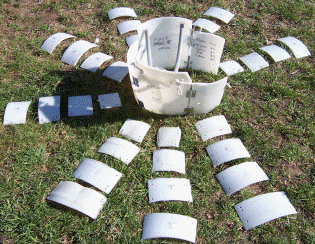
This is the entire suit, unstrung prior to painting. |
| This is a closeup of the corselet (chest protection). The gray things are actually lengths of garden hose, through which I ran ropes to hold up the armor. When worn, the weight rests on your shoulders. | 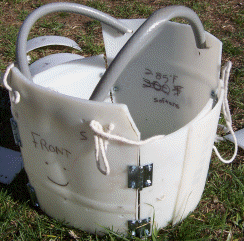 |
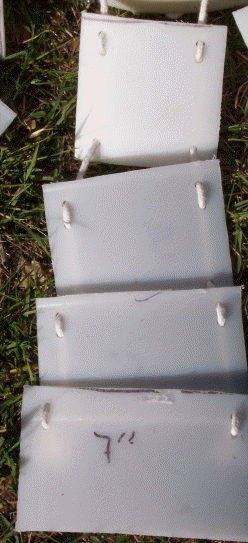 |
The hip guards are made up of four plastic plates, each slightly larger than the one before, and tied together to hang from the torso piece. Technically, you don't need hip protection...but I got hit too many times in the hip, and while I was never injured, it really hurts... |