By the early 1980s, little American Motors was on the ropes. After years of losing money, too many instances of building the wrong cars at the wrong time (the downfall of many an independent automaker) and a failing marriage to Renault, which produced such memorable econoboxes as the Alliance and Encore, it was time to either put up or shut up ... or shut down, which was starting to look more and more probable. AMC did have a couple of bright spots in this otherwise gloomy picture: The company was doing moderately well with the pioneering 4WD Eagles (particularly in station wagon form), and, of course, there was Jeep.
Since AMC's purchase of Jeep from Kaiser in 1970, the storied maker of 4-wheel drives had been almost constantly the major breadwinner for the company. Even in the years of losses, it was Jeep that kept the financial picture from becoming truly ugly. In fact, some analysts on Wall Street and even a few executives within AMC wondered aloud (if anonymously) if it might not be a good idea for AMC to drop cars altogether and concentrate on Jeep.
But that isn't to say that Jeep didn't have its own problems. The 1979 oil crisis threatened to do to Jeep what the marketplace was doing to AMC's car lines. The crisis forced AMC to link up with Renault to engineer new products that would sell in the new, more fuel-efficiency-oriented economy. Renault assisted in developing the 1984 XJ Cherokee and Wagoneer Sportwagons, which, while smaller than previous models, were just as capable and sold literally as fast as the men and women in Toledo could build them.
The classic Grand Wagoneer hung around, despite its low fuel economy, because folks in high society still demanded the big luxury and capability it provided. It continued to rack up huge profits even on just 20,000 to 29,000 sales per year, mainly because its tooling had long ago been paid for.
But the one weak link in the chain that hadn't been repaired as of 1984 was in the pickup truck segment. Jeep's long-serving full-size pickups, the half-ton J10 and three-quarter-ton J20, just wouldn't sell. The main reason why is simple enough. The J-trucks had been on the market without a major design change since their introduction in 1963, and 21 years is an absolute eternity by automotive standards. While age wasn't really a problem for the related Grand Wagoneer because it was still popular and profitable with all its luxury gadgets, it was a very big problem for the plainer trucks. They played in a different league, and they just couldn't match the more-modern engineering of the Big Three's full-size pickups.
It also didn't help that the J-trucks were gas-guzzlers of the kind that only an OPEC oil minister could love. With its standard 360-cubic-inch V8, the three-quarter-ton J20 could, on a good day, deliver perhaps 10 to 12 miles per gallon out on the open road. And the half-ton J10 wasn't much better, even with its standard six-cylinder and four-speed stick.
So it was obvious that Jeep sorely needed a new truck, but the folks in charge at AMC wisely decided to leave the full-size market to Ford, GM and Chrysler. Instead, they would build a truck to compete head-to-head with the lowest-priced trucks around -- the compacts. They would, out of necessity, have to do it cheaply, but they'd also have to do it right. There would be no second chance. The money simply wasn't there ... nor the time.
And there was another issue: Jeep's new little truck would have to be improved in almost every way when compared to the soon-to-be-departing CJ-8 Scrambler, which had been introduced in 1981. Based on the CJ-7 but with a longer wheelbase, the Scrambler seated two and had a very short bed, barely five feet long. Despite its layout, for some reason Jeep didn't initially advertise Scrambler as a truck (and they wouldn't until '83), which caused some confusion as to what it really was. What Scrambler was, in point of fact, was a "lifestyle vehicle," something that would be completely at home in today's market. In the '80s, however, Jeep's little CJ pickup simply didn't have anything to recommend itself over competitive trucks, and sales suffered accordingly.
With Scrambler's failure fresh in their minds, the team at Jeep decided to make the new Comanche as innovative as possible, but without making too many waves. In their search for the right path to take, Jeep's designers and engineers drew some inspiration from a stillborn compact Jeep pickup concept from the early 1970s that was to have been called the Cowboy.
The Cowboy prototypes that were built had been based on the stalwart AMC Hornet. In order to save on the cost of tooling for that proposal, AMC's engineers cleverly designed a rear subframe on which the separate cargo bed would be mounted. It was a great layout and many believed it would be a sure-fire winner for Jeep. However, sales of the Hornet were so strong in 1973 that AMC decided it would be best to concentrate on the four popular Hornet body styles already on the market instead of creating another distinct body type that might not sell well. It was probably a wise decision, because the car-based pickup market (which the Cowboy would have competed in) all but vanished in the late '70s.
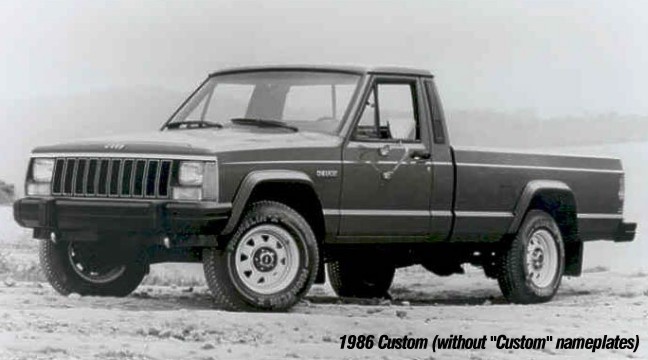
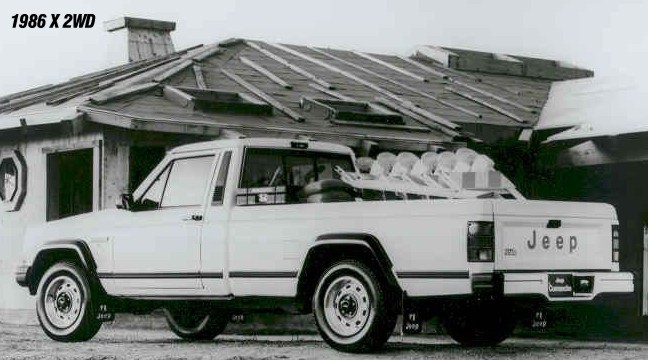
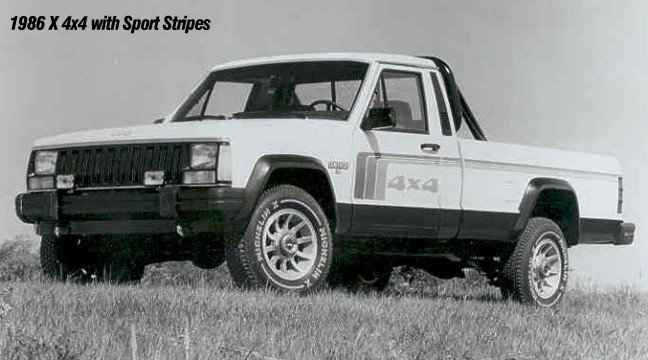
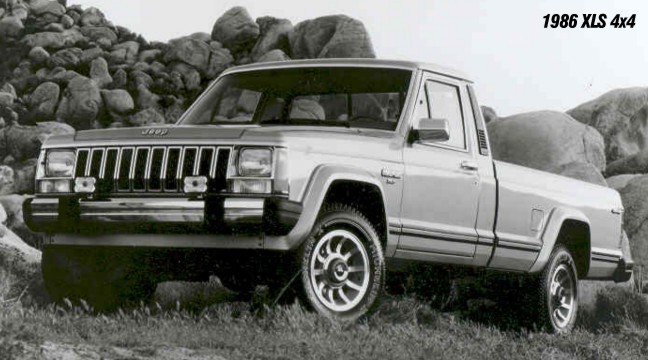
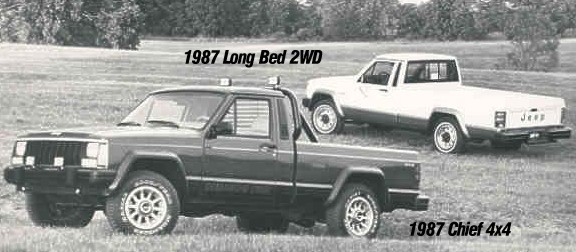
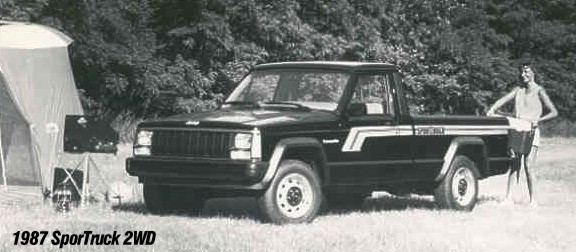
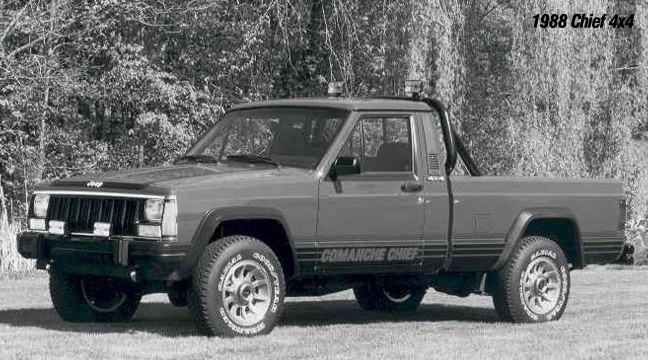
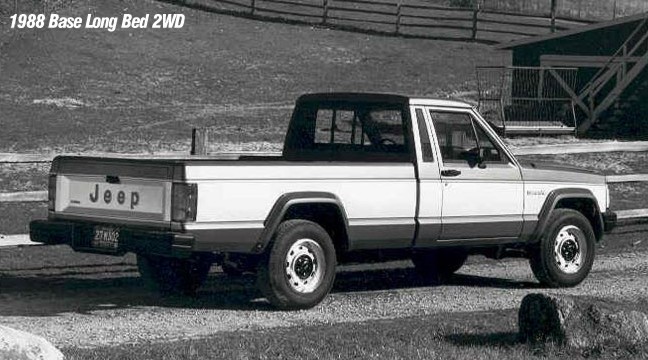
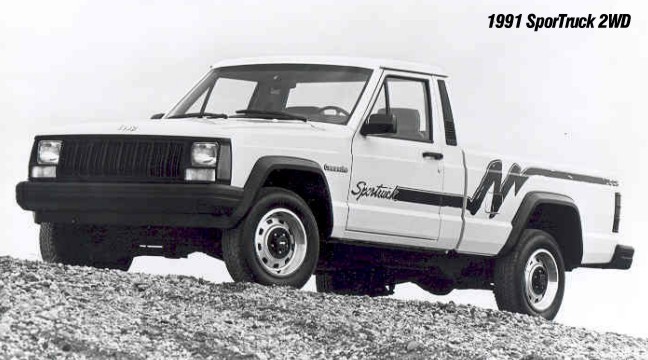
More than a decade would pass before the Cowboy's ingenious type of construction, though modified to some degree, melded seamlessly with the XJ Cherokee's sturdy UniFrame front body structure and handsome, angular styling, that was finally put to use for the Comanche, which debuted in the fall of 1985 as a 1986 model.
The result was -- and still is -- very pleasing to look at, fun to drive, tough as nails and just as timeless in its design as the original Jeep. And, true to its Jeep heritage, the Comanche looks just as good covered in mud as it does with a showroom shine!
Even today, nearly 15 years after production of what became the last Jeep pickup truck ended, there is a group of Jeep fans across the country who love their little trucks, and since there are many parts that are common to both the Comanche and the XJ Cherokee, strong aftermarket support, and clubs like ComancheClub.com online, these folks should expect to continue their passion for these fine trucks long into the future.
This website is dedicated to those fans, and that one special truck we all love.
There's only one Jeep Comanche. |