| Jeep wasn't about to rest on its laurels for Comanche's second model year. Having brought home Four Wheeler Magazine's 1986 "Four Wheeler of the Year" award, the marketing and engineering teams -- especially the engineers -- were working hard behind the scenes to make the already-good Comanche even better for 1987 through some minor changes ... and a major power infusion. The model lineup was changed from 1986's Custom, X and XLS to Base, Chief, Pioneer and Laredo. This move made Comanche's model lineup roughly equal to that of the Cherokee. Customers and dealers had been clamoring for a shortbed model to compete with the Ranger and S-10, so Jeep unveiled one for '87, immediately putting on the style show with the new SporTruck appearance package for the Base model, and the flashy 4x4 Chief. Both were available at the beginning of the model year solely in shortbed models*, while, conversely, the new top-of-the-line Laredo came only as a longbed. Inside the cab, the marketing staff promoted Comanche's wide variety of available features, such as the comfortable wingback bucket seats and luxurious-looking trim. During the '80s, the pickup truck as personal transportation had become the latest thing to have, and Jeep was, as usual, at the forefront of innovation. In fact, when properly optioned, a Comanche Laredo could be as luxurious as any American luxury car ... and Lord knows the Comanche was a lot more capable, on or off the road. But it was under the hood where the big changes were made, and they were welcomed with open arms by the Jeep faithful. The standard 2.5-litre four-cylinder found its horsepower raised by four, to 121. Not that it really needed the help -- Jeep's four was already far and away more powerful than the fours offered by GM and Ford in their small trucks. Not even the new-for-'87 Dodge Dakota's four (which was really the old K-car engine) could come close -- it wheezed out just 96 horsepower. Taken against the competition, the Comanche was obviously the "hot rod" of the four-cylinder field. And it didn't stop with the four-cylinder. There was a new six-cylinder engine, and it was drawing a lot of attention to Comanche for '87. No longer would Jeep buyers have to swallow their pride and settle for the mediocre 115-horse Chevrolet 2.8-litre V6 as the "step up" option. Into the 2.8's place on the option sheet strode Jeep's new in-house-designed-and-built Power-Tech 4.0-litre Six. No other U.S.-built six of the time could even approach the Power-Tech's 173 horsepower, nor its smoothness and durability. Better still, the 50% increase in horsepower and 47% increase in torque came at no penalty in fuel economy. Most owners happily reported noticeably better fuel economy than what had been delivered by the V6. For diesel lovers (whose numbers must have been few), the Renault 2.1-litre turbo diesel was still around as an option on two-wheel drive longbed models, at least for part of the model year. While it delivered only 85 horsepower, it had a good torque output and was very fuel efficient. Unfortunately, diesels were, by this point, well and truly out of favor among customers in the U.S., with the blame for that falling to GM's poorly-designed, unreliable V8 diesels of the late '70s and early '80s. Few Comanche diesels were sold, although the exact number isn't available. And it didn't really matter, anyway. While it's not certain when the engine was dropped from the options list, it's generally believed that it went away before the end of the model run. Even the transmission lineup saw some changes. The Chrysler three-speed TorqueFlite was broomed, and in its place was the new Aisin-Warner AW-4 four-speed electronically-controlled unit. This advanced new transmission had selectable "power" and "comfort" shift schedules and included an overdrive fourth gear for economy, and it was available with both the 2.5 and 4.0 engines. The Peugeot-built BA-10/5 five-speed stick that was standard equipment with the new 4.0 was new, too. Trucks equipped with the 2.5 kept the choices of the Aisin AX-4 four-speed and AX-5 five-speed. The AX-5 was the only transmission available with the diesel. With all of the powertrain developments, Jeep didn't need to make many other changes, so with the exception of a few very minor trim changes (such as new badges, which now resembled those of the Cherokee and Wagoneer), few were made. Newly available on the options list were money-saving "Preferred Option Discount Groups," or option packages, which we take for granted today since everyone now offers them, but it was just another example of the Jeep marketing folks "thinking outside the box" in 1987. All in all, 1987 was a great year for Comanche. The new SporTruck and Chief established a beachhead against the Ranger and S-10 shortbeds, while the new Laredo longbed proved beyond a doubt that "luxury" and "pickup truck" need not be mutually exclusive terms. The Comanche seemed to be on a roll ... but there were clouds on the horizon for 1988 and beyond. |
 |
| FOOTNOTES: * While it is generally accepted (believed?) that the '87 SporTruck was a short-bed-only model, at least one long-bed (with the 4.0 and BA-10/5 powertrain) is known by the Webmaster to exist in Texas. Is this an owner modification or are there others somewhere out there? |
| THIS PAGE LAST UPDATED 12/1/06 |
 |
| 1987 Comanche Colors & Trim |
| EXTERIOR COLORS (all paints are clearcoat, metallics & two-tones extra cost) |
| INTERIOR TRIM |
| Hunter's Plaid Fabric Celtic Grain Vinyl Premium Vinyl Mesa II Fabric |
| Standard on Laredo Colors: Tan, Cordovan (Cordovan shown) Standard on Base Colors: Black, Blue, Tan, Cordovan (Tan shown) Standard on Pioneer & Chief with bench or bucket seats; Optional on Base with bucket seats Colors: Black, Blue, Tan, Cordovan (Blue shown) Optional on Base, Pioneer and Chief with bench seat Colors: Black, Blue, Tan, Cordovan (Black shown) |
| Home Page |
| Ahead to 1988 |
| 1987 Comanche Dimensions & Specifications |
LENGTH WIDTH OVERHANG HEIGHT INTERIOR COMPARTMENT CARGO COMPARTMENT TURNING RADIUS, Curb to Curb |
| DIMENSIONS (shown in inches, except where otherwise noted) |
Wheelbase Overall length (w/o rear bumper) Tread (front/rear) Overall width (at rear wheel flares) Front Rear (w/o bumper) Overall height-curb Clearance, rear axle to ground Angle of approach (Degrees) Angle of departure (Degrees) Breakover angle (Degrees) Headroom Legroom Shoulder room Hiproom Overall length at floor Overall width at floor Width between wheelhouses Width of tailgate opening Box depth Cargo volume (cu. ft.) Feet |
| Shortbed 4x2/4x4 113.1/112.9 179.3 57.0/57.0** 71.7 27.5 38.7/38.9 64.0/65.0 7.5 40.6/42.2 30.5/32.0 22.7/24.9 39.2 39.9 55.3 55.3 73.7 60.0 43.8 52.5 16.4 38.6 39.3 |
| Longbed 4x2/4x4 119.6/119.4 194.0 57.0/57.0** 71.7 27.5 46.9/47.1 63.7/64.7 7.5 39.8/41.5 24.8/26.1 21.5/23.7 39.2 39.9 55.3 55.3 88.5 60.0 43.8 52.5 16.4 46.4 41.3 |
| SPECIFICATIONS |
| AXLES/SPRINGS/SUSPENSION -- Front: Solid axle with 4 locating arms. Single cardan outboard joints and live spindle hubs (with shaft disconnect system on 4-wheel drive, Command-Trac). Coil springs. Stabilizer bar, steering damper and dual action shock absorbers. Standard axle ratio 3.55:1. -- Rear: Solid axle, semi-floating open-end Hotchkiss design. Multi-leaf springs. Dual action shock absorbers. Standard axle ratio 3.55:1. BRAKES -- Front: Low-drag ventilated disc, with power assist. -- Rear: Drum, self-adjusting with power assist and high load sensing variable rate rear brake control valve. CLUTCH -- 9.1" diameter disc with hydraulic actuation. ENGINE -- Standard: 2.5 litre (150 CID), 4-cylinder; 9.2:1 compression ratio, electronic fuel injection. -- Optional: 4.0 litre (242 CID), I-6; 9.2:1 compression ratio, multi-point fuel injection. -- Optional: 2.1 litre (126 CID), 4-cylinder turbo-diesel; 21.5:1 compression ratio. FUEL TANK -- Standard: Shortbed, 18-gallon capacity. Longbed, 16-gallon capacity. -- Optional: Longbed, 23.5-gallon extended-range. STEERING -- Standard: Recirculating ball type; manual with 24:1 ratio. -- Optional: Recirculating ball type; variable ratio (14:1) power assist. TRANSFER CASE, 4WD MODELS -- All models: 2-speed NP 231 manual, with shift-on-the-fly capability; includes low range (2.6:1) TRANSMISSION -- Standard, Base & Pioneer shortbed: Full synchromesh 4-speed floor shift manual. -- Standard, Chief & Laredo, Base & Pioneer longbed: Full synchromesh 5-speed overdrive floor shift manual (optional on Base & Pioneer shortbed). -- Optional: 4-speed automatic overdrive column shift with lock-up torque converter (requires bench seats; and power steering, with 4WD) -- Optional: 4-speed automatic overdrive floor shift with lock-up torque converter (requires bucket seats; and power steering, with 4WD) WHEELS -- Standard, Comanche Base: Four 15" x 6", 5-lug, argent styled steel with black hub covers (Base shortbed model [SporTruck] includes bright trim rings). -- Standard, Comanche Pioneer: Four 15" x 6", 5-lug, argent styled steel with bright trim rings and black hub covers. -- Standard, Comanche Chief: Four 15" x 7", 5-lug, white styled spoker with bright hub covers. -- Standard, Comanche Laredo: Four 15" x 6", 5-lug, argent styled steel with bright trim rings and bright hub covers. |
| ** Tread width 58.0 inches when equipped with 15" x 7" wheels |
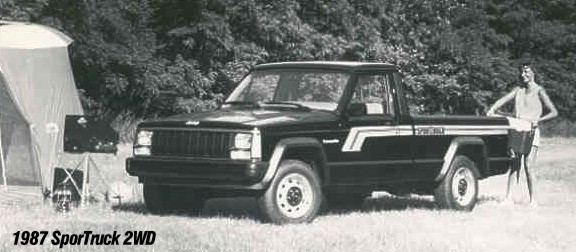 |
| The new Comanche SporTruck shortbed, shown at left, hit the showrooms in 1987 priced at just $6,495, and instantly heated up the low-price battle. |
 |
 |
 |
 |
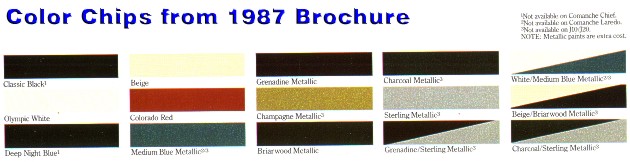 |
| N/A on Chief: Classic Black, Deep Night Blue N/A on Laredo: White/Medium Blue Metallic, Medium Blue Metallic |
 |