| Once Upon a Dream |
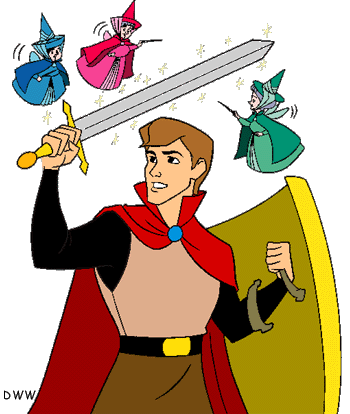
| Prince Philip marks the first time that a Disney Prince played a central role in the story. Unlike the Prince Charmings before him, Philip would meet his beloved earlier in the story and then play an important role in rescuing her as he had to fight Maleficent before he could awaken Aurora with true love's first kiss. The climactic battle in the film marked a departure from earlier Disney films as the heroes were in true peril. Maleficent's transformation into a fire breathing dragon raised the bar for Disney villains thereafter. The three good fairies, Flora, Fauna, and Merryweather provide much of the humor in the film and play a crucial role in helping protect Aurora from Maleficent as long as they can in addition to aiding Phililp in his fight against Maleficent. Disney animators found inspiration for the fairies by observing old ladies at the grocery store. |
| Work on Disney's Masterpiece began in 1951 when Disney gave the film a story treatment. Disney's treatment is based off the Charles Perrault version of the story. Walt would often act out the entire story for his animators to see in story meetings. He had originally planned to make the film after Snow White and the Seven Dwarfs, but felt the technology to make it the way he envisioned was not yet available. Walt Disney decided to use veteran artist Eyvind Earle, who had already worked on Lady and the Tramp, to draw the backgrounds for Sleeping Beauty because of Earle's experience with medevial art. Disney wanted the film to look as if it had taken place in the 14th Century and the resulting medevial influence gave the film's backgrounds remarkably rich backgrounds where even the texture of the castle walls could be seen. Earle was also in charge of ensuring that the film fit visually. The end result is a Disney film that looks like no other Disney film ever made. Even today, nearly 50 years after it's release, Sleeping Beauty holds it's own visually against modern animated films made with the most recent technology. |
 |
| How I fell in love with Sleeping Beauty. |
| Of all the things I enjoyed as a child, only two of them still capture my imagination in adulthood, Disney and Star Wars. I suppose this is in part because my parents, not big movie goers themselves, did take me to see all the Star Wars movies and Disney movies in theaters. Sleeping Beauty was the one Disney film that I watched over and over again in my youth. I loved the music inspired by Peter Ilych Tchaikovsky's ballet of the same name, the rich and lush artwork throughout the film, the sweet innocence of Princess Aurora, and the courage of Prince Philip as he battled Maleficent to wake Aurora from her sleep. As a young adult, I would serve a volunteer church mission in Moscow, Russia. Looking back on that experience, I realized that Walt Disney's work which featured Russian classical music helped me develop an appreciation of Russian culture long before I was asked to serve there, and Sleeping Beauty was a big part of that. To be sure, I enjoyed the other Disney fairy tales, but there was something different about Sleeping Beauty. Maybe it was that Aurora was the first Princess I fell in love with. Maybe it was that she wore blue, my favorite color. Maybe it was the fact that Phillip was the first Disney Prince who actually had something to do in order to win the heart of his Princess. Whatever it is, the film has inspiried my imagination and dreams for years. |
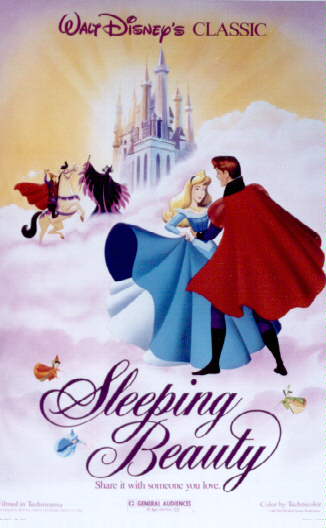
| The 1986 Release Poster |
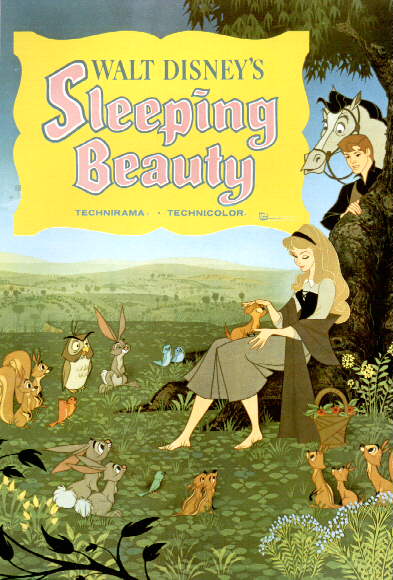
| My favorite of the 1959 Release Posters |
 |
 |
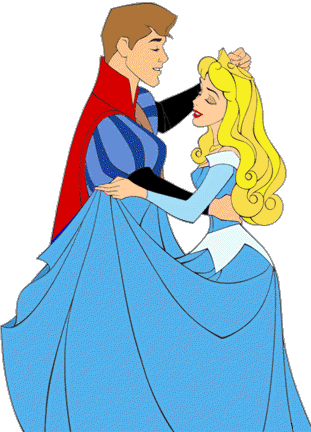
| George Bruns received an Oscar nomination for Best Music in Scoring a Motion Picture for his adaption of Tchaikovsky's ballet of the same name. One of the things that makes Sleeping Beauty different is how music is used to actually tell the story. In a departure from most Disney animated features, the story is advanced more through the film's score than the songs. The only true song in the film is the signature piece, Once Upon a Dream, to which Aurora and Philip dance in the forest both unaware of the other's true identity and their relationship to each other, and again at the end of the film after Prince Philip has awakend the peasant girl who was born a Princess. All the other songs in the film are very short pieces describing the events seen onscreen sung by an invisible choir. I trace my appreciation of classical music to Walt Disney's use of Tchaikvosky's Sleeping Beauty ballet in making his masterpiece, the last fairy tale produced by Walt Disney himself. |
 |
 |
 |