

(Click thumbnails for full-sized images).
Trip to the Freer and Hirshhorn Galleries (6.28.03)On a whim, Jason, Trinh, Norman, Ellen, and I decided to visit some art museums one beautiful D.C. Saturday. We started at the Freer Gallery, which primarily houses Asian art, then moved on to the Hirshhorn, which has pop/contemporary art and sculpture. Two apologies about the picture quality—it was my first time using my digital camera (shoutout to the Canon Powershot A70! yeah I'm a nerd!), so sometimes the pics are a little fuzzy, on top of which we weren't allowed to use flash on some of the exhibits, which made those shots come out kind of unclear. It'll get better with time, I promise—and anyway, I'm going to go back soon enough to get some photos of those awesome Chinese scrolls. | ||
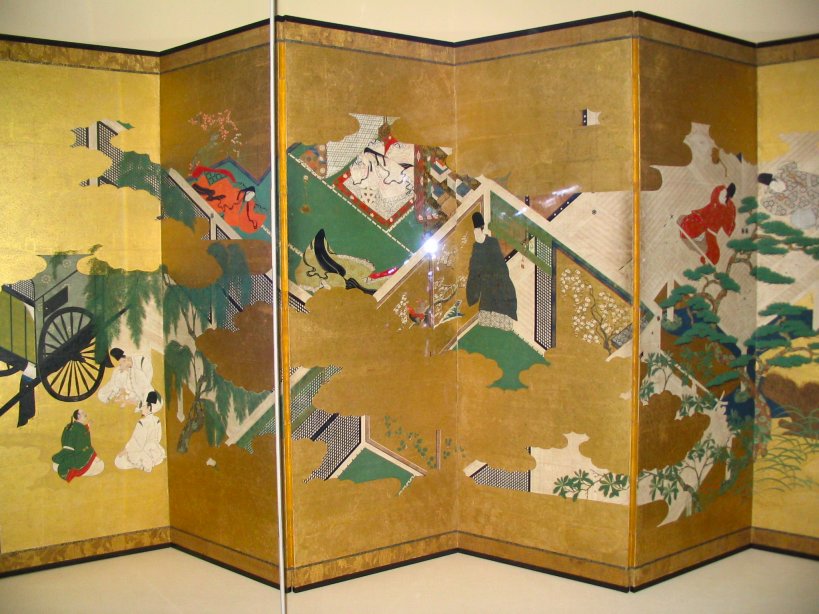 This Japanese screen details scenes from Murasaki Shikibu's 11-century epic, The Tale of Genji. This particular screen bears a striking resemblance to the woodcuts used to illustrate the Seidensticker translation of Genji—notice especially the thick golden clouds that seem to veil each scene with a sense of mystery, the bird's-eye perspective that allows onlookers to peer down into private interactions, and the overall emphasis on interplays between voyeurism and secrecy. |
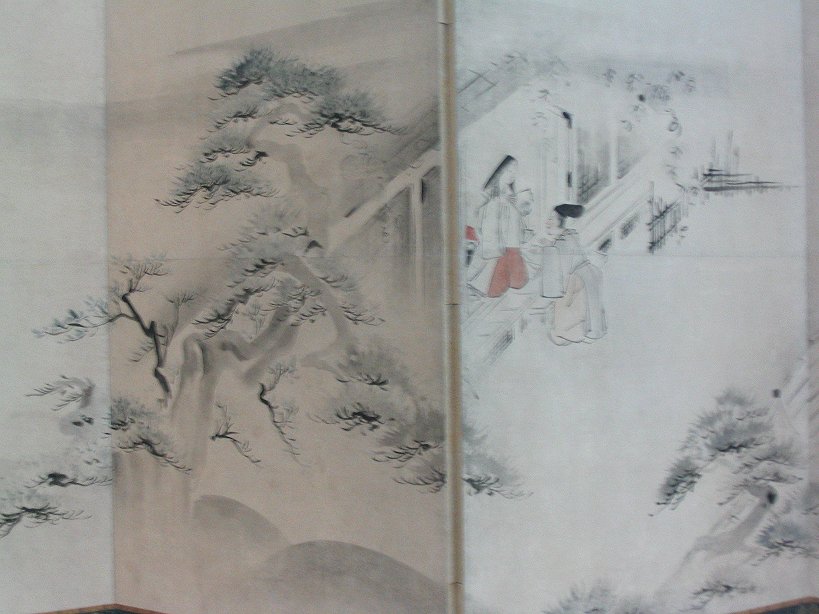 Here's another Genji screen, this one apparently depicting an episode in Chapter 6 ("Aoi," or "Heartvine"). This is obviously a different artist, but more interestingly, notice how the screen as an artistic medium can make use of a more monochromatic black-and-white palette just as well as it can a bolder mixture of colors. |
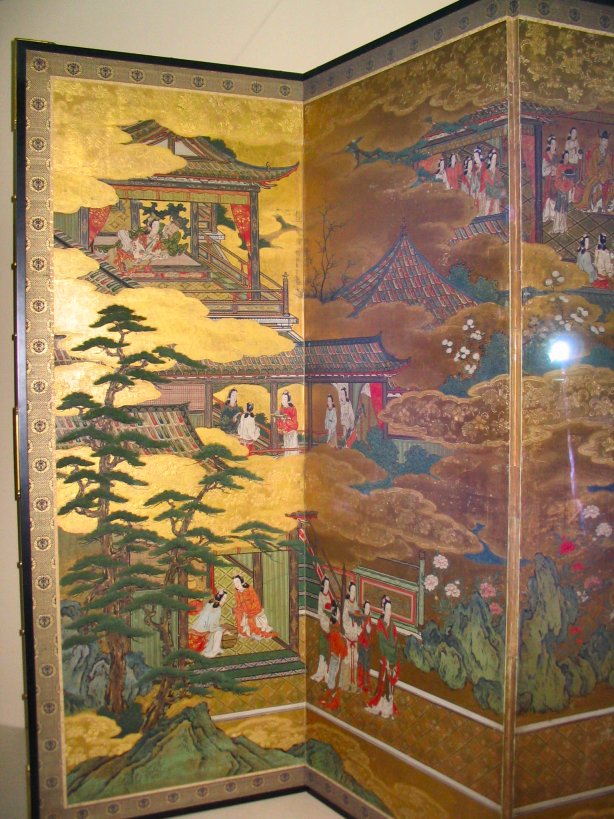 Two panels of a Japanese screen depicting an episode of "The Song of Everlasting Sorrow," a poem by Po Ch�-i. As far as I can remember, the poem describes the T'ang emperor's grief after the death of his beloved concubine, Yang Kuei-fei, and it exhibited a strong influnce upon Japanese poetry and culture. |
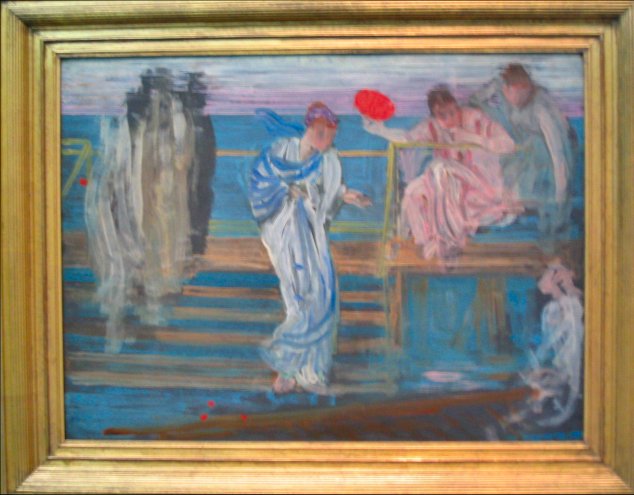 For some reason this Whistler painting, Symphony in White and Red (c. 1868), made a strong impression on me. Perhaps it was because of the thoughtful monograph on the wall, which mentioned Whistler's devotion to the notion of aestheticism—"art for art's sake"—which made me think about whether art can ever truly be disinterested (apolitical, ahistorical, etc.), and if so, what precisely constitutes "art"... beauty? symmetry? hoi? Anyway, it just struck me as very graceful and poised. |
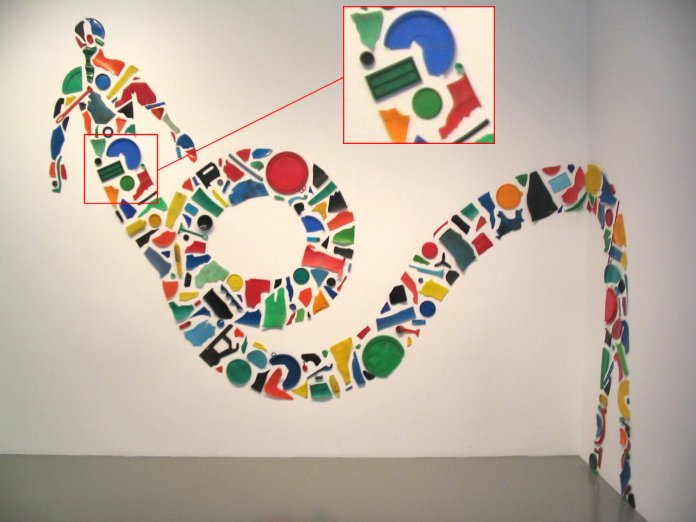 This was a cool piece from the Hirshhorn—a bunch of colored plastic fragments that have been arranged on the wall to form some sort of serpent-man. The inset shows a part I zoomed in on to give you a better sense of what the little scraps actually looked like. Sorry—didn't catch the artist or the piece's name. |
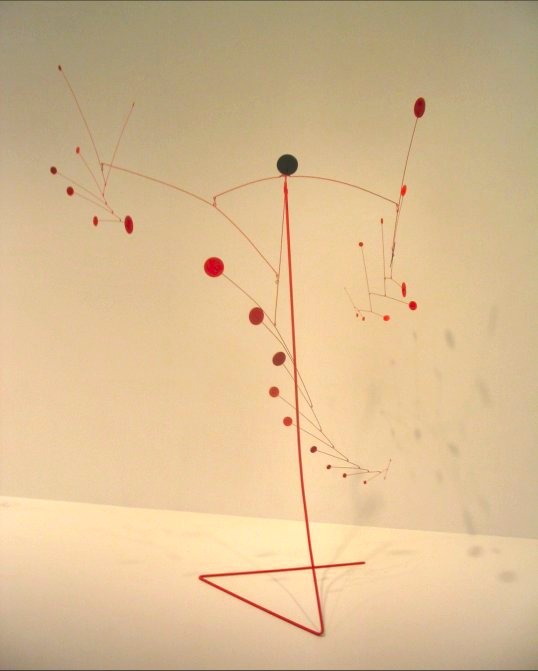 I thought this mobile-sculpture was kind of cool, too, in a science-fair type of way—all the little red circles cascading downward. It's called, appropriately enough, Red Cascade (1954), and it was made by Alexander Calder, who had a bunch of other pieces there too. |
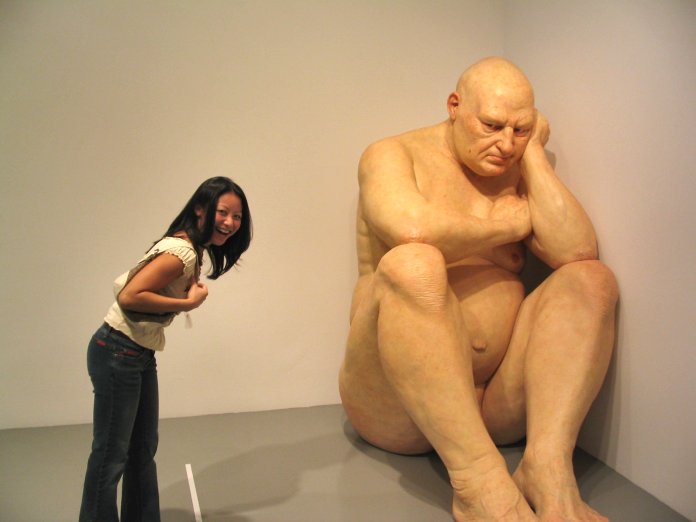 There's Trinh to give some sense of scale—for some reason, she loved this huge sculpture. While I thought it was cool (and very realistic), I also found it to be just a tad creepy. The title was something like "Big Man." |
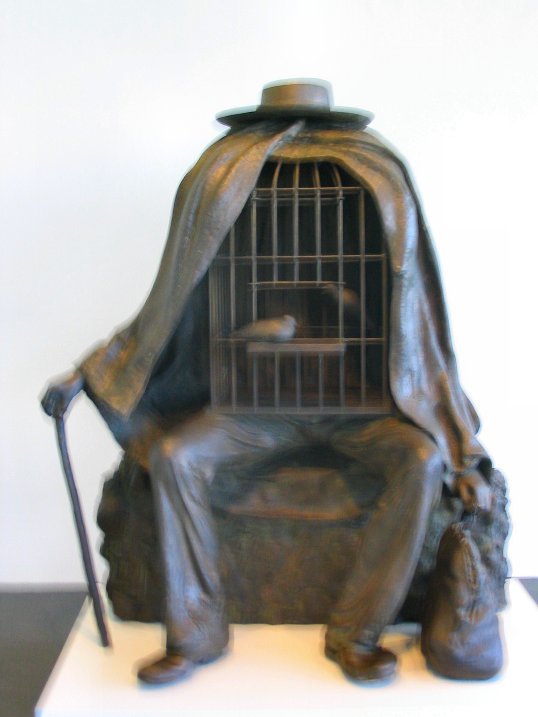 This sculpture by Ren� Magritte quickly caught my eye, especially after I saw that it was called The Healer (1967). What does it mean?? (Sorry about the shaky camera hand!) |
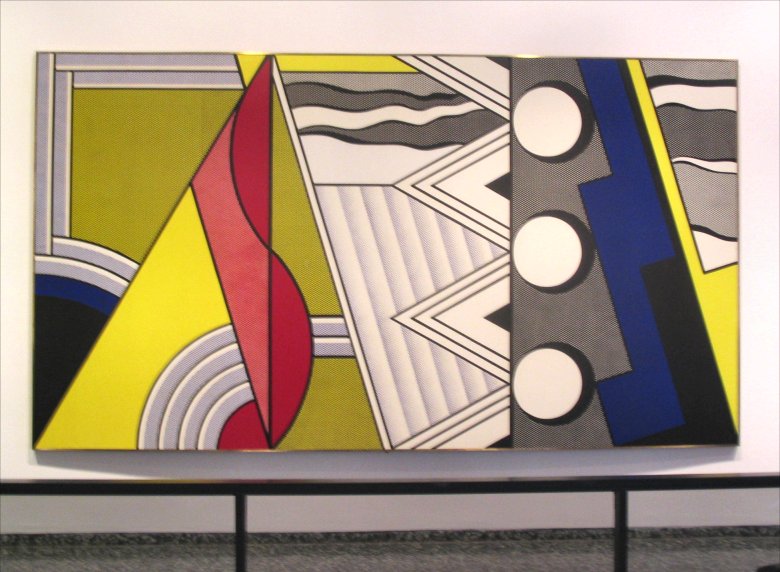 A Roy Lichtenstein, as you can tell by the little comic-strip dots—but I found the title especially intriguing: "Modern Painting with Clef" (1967). The clef is visible slightly left of center, and I think there are a lot of implied musical motifs sprinkled around the rest of the painting. It reminds me of a piece at the Yale Art Gallery whose name escapes me right now. |
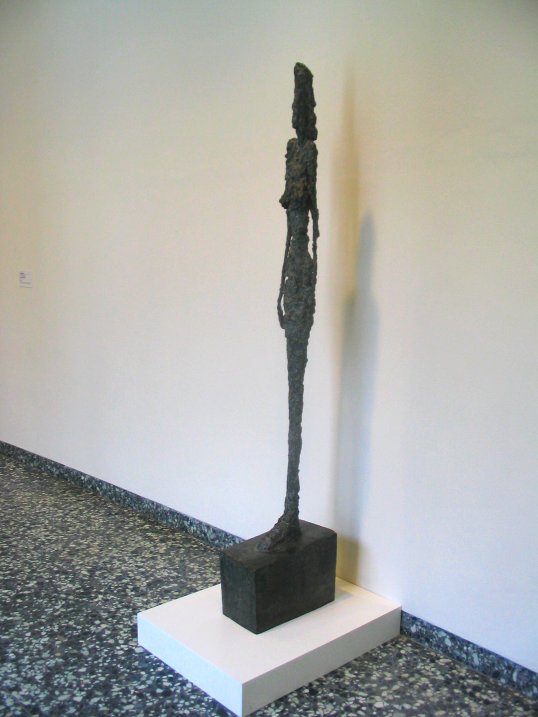 One of Giacometti's "Thin Figures." They have some of this guy's sculptures in the modern bronze exhibit at the Yale Art Gallery as well... wouldn't it be cool to have one of these in your house? |
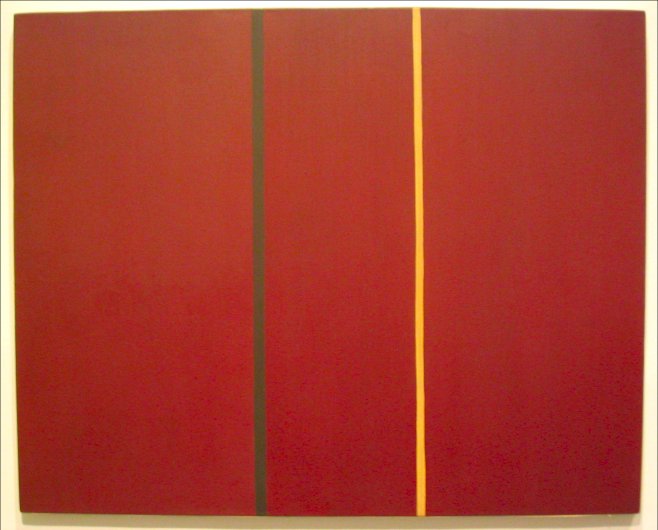 This is the type of art I have the most trouble understanding. This particular painting, by Barnett Newman, is entitled Covenant (1949). I snapped a photo in part because we talked about this exact piece in my Philosophy of Modern Art class. (We also talked about this other Newman piece that got slashed by some lunatic-artist, and the ensuing controversy over whether the mutilated painting constituted a new piece of "art" because it was an expression of the lunatic-artist's rage, etc. etc.—but that's a whole other story). |
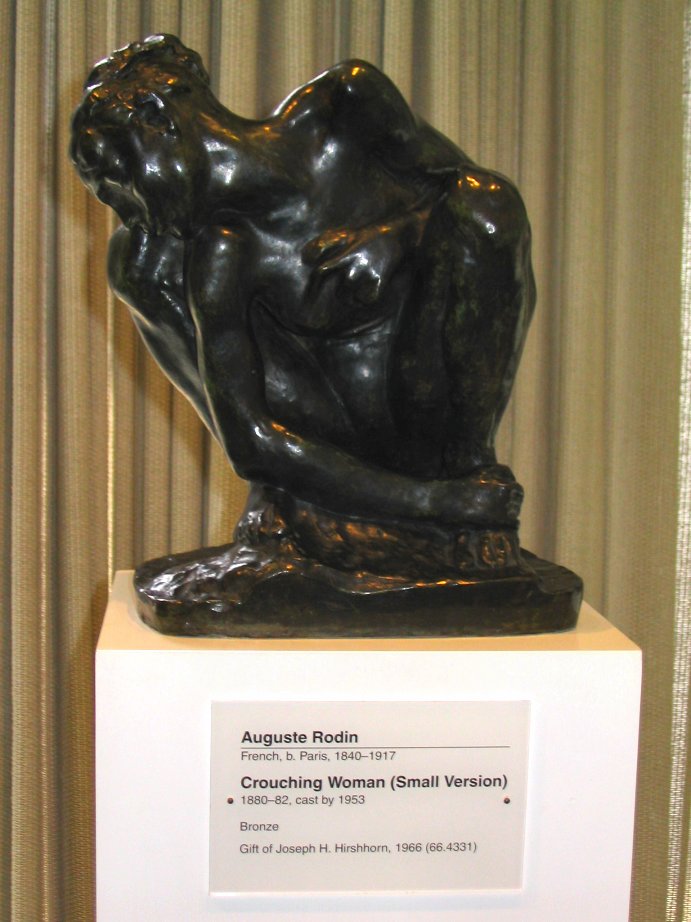 A Rodin sculpture. I'm interested in Rodin because of his strong influence on the poetry of Rilke. Anyway, this one caught my attention—you'll definitely have to click on the thumbnail to make out any details in the woman's face. |

|
