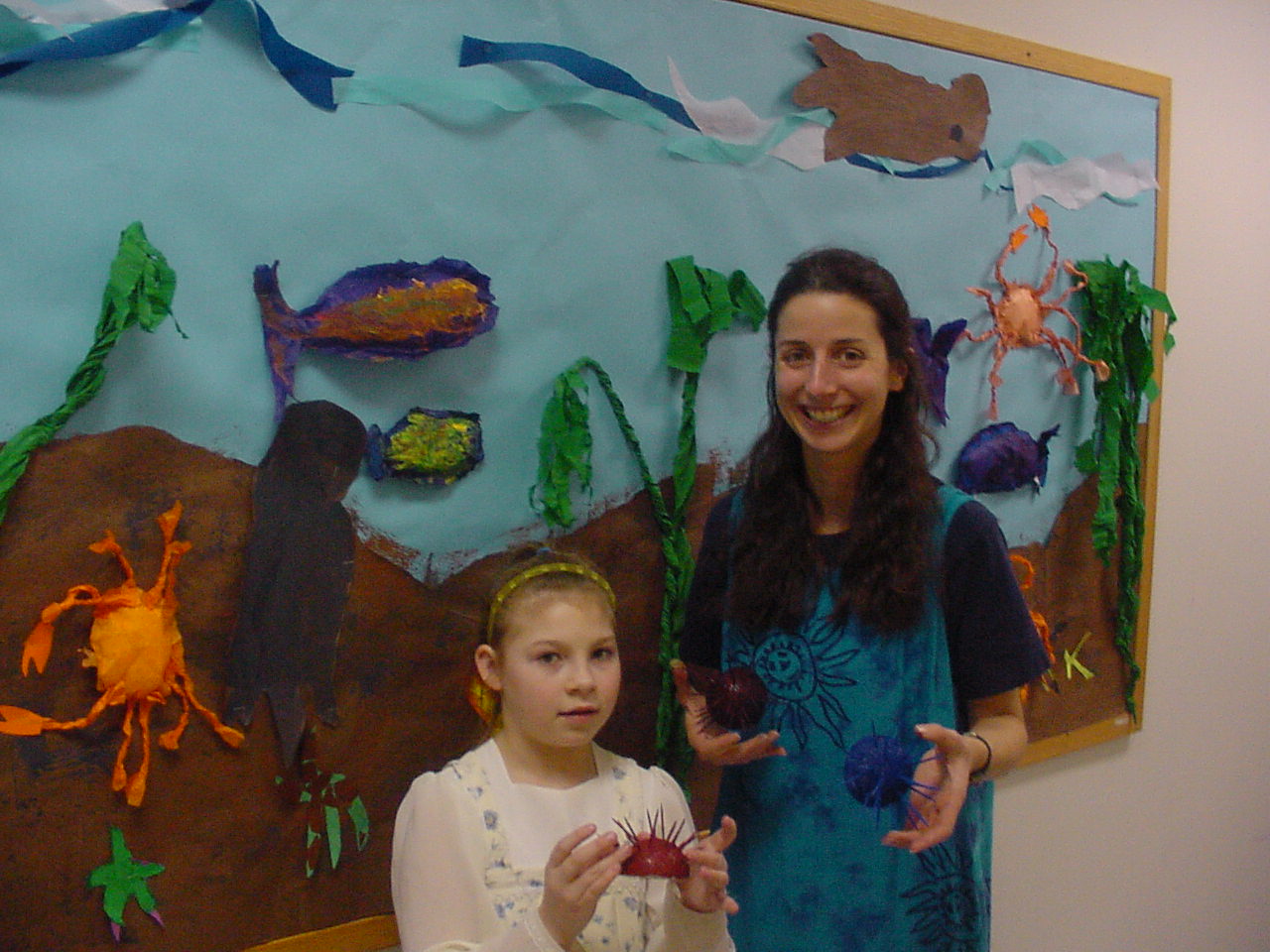
Ms. Chapple and student with sea urchins in "Sea Otter Paradise"
 Adventure Guide
 Choose
a topic to learn about my teaching experiences.
Choose
a topic to learn about my teaching experiences.
Teaching Adventures
Philosophy of Education
Resume
Insect Unit
Light Lessons
Seasons and Weather Lessons
Multicultural Traditions Lessons
Recycling Lessons
Oceans Unit
Teaching
Adventures
I grew up on the shore of Kachemak Bay in Homer,
Alaska. Spending my childhood on the narrow strip of gravel called
the Homer Spit, all sand and sea grass in summer and snow drifts
and high surf in winter, fostered my love of the outdoors and adventurous
spirit. I embraced the opportunity to travel to the bush to begin
my teaching adventure.
It seemed natural for me to travel for my first
teaching positions because I have always been intrigued by different places
and cultures. My positions in Goodnews Bay and Seldovia provided incredible
learning experiences on both personal and professional levels. Living in
these remote villages allowed me to share my love of the wilderness with
students, and pursue my personal interests in outdoor recreation and education.
My background in athletics was an asset to these small schools and I thrived
on the challenge of getting students involved in new experiences.
My varied teaching experiences over the past six
years have helped me establish a strong foundation of teaching methods.
I have had the opportunity to teach at primary and intermediate multi-age
classrooms. I have seen the positive effect of building confidence
in students and involving parents in education. I understand the
dedication and effort that is necessary to help students be successful
in school and in their community. I have also learned that support
and collaboration among the education team is essential to create the most
positive learning atmosphere.
I look forward to my next teaching adventure!
Ms. Chapple and student with sea urchins in "Sea Otter Paradise"
Philosophy of Education
Learning is an adventure that requires
a commitment from parents, students and teachers. The adventure demands
meaningful experiences, communication and mutual respect. It is the
responsibility of the teacher to create an environment where children can
become actively engaged in exciting and relevant learning activities.
Children have individual needs and varied strengths and weaknesses.
It is essential for educators to be sensitive to these needs when designing
instruction. In my lessons I use learning strategies that allow students
to see, hear, say and do.
On a well guided adventure children will develop
self-esteem and positive attitudes. Experiencing success nurtures
these attributes. If children feel capable they will be more willing
to try. We educate children so they can acquire basic skills to become
successful, responsible citizens but it is equally important for children
to be self motivated so they become independent life-long learners.
The class is a team in which children can
strive to reach their individual potential and work cooperatively toward
group goals. To feel connected to the team, individuals need
to contribute. Sharing ideas and experiences builds a bond that helps
each member feel valued. Showing concern and respect for others strengthens
this bond and builds self-confidence.
The school staff is also a team. Collaboration
and frequent communication is essential to effectively reach each student
and facilitate quality educational programs. As an educator I want
to be part of a team that is committed to and excited about education and
open to innovative ideas. Adults need to model the values we teach
to children and that means showing appreciation for efforts of others and
respect for differing opinions.
I want my students to feel self-assured
enough to take risks on their learning adventure. My goal as a teacher
is for each of my students to leave my class confident in their skills
and abilities and proud of their achievements.
Teaching Adventures
Philosophy of Education
EDUCATION
University of Alaska, Anchorage, AK
Bachelor of Education, and Elementary Education
Minor: Sociology and Psychology
Graduated with honors, December 1995
Western Oregon State College, Monmouth, OR
Elementary Education Major, March 1993
SUMMARY OF QUALIFICATIONS
* Adept in reaching students’ developmental and academic needs through
varied teaching methods.
* Strong leadership and classroom management skills.
* Experience in integrating computer technology with instruction.
* Training in reading and writing instruction and assessment.
* Positive contributor to a collaborative education team.
EXPERIENCE
August 2000- present
Multi-age Team Teacher (Grades 1 and 2)
Kenai Peninsula Borough School District, Voznesenka School, Fritz Creek
* Collaborated with cooperating teachers to design a flexible grouping,
multi-age learning environment.
* Created and maintained a class web page for the second grade students.
* Utilized a variety of interventions strategies and intervention team
recommendations to assist students in meeting academic and social goals.
* Established positive communication with parents in order to maintain
the unique cultural values in the classroom.
* Developed a primary, standards based report card and assessment portfolio
as a supportive member of the Quality School Initiative..
* Designed and taught 6 interdisciplinary, theme units and resource
totes based on district curriculum and Alaska States Standards.
October 1999 – May 2000
Middle School Teacher (Grades 7 and 8)
Kenai Peninsula Borough School District, Homer Middle School, Homer
* Prepared lessons and taught classes in Physical Education, Social
Studies, and Reading.
* Participated in daily teaching team meetings to develop integrated
curriculum and establish interventions plans for at risk seventh grade
students.
* co-authored the Remediation Grant and distributed funds between remediation
classes and after school programs.
* Designed Accelerated Reading and Study Skills course curriculum to
meet the needs of at risk eighth grade students.
August 1997 - Oct. 1999
Multi-age Classroom Teacher (Grades 5 and 6)
Kenai Peninsula Borough School District, Susan B. English, Seldovia
* Utilized varied teaching strategies to reach content goals including,
simulation, cooperative learning, shared inquiry, hands-on science, visual
math, and literature circles.
* Established a positive classroom community through student responsibility
and preventive, supportive and corrective discipline practices.
* Developed interdisciplinary, hands-on science units and kits for
grades K-6.
* Coordinated and supervised school wide activities and competitions
including Spelling Bee, Geography Bee, Forensic Meet, Friendly Helpers
and after school sports.
Sept. 1996 - May 1997
Classroom Teacher (Grades 1 and 2)
Lower Kuskokwim School District, Goodnews Bay, Alaska
* Designed and taught lessons for all curriculum areas, including P.E.
and music.
* Utilized a variety of instructional methods and teaching strategies
including: hands on science, cooperative learning, whole language, explicit
phonics, and peer tutoring.
* Practiced Cooperative Discipline to encourage good citizenship and
self-confidence.
* Monitored academic growth and assessed skill competency through portfolios,
written and oral tests, skills checklists, interviews and student self
assessment.
* Encouraged parental involvement through daily homework, weekly newsletters,
monthly invitations to class functions and regular parent teacher meetings.
* Adapted instruction to include learning impaired and physically challenged
students in regular classroom instruction.
September 1996 - May 1997
Art Teacher (Grades 7 and 8)
Lower Kuskokwim School District, Goodnews Bay, Alaska
* Designed original instructional units using a wide range of materials
and focused on a variety of artistic subject matter including: the elements
of art, traditional mask making, photography, art and conservation, and
ceramics.
December 1995 - May 1996
Substitute Teacher (Grades K-12)
Kenai Peninsula Borough School District
* Taught classes in all grade levels including resource classrooms,
following teacher prepared lesson plans and utilizing my own lessons.
Sept. 1995 - Dec. 1995
Student Teacher (Grade 1) Paul Banks Elementary
Homer, Alaska
* Planned lessons and taught 24 students using interdisciplinary units
based on district curriculum.
* Utilized a variety of assessment methods.
* Enriched learning experiences by incorporating classroom technology,
parent
volunteers and special services aids into instruction.
RELATED PROFESSIONAL EXPERIENCE
· Yearbook Advisor, Homer Middle, Homer, Alaska
· Site Advisory Committee, Homer Middle, Homer Alaska
· High School, Middle School and Elementary Coach, Seldovia
and Homer
· Parent Advisory Council, Susan B. English, Seldovia Alaska
· Reading Tutor, Mountain View Elementary, Anchorage, Alaska
· Special Services Tutor, Intensive Early Intervention Autism
Project, Anchorage
· Elementary Consultant, Junior Achievement, Anchorage Alaska
· Activity Counselor, Camp Fire After School Program, Anchorage,
Alaska
Insect
Unit
Grades 1 and 2
Science Goals
What is the habitat of an insect like?
What do they eat? Where do they find shelter? What
are their predators? How do insects adapt to their environment? (camouflage)
What is an insect?
How many body parts? What are their physical features?
Compare how different insects are alike or different (moths and butterflies)
What is the life cycle of an insect?
Language Arts Standards
Standard A
Explain a drawing of a Invented Insect in writing. Tell about
the insect they create. Revise, Edit and publish this draft.
Brainstorm ideas on a insects habitat, camouflage, and similarities
and differences of insects.
Identify predators in pictures in a small group discussion.
Standard B
Listen to books about insects read on tape and by
adults.
Make connections between the text and personal experiences
with insects.
Read text about insects and respond in writing.
Read text aloud with expression.
Standard C Use a Venn Diagram in a small
group to generate ideas about insects.
Use a computer to learn about insects.
Read and follow simple directions to complete a
drawing of an insect with a partner.
Standard D Express an opinion about whether
you like bugs.
Express an opinion of which insect is their favorite.
Answer questions about insects.
Reading Materials
Literature
The Very Hungry Caterpillar Eric Carle
The Very Quiet Cricket Eric Carle
The Luna
Back Yard Insects
Scholastic
Miss Spiders Tea Party
Miss Spiders Wedding David Kirk
Scholastic
Monarchs
Scholastic
Bugs and Beasties Cheryl Nathan
Cool Kids Press
Night Visitors Ed Young
Trumpet
Insect Lives Melvin Berger DMC 595.7 INS 1-783
A Butterfly is Born Melvin Berger DMC 595.78 BUT 97-275
Insects Robin Bernard DMC 597 INS 1-848
Creepy Crawly Caterpillars Margery Facklam
Poems
What Do Caterpillars Do?
What do caterpillars do?
Nothing much but chew and chew.
What do caterpillars know?
Nothing much but how to grow.
They just eat what by and by
Will make them be a butterfly.
But that is more than I can do
However much I chew and chew.
Aileen Fisher
Grasshopper Green
Grasshopper green
Too quick to be seen
Jump like a Mexican jumpity bean
Grasshopper high
Grasshopper low
Over my basket of berries you go!
Grasshopper low
Grasshopper high
Whit it or you will end up in a pie!
By Nancy Dingman Watson
Fuzzy Wuzzy, Creepy Crawly – from Hey Bug by Lillian Schulz
Fuzzy wuzzy, creepy crawly
Caterpillar funny
You will be a butterfly
When the days are sunny.
Winging, flinging, dancing, springing
Butterfly so yellow,
You were once a caterpillar,
Wiggly, wiggly fellow.
Math Standards
Standard A-3
Estimation and Computation
Add and subtract using insect manipulatives.
Ant Race addition and subtraction board game.
Grasshopper Addition activity.
Standard A-6 Statistics and Probability
Collect data on insect characteristics.
Organize insect in categories.
Bugs with wings, bugs that live eat other bugs, bugs that eat plants,
bugs that fly at night, bugs that fly during the day, bugs that bite, and
other categories students think of.
Construct Graphs: How many second graders like insects?
What is our favorite insect?
Which insects have wings?
Other questions students have.
Standard B Problem Solving
Write story problems about insects.
Insect Lessons
1) Invent an Insect Project
Objectives:
1. Students will use colorful classroom materials to create an original
insect with 3 body parts, 6 legs and 2 antennae.
2. Students will identify the features that make an animal an insect.
Materials: pipe cleaners, Styrofoam balls, buttons, beads goodly eyes and pompoms and a variety of colorful materials. Glue gun. Insects by Robin Bernard, drawing paper with lines for writing at the bottom. ,insect puppets, figures and pictures.
Procedure:
1. Anticipatory Set: How will you find out what your students
already know about the topic?
Have a class discussion about insects. Ask the children: What
is an insect? What do you know about insects. Look at different
pictures of animals and decide as a class which are insect and which are
not. Ask the children: Why is this an insect? Why is
this not an insect? Have students draw a picture and write a sentence
telling why they know it is an insect.
2. Model: How will you present and explain the topic?
Read a non-fiction book about insects and record the important facts on
a chart.
Show several different insects and point out how they are the same.
Count legs and body parts on insects.
3. Guided Practice: What cooperative learning activities will
provide meaningful practice?
In small groups have students sort animal cards into insect / non insect
groups.
4. Check for Understanding: How will students assess their own learning?
Using the materials provided students will invent their own insect.
As they work ask: How many legs does your insect have, body parts
and antennae? How many should your insect have?
5. Independent Practice and Expansion: What thinking skills discussion
questions are appropriate? How will students apply what they have
learned to new situation?
Children will share their insects and write a story about them. Students
will collect live insects in a follow up lesson. In a final assessment
students will draw and label an insect.
Evaluation:
Invent a Bug Rubric
2) Invent a Bug Writing
Objectives:
Name in identify the parts
of an insect habitat.
Identify ways insects move.
Identify ways insect communicate.
Materials:
Writing paper and adult
of upper grade level students to assist in the writing process, overhear
projector, teacher invented bug.
Procedure:
1. Anticipatory Set: How will you find out what your students
already know about the topic?
Show a teacher created but and explain that this bug is going to go on
an adventure.
2. Model: How will you present and explain the topic?
Show writing rubric and high light what ideas and details need to be included.
Make a word bank with student generated words they may need to use in their
story.
3. Guided Practice: What cooperative learning activities will
provide meaningful practice?
As a shared writing on the over head projected write a Bug Adventure with
student ideas. Check off the required details as they are accomplished.
4. Check for Understanding: How will students assess their own learning?
Students will write their story using the rubric as a guide.
5. Independent Practice and Expansion: What thinking skills discussion
questions are appropriate? How will students apply what they have
learned to new situation?
Students will share their stories and show their bug to the class.
The class will evaluate their story for the required details. For
the final assessment students will draw and label an insect.
Evaluation:
Invent A Bug Rubric
3) Moths and Butterflies Venn Diagram
Idea from: Teacher Created Materials,
"Creepy Crawlies", 1990, Page 43
Objectives:
Discuss the characteristics that are alike and different about a butterfly
and moth.
Identify a butterfly and moth.
Materials:
Chart paper, butterfly and moth pictures, dried specimens or models,
marker.
Procedure:
1. Anticipatory Set: How will you find out what your students
already know about the topic?
Show pictures of butterflies and moths and ask: What is this?
2. Model: How will you present and explain the topic?
Read a book about butterflies and a book about moths. Ask:
How are butterflies like moths? Show specimens and have the
group decide if it is a butterfly or moth.
3. Guided Practice: What cooperative learning activities will
provide meaningful practice?
Cut out moths and butterflies from children's science magazines.
4. Check for Understanding: How will students assess their own learning?
Draw and label a picture of a butterfly.
Draw and label a picture of a moth.
5. Independent Practice and Expansion: What thinking skills discussion
questions are appropriate? How will students apply what they have
learned to new situation?
Show a picture of a butterfly or moth and ask students
to tell what it is and what clues helped them to figure out the answer.
Evaluation:
All about Insects assessment
4) Camouflage Moths
Idea from: Aims Education Foundation, "Critters",
1989, Page 128.
Objectives:
Understand why moths are different colors.
Explain how camouflage helps insects.
Restate what camouflage means.
Materials:
news paper, colored paper, markers, tape
Procedure:
1. Anticipatory Set: How will you find out what your students
already know about the topic?
On a piece of news paper
place cut out moths of different colors. Include some of news print.
Place a sheet of paper over the news paper so students can not see it.
Explain that they will be able to look at what is under the paper for 10
seconds and try to count the number of moths. After they have
looked have them share their guess. Then show it again and count
them together and point out the camouflage ones.
2. Model: How will you present and explain the topic?
Ask the class: What
is it classed when something is hidden in its environment? Read a
book about camouflage animals.
3. Guided Practice: What cooperative learning activities will
provide meaningful practice?
Look around the room and
find a place they would like to place a camouflage moth they make.
Choose the spot and color the moth than put it in place.
4. Check for Understanding: How will students assess their own learning?
After all the moths are
in place ask the children to try to find them all.
5. Independent Practice and Expansion: What thinking skills discussion
questions are appropriate? How will students apply what they have
learned to new situation?
Show pictures of different
moths and ask the students to draw a habitat where they would be camouflaged.
Evaluation:
The picture should match the moth in some way. Have students
write a sentence explaining why camouflage is helpful
5) Life Cycle of a Butterfly
Objectives:
Draw the life cycle of the butterfly and label them.
Materials: crayons,
Procedure:
1. Anticipatory Set: How will you find out what your students
already know about the topic?
Show the a caterpillar and
ask what it will look like when it is grown up?
Have the students draw a
picture of it.
2. Model: How will you present and explain the topic?
Read The Very Hungry
Caterpillar.
3. Guided Practice: What cooperative learning activities will
provide meaningful practice?
Give photographs of the
butterfly life cycle and ask cooperative groups to put them in order.
Give them the names for
each stage of life.
4. Check for Understanding: How will students assess their own learning?
Check for correct order
with a complete life cycle.
5. Independent Practice and Expansion: What thinking skills discussion
questions are appropriate? How will students apply what they have
learned to new situation?
Have student draw the cycle and paste the prewriting stage labels under
their pictures.
Evaluation:
Advanced - All labels and pictures are correct.
Proficient - All pictures are in the correct order but the 1-2 labels
are incorrect.
Developing - 1-2 pictures are missing or incorrect 1-2 labels are incorrect.
Emerging - More that 3 mistakes in pictures and labels.
6) Bug Hunt
Objectives:
Find and identify insects by their characteristics.
Identify the body parts of an insect by observation
Materials: jars, butterfly net, magnifying glasses
Procedure:
1. Anticipatory Set: How will you find out what your students
already know about the topic?
Ask the class what is an insect and record their responses.
2. Model: How will you present and explain the topic?
Show pictures of insects and other small animals and ask:
Is it an insect? How do you know? How do you know it is not?
What does it have that you believe it is an insect.
3. Guided Practice: What cooperative learning activities will
provide meaningful practice?
In small groups have student collect insects in jars. Before they begin
have the group discuss and record three characteristics of insects.
4. Check for Understanding: How will students assess their own learning?
Place the jars on a table and allow students to rotate around and and
observe all the insects. Bring the whole group together and ask is
all the jars have only insects. Discuss any inconsistencies.
5. Independent Practice and Expansion: What thinking skills discussion
questions are appropriate? How will students apply what they have
learned to new situation?
In small groups have students pick on insect to draw and record observations.
How does it move? Does it have wings? Does it make a noise? What color
is it? How big is it? Do you know what it's name is?
Can you find it in one of the research books?
Evaluation:
Take the class out to collect bugs in jars.
Date:
Where we found it:
What we think it is:
Why we think it is an insect:
How it moves:
Draw a picture of the insect:
Insect Activities
Aphids and Ladybugs
Label Insect Body Parts
Insect Habitats
Draw with the components of a habitat. Food, shelter, water,
space, predator.
Butterfly Art
Coffee Filter
Tissue Paper
Bug-O
Favorite insect Graph
Light Mobiles
Objectives: Understand what reflection is.
Materials:
at least 10 objects made of different materials, plastic, medal, flash
light.
Procedure:
1. Anticipatory Set: How will you find out what your students
already know about the topic?
Show many different objects
and shine a flash light on them. Ask the class to notice what happens
to the objects when light shines on them.
2. Model: How will you present and explain the topic?
Ask the class: Which
objects does the light bounce off.
Explain that when light
bounces the word for that is reflect.
3. Guided Practice: What cooperative learning activities will
provide meaningful practice?
Act out light reflecting
by engaging students in imaginary light ray activity . Explain that
they area all a ray of light and they will be reflecting off something
on the play ground. So they would choose something that would reflect
light and walk or run
toward it and bounce off.
4. Check for Understanding: How will students assess their own learning?
Give cooperative groups
of students many objects and have them sort by objects that reflect light
and objects that do not.
5. Independent Practice and Expansion: What thinking skills discussion
questions are appropriate? How will students apply what they have
learned to new situation?
Give each student a hanger
and explain the directions for the reelection mobile.
They must include items
in their mobile that reflect light.
Evaluation:
See reflection mobile rubric.
Bending Light
Objectives: When light bends colors are separated.
Refract means to bend light.
Materials:
prisms of different shapes, flash light or sunlight, cds
Procedure:
1. Anticipatory Set: How will you find out what your students
already know about the topic?
Show different prisms with
a flash light. Ask: Why do we see a rainbow when light shines
through a prism.
2. Model: How will you present and explain the topic?
Use the brainpop website
to explain that when a light ray bends the colors separate.
3. Guided Practice: What cooperative learning activities will
provide meaningful practice?
Try different ways of bending
light and draw the results.
4. Check for Understanding: How will students assess their own learning?
Use a cd and shine a flashlight
on it and draw what happens.
Explain that when pure light
is refracted or bends in separates into all the colors of the spectrum.
5. Independent Practice and Expansion: What thinking skills discussion
questions are appropriate? How will students apply what they have
learned to new situation?
Look for light bending in
the environment and keep a list.
Evaluation:
Color Wheel
Objectives: Show that all colors are in white.
Materials: Paint a color wheel pattern paint for all the colors
of the spectrum, drill,
Procedure:
1. Anticipatory Set: How will you find out what your students
already know about the topic?
Draw and color a picture
with a rainbow.
What are the color of the
spectrum? Red, orange yellow green, blue indigo, violet.
2. Model: How will you present and explain the topic?
Ask the class: Does
pure light have all these colors?
Yes it does, but we do not
see the colors unless the light bends like it does when it shines through
water.
3. Guided Practice: What cooperative learning activities will
provide meaningful practice?
Give out a color wheel pattern
and and have students and have them color it in order of the colors of
the rainbow.
4. Check for Understanding: How will students assess their own learning?
Choose on child's painted
color wheel and secure it to a piece of cardboard attached to a drill.
Turn the drill on and explain that light travels very fast like how fast
a drill spins. If the wheel is painted correctly
when it spins it will look
white just like light.
5. Independent Practice and Expansion: What thinking skills discussion
questions are appropriate? How will students apply what they have
learned to new situation?
Have students write about
the color wheel activity.
Evaluation:
Advanced
Proficient
Developing
Emerging
How much light shows through?
Objectives: Explore transparent, translucent and opaque.
Materials:
20 objects some that allow all light, some and no light to pass
through, chart paper
Procedure:
1. Anticipatory Set: How will you find out what your students
already know about the topic? Place all objects where students can
see them. Place a sign that says “How much light shines through?”
2. Model: How will you present and explain the topic?
Ask the class: Make
a chart that says: All – Some – None. Have student sort objects
by holding them up the light and deciding which column to put them in.
3. Guided Practice: What cooperative learning activities will
provide meaningful practice?
Discuss when finished:
What kinds of materials let a lot of light pass through?
What kinds of materials let some of light pass through?
What kinds of materials let none of light pass through?
4. Check for Understanding: How will students assess their own learning?
Explain that objects that allow all light to pass through are transparent.
Object that allow some light to pass through are translucent.
Objects that allow no light are opaque.
5. Independent Practice and Expansion: What thinking skills discussion
questions are appropriate? How will students apply what they have
learned to new situation?
Have student draw their houses. The window they should paint
vegetable oil on and they will become translucent when they are held up
the window while rest of the house is opaque.
Evaluation:
Ask students to find other objects and sort them by how much light
shines through.
Rainbow Prints
Objectives: Create and observe the rainbow colors reflected from nail
polish on black paper.
Materials:
clean nail polish, black paper, shallow bowl, scissors, towels
Procedure:
1. Anticipatory Set: How will you find out what your students
already know about the topic? How are rainbows created? Can we catch
a rainbow?
2. Model: How will you present and explain the topic?
Ask the class: Why
do we see a rainbow when sunshine and raindrops?
3. Guided Practice: What cooperative learning activities will
provide meaningful practice? Fill a bowl with water and push
black paper down to the bottom.
Put a drop of nail polish on the top of the water. Gently pull
the black paper to the surface and the film of nail polish will stick to
it.
Allow to dry.
4. Check for Understanding: How will students assess their own learning?
Hold the rainbow print under bright sunlight. Tilt the paper
to see bright colors.
5. Independent Practice and Expansion: What thinking skills discussion
questions are appropriate? How will students apply what they have
learned to new situation?
The nail polish is very thin so it reveals hidden colors in white light.
Evaluation: Discuss how the rainbow print is alike and different from
a rainbow.
Black Magic
Objectives: Discover that black is made of all colors.
Materials:
scissors, white coffee filter, black markers, water, Rainbow Crow
Procedure:
1. Anticipatory Set: Read the book Rainbow Crow While
reading the story show a paper crow with black, coffee filter feathers,
as the story continues add water to the feathers and watch them turn
rainbow colors.
2. Model: How will you present and explain the topic?
Ask the class: Why
does color come out of a black marker?
3. Guided Practice: What cooperative learning activities will
provide meaningful practice?
Give each students a black maker and a coffee filter.
They should make a dot about the size of a quarter in the middle.
Add water to their filter and let them watch the colors develop.
4. Check for Understanding: How will students assess their own learning?
Why does the filter separate the colors in a black marker.
Black is make of many colors and the filter traps the pigment of these
different colors. Ink and paint get their color by absorbing some
of the colors in white light and reflecting others. When you mix
green , red, blue and yellow ink, each ink you add absorbs more light.
That leaves less light to reflect to your eye. Since a mixture absorbs
light of many colors and reflects little, you end up with black.
5. Independent Practice and Expansion: What thinking skills discussion
questions are appropriate? How will students apply what they have
learned to new situation?
Mix those colors of paint and try to make black.
Evaluation:
Student draw a diagram to explain why we see red, yellow, blue and
green as black.
Ocean Life
Intro: This unit is for students K - 3. Students will learn
facts about the ocean. We will focus on ocean animals and plant life.
Language Arts Goals and Objectives
Goal: Students will be active listeners and readers.
Objective Students will
be able to summarize the story and recall characters.
Objective Students will
be able to differentiate fiction and nonfiction text. We will have
nonfiction books about the ocean
Goal: Students will work in groups to do projects.
Objective Students will
work independently and cooperatively.
Objective Students will
be able to use different resources to get information needed.
Goal: Use writing process
Objective: Students will write use pre-writing techniques.
(KWL chart, brainstorming or group discussion)
Objective: Students will use correct conventions. (I.E. spelling,
punctuation, Capitalization)
Activities
1. Literature Exploration: Ibis: A True Whale Story,
Rainbow Fish, Sea Watch, Fish Faces
2. Make a KWL chart about fish.
3. Write what fish they would be if they lived in
the ocean.
Science
Classify marine animals by characteristics.
Describe a habitat for a marine animal.
Describe how humans impact the marina environment.
Explain how plants and animals adapt to their environment.
Discover how plants and animals interact in their environment.
Examine how predators and prey are interdependent.
Math
Collect and organize data on marine life.
Social Studies
Locate the oceans on the globe.
Be aware of how human actions impact marine life.
Activities
Science
Create a diorama of a marine animals habitat.
Create a marine habitat using the classroom..
Explore Sites to answer questions for a research project.
http://www.kids.discovery.com
http://www.seaworld.org
Math
Participate in a game with a partner
http://www.kidspsych.org/octopus.html
Music, PE and Art Goals
Music Objectives: 1. Students will work cooperatively to write the
lyrics to a song. 2. Students will sing an original song to a familiarly
tune, Over in the Meadow.
Art and Drama Objectives
1. Students will design and create a sea animal puppet.
2. Students will make up a skit with a group of classmates to show
how sea animals are interdependent. http://library.thinkquest.org/12880/index2.html
A site made by students that has pictures of clay sea animals as clip art,
a trivia game and interesting facts about animals http://library.thinkquest.org/12880/seahorse.html?tqskip=1
Contains specific information about the sea horse. Lots of ideas on sea
animals they may like to create and the site plays octopus' garden while
you look at the pictures!!
PE 1. Students will participate in movement activity by imitating the
movement of sea animals to music. http://www.kididdles.com/shop2/itm01586.htm
While listening to Baby Beluga or Octopuses Garden a child will call
out the name of a sea animal and the rest of the class moves like that
animal. The child picks who ever they think moves most like the animal
and the child can choose the next animal.
Sea Lion Color Picture http://www.greenpeaceusa.org/green/clubhousetext.htm
Ocean Games free to Download http://www.microsoft.com/kids/freestuff/
Assessment
Rainbow Fish Research Rubric
Let's learn more about Rainbow fish and his friends in the ocean!
Go to the Think Quest Site http://library.thinkquest.org/12880/index2.html
find out about an ocean creature.
1. Click on Aquarium.
2. Choose and animal from the list and click on the “Dive in” button.
3. Read about the animal and record the name of the animal and three
facts. Where does it live? What does it eat? What eats
it?
4. Draw a picture of the animal.
Beginning
Animal name is written and picture is drawn.
Developing
Three facts are written and picture drawn.
Accomplished
Three specified facts are written in complete sentences and picture
is drawn with color detail.
Exemplary
Three facts are written neatly in complete sentences and correct spelling.
Picture neatly and carefully drawn with attention to detail and accuracy.
Sites
Web Quest Activity on Fish Characteristics
http://projects.edtech.sandi.net/encanto/fishfeatures/fishfeatures.html
Web Quest Activity on Inter tidal Zone
http://projects.edtech.sandi.net/grant/intertidal/
Web site with information about protecting the environment
http://www.cobb.k12.ga.us/~keheley/kidpower/kidpower.htm
Web Quest on Sharks
http://projects.edtech.sandi.net/sessions/sharks/
Information Database on sea animals
http://www.seaworld.org/infobook.html
Pictures of marine animals taken by divers
http://www.webdive.com/octopusgarden/
Fish Rhymes and art projects.
http://www.littleexplorers.com/themes/ocean.shtml
Virtual field trip on a variety of marine topics
http://www.field-trips.org/sci/oceank/index.htm
Marine Activities
http://www.alfy.com/Cool_Sites/Animals_and_Pets/Marine_Life.asp
Calendar
Week One
Read Rainbow Fish, KWL chart on what they know about the ocean and
what do they want to learn. Begin Rainbow Fish Research Project.
Week Two
Read Sea Watch, a book of poems about sea life. PE movement activity.
Choose a computer ocean game.
Week Three
Fish Faces, Animal Puppet Project. Cooperative sea life song
lyrics. Locate and name oceans on the globe an maps.
Week Four
Ibis: A True Whale Story, Discuss how humans impact marine wildlife?
Explore conservation sites.
Week Five
Create a marine habitat in the classroom. Choose a web quest
to complete with a partner. Share research facts. Discuss predator
and prey interdependence.
Multicultural
Traditions
Las Posadas:
Objectives: Use literature to identify cultural diversity. Locate
Mexico on the globe. Identify cultural symbols.
Materials:
tissue paper, cups, string
Procedure:
1. Anticipatory Set: How will you find out what your students
already know about the topic?
Wear a sombrero to school and act like it is
no big deal. When the kids ask about it ask them why they think it
is strange. Where is this hat from? What is it called.
What other Spanish words to you know? Write Mexico on the board and
ask students to tell something they know about Mexico. Find Mexico on the
globe and make it on a classroom map.
2. Model: How will you present and explain the topic?
Ask the class: Explain the traditions of
Las Posadas.
Read The Night of Las Posadas or Ceci’s
First Posadas
3. Guided Practice: What cooperative learning activities will
provide meaningful practice?
Act out Las Posadas: Give a Mexican hat
to each child and walk around to other classrooms and ask if the classes
if they can take shelter. All the classes say no until they get back
to their class and then they have a piñata.
4. Check for Understanding: How will students assess their own learning?
Play Spanish number bingo. Hand out a Bingo
boards and have child fill in the board with. Say the Spanish number
and give students a few minutes to identify the number then have the class
say it together. Each child will then cover the number on their board
and cover the number. uno, dos, tres, cuatro, cinco, seis, siete, ocho,
nueve, diez, once, doce, trece, catorce, quince, dieciseis, diecisiete,
dieceocho, diecenueve, viente.
Discuss with a partner what they like best about
the Mexican tradition of Las Posadas.
5. Independent Practice and Expansion: What thinking skills discussion
questions are appropriate? How will students apply what they have
learned to new situation?
Make paper cup piñatas. Fill a paper
cup with candy. Tape another paper on top of it. Use a water/glue
solution to attach multicolor tissue paper. Poke a paper clip through
the top and attach a string.
Allow students to take the piñata home
and discuss the Los Posadas tradition and break open the piñata
with their family.
Evaluation:
Write and draw a picture of what they like remember
about Las Posadas.
Emerging: A picture with one element of the tradition.
Developing: A picture with two elements of the
tradition evident and a sentence describing one.
Proficient: Detailed picture showing more
that 2 Las Posadas Traditions and more than two sentences.
Advanced: A colorful and detailed picture
with more than five cultural symbols: piñata, parade, clothing,
food. language
Divali
Objectives: Use literature to identify cultural diversity. Locate
India on the globe. Identify cultural symbols.
Materials:
salt, flour, string, paper, pipe cleaners, tissue
paper, white sand, tempura paint, glue, construction paper.
Procedure:
1. Anticipatory Set: How will you find out what your students
already know about the topic?
Dress in a Sari. Ask the class: Do
you know what country some people dress like this? Locate India on
the globe and mark it on your classroom map.
2. Model: How will you present and explain the topic?
Ask the class: Show pictures of divali
and explain that it means festival of lights. Point out the dipa
lamps, hindu floor mats, and flower garlands.
Read Divali
3. Guided Practice: What cooperative learning activities will
provide meaningful practice?
Make flower garlands: Use 3 four inch tissue
paper squares and a pipe cleaner. Stack the tissue and poke the pipe
cleaner through the middle. After students have completed their individual
flowers connect them with the stem portion of the pipe cleaner.
Make dipa lamps: Use a simple salt dough solution
to make a make a tiny pinch pot bowl with a spout. After the bowl
dries it may be filled with oil and a wick placed in the oil. Rows
of these dipa lamps are placed in windows and along walks in India at Diwali.
Make hindu floor mats: Use died white sand
to make designs that begin in the middle of the mat and work out in a design
of the students choice.
4. Check for Understanding: How will students assess their own learning?
Make a word wall with student participation for
Divali vocabulary.
5. Independent Practice and Expansion: What thinking skills discussion
questions are appropriate? How will students apply what they have
learned to new situation?
Discuss with the class how Divali is different
from holiday traditions students share with their families. Discuss
how they are the same. Create a venn diagram to show the similarities
and differences.
Evaluation:
Complete a crossword puzzle using the vocabulary
from the list.
Bodhi
Objectives: Use literature to identify cultural diversity. Locate
Japan on the globe. Identify cultural symbols.
Materials:
white paper, chop sticks, paint brushes, rice, ribbon
Procedure:
1. Anticipatory Set: How will you find out what your students
already know about the topic?
Write the numbers is shodo
style on the board. Ask: Where do you think children could
read these numbers?
2. Model: How will you present and explain the topic?
Ask
the class: Go to the web site and watch the shodo demonstration,
japanese calligraphy.
Show
dolls with Japanese clothing.
3. Guided Practice: What cooperative learning activities will
provide meaningful practice?
Use
white paper and black ink to try to draw the shodo numbers.
Use
scrap wrapping paper to make Japanese paper dolls.
4. Check for Understanding: How will students assess their own learning?
Show
student shodo and ask the class to pronounce each number.
Show
pictures of Japanese food and demonstrate eating with chop sticks.
5. Independent Practice and Expansion: What thinking skills discussion
questions are appropriate? How will students apply what they have
learned to new situation?
Ask
for volunteers to bring rice and vegetables. Students try to eat
with chopsticks.
Evaluation:
Mizuhiki Knots- At Bodhi the Japanese tie
tiny bows on gift boxes. Have each child chose three ribbons to tie
together into a bow. Children write letters to tell what they think
about Bodhi and Japanese customs.
Roll the letter up and tie the Mizuhiki know
around it. Put all the letters in a box and have each student chose.
They my keep the Mizuhiki Knot.
Saint Lucia Day
Objectives: Use literature to identify cultural diversity. Locate
India on the globe. Identify cultural symbols.
Materials: white and blue paper, garland
Procedure:
1. Anticipatory Set: How will you find out what your students
already know about the topic?
Dress in a white dress, red sash with a wreath
with candles on your head. Explain the swedish tradition of Saint
Lucia Day.
2. Model: How will you present and explain the topic?
Ask
the class: Show pictures of girls dressed as Saint Lucia. Read
the poem that girls that dress as Saint Lucia read on Saint Lucia Day:
The Feast of St. Lucy
And I will stay awake throughout the longest
winter night
And dress up in a red silk sash and flowing gown
of white
And serve my parents with warm sweets and sing
for their delight.
And I will wear upon my head a crown of fragrant
green
A blaze with tall white candles, with golden
candle gleam,
And I will be a Lussibrud as in some wondrous
dream.
And as the night begins to fade I'll greet December
sun
And knock on all the neighbors' doors and sing
to everyone
And offer all the friends I greet a golden saffron
bun.
Lucia maidens will come too, with silver in their
hair
And starboys with their studded wands and pointed
caps to wear,
And elfin boy will follow us as we walk everywhere.
And I will stay awake throughout the longest winter
night
And dress up in my silken sash, my crown, my
robe of white
And I will be, for one brief day, Lucia of the
Light.
Myra Cohn Livingston
3. Guided Practice: What cooperative learning activities will
provide meaningful practice?
Girls make garland crowns with paper candles
and tissue flame.
Boys make star boy hats by rolling paper into
a cone and cutting out blue stars.
4. Check for Understanding: How will students assess their own learning?
In Sweden children leave their shoes on the door
step for Saint Lucia. Ask children to leave a shoe on their desk
and put a small wrapped treat on it.
5. Independent Practice and Expansion: What thinking skills discussion
questions are appropriate? How will students apply what they have
learned to new situation?
Go to the web site http://www.swedishkitchen.com/lussekat.html
for the recipe for Lucia buns. Make them is small groups and bake
them at home for a snack the next day.
Evaluation:
Make and idea web with all the things they remember
about St. Lucia Day.
Kwanza
Objectives: Use literature to identify cultural diversity. Locate
Japan on the globe. Identify cultural symbols.
Materials: paper, crayons, died noodles, boxes and cans, dowels
Procedure:
1. Anticipatory Set: How will you find
out what your students already know about the topic?
Explain that Kwanza is an African American tradition
that last for seven days. Gives students a kwl chart and ask them
to write in what they know about African American people. Then ask
them to write at least on thing they would like to know.
Show a Kinara - seven candle holder used by African
American people to celebrate Kwanza. The three red candles represent
their past struggles, the three green represent their hope for the future
and the one black represent their people. Explain that the people
how practice this tradition light a candle each day for seven days and
talk about he seven principles of their culture: Unity, self-determination,
collective work, responsibility, cooperative economics, purpose, creativity,
and faith.
2. Model: How will you present and explain the topic?
Read My first Kwanza
Ask
the class: Show a bendera - African American flag. Explain
that the black line stands for their people staying together, the red for
fairness and freedom and the green for the future.
Students can make benderas by dividing the white paper into equal sections and coloring the sections. Glue the papers on to dowels
Ask the class to tell what the African American people believe each color represents.
3. Guided Practice: What cooperative learning activities will
provide meaningful practice?
Explain that bead work is a traditional African
Art. Give each student a 30 length of yarn and a variety of colored
noodles to string.
Explain the drubbing is a tradition in Africa and allow them to explore rhythm activities with boxes and cans.
Make a Mkeka - place mat. Give students
a white crayon and white paper. Have them draw designs with the crayon
and then paint over the designs with watery paint. Laminate the mats
to protect them. Allow students to eat lunch using the Mkeka like
the Kwanza feast called Karamu. Or make sweet potato pie a tradition
in the southern states.
4. Check for Understanding: How will students assess their own learning?
As seen in Teacher Created Materials Multicultural
Holidays book
Play Kalah, also called mankala. Make the
playing boards with egg cartons. Use two different color beans.
5. Independent Practice and Expansion: What thinking skills discussion
questions are appropriate? How will students apply what they have
learned to new situation?
Discuss how the traditions you have covered are
the same and different.
Evaluation:
Fill in the last portion of their kwl chart.
Sinterklaas
Objectives: Use literature to identify cultural diversity. Locate
Japan on the globe. Identify cultural symbols.
Materials:
Procedure:
1. Anticipatory Set: How will you find out what your students
already know about the topic?
Show pictures of black peite, Saint Nicholas,
and the horse. Ask who does Saint Nicholas remind you of? Show
pictures of the Netherlands lakes and people ice skating and riding on
horse drawn sleighs.
2. Model: How will you present and explain the topic?
Go to the Sinterklass web site to see pictures
and short video of what happens on Sinterklaas.
3. Guided Practice: What cooperative learning activities will
provide meaningful practice?
In small groups read about Sinterklaas
from the web site.
4. Check for Understanding: How will students assess their own learning?
Write and draw pictures of what Sinterclaas is
like and locate the Netherlands on their map.
5. Independent Practice and Expansion: What thinking skills discussion
questions are appropriate? How will students apply what they have
learned to new situation?
Take the Sinterklaas quiz on the web site.
Evaluation: Use popsicle sticks to make
a horse drawn sleigh and put it in a picture of what they would do if they
were to visit the Netherlands.
Seasons
and Weather
Sign of the Seasons
Objectives: Identify changes that occur in each season.
Materials:
picture of each season, pencil
Procedure:
1. Anticipatory Set: How will you find out what your students
already know about the topic? List some things that happen in winter,
spring, summer, fall.
2. Model: How will you present and explain the topic?
Ask the class to read the
list of events: icy roads, short days, long days, animals have thick
fur, weather is cold, weather is hot, weather is warm, weather is cool,
we go sledding, start school, leaves change, flowers bloom, snow falls,
animals sleep, birds fly South, we fish, we wear mittens, harvest garden,
snow melts, ponds freeze, insects come back, bird nest, plants grow, have
picnics, plant gardens, easter, school is out, go swimming.
3. Guided Practice: What cooperative learning activities will
provide meaningful practice?
Hand a out a paper with all the events listed. Students cut them
out and put them in the correct season. Winter, spring, summer, or fall.
4. Check for Understanding: How will students assess their own learning?
Students compare their sorting activities and discuss differences.
5. Independent Practice and Expansion: What thinking skills discussion
questions are appropriate? How will students apply what they have
learned to new situation?
Look at pictures and decide what season each picture represents.
Evaluation: Events should be in the correct season.
Weather Cinquains
Objectives: Write a simple, five-line verse poem.
Materials:
weather pictures, paper, pencil
Procedure:
1. Anticipatory Set: How will you find out what your students
already know about the topic? Ask students to name different types of weather.
Write the list on chart paper.
2. Model: How will you present and explain the topic?
Show pictures and ask students
to add to their list of weather. Ask students to think of describing
words (adjectives) for different types of weather. Generate a list
of verbs also.
3. Guided Practice: What cooperative learning activities will
provide meaningful practice? Using the word back the class
generated make and example of a cinquain with the participation of the
class:
line 1: one word of two syllables
line 2: four syllables (describing the subject of title)
line 3: six syllables (describing the subject)
line 4: eight syllables (expressing a feeling or observation about
the subject)
line : two syllables (describing or renaming the subject)
4. Check for Understanding: How will students assess their own learning?
Students create their own cinquain using the word bank.
5. Independent Practice and Expansion: What thinking skills discussion
questions are appropriate? How will students apply what they have
learned to new situation?
Students proofread their writing and share with a classmate.
Evaluation: Students draw a picture to go with their poem and then share
with the class.
A Tree for all Seasons
Objectives: How does a tree change with the seasons.
Materials:
tissue paper, paper, crayons,
Procedure:
1. Anticipatory Set: How will you find out what your students
already know about the topic?
Look a tree outside and ask students to describe it. Record
their observations. How will the tree be different in the fall? Winter?
Spring?
2. Model: How will you present and explain the topic?
Make a large paper tree.
Collect leaves and rub with green crayon cut out each leaf and attach
to the tree.
Use a leaf pattern and cover it with wax paper. Use a water glue
solution to attach orange, yellow and red tissue paper on the leaf. Allow
to dry and remove. Attach to the tree.
Make paper snowflakes and attach top the tree.
Make buds of wads of tissue paper.
3. Guided Practice: What cooperative learning activities will
provide meaningful practice?
Have students decide which season each part of the tree
represents.
4. Check for Understanding: How will students assess their own learning?
Students write a story of how the tree changes through the year.
5. Independent Practice and Expansion: What thinking skills discussion
questions are appropriate? How will students apply what they have
learned to new situation?
Season Place lesson.
Evaluation:
Story should include all four seasons and what happens to create the
changes in the tree.
Season Place
Objectives: Students represent a place in every season.
Students see their home chances with the seasons.
Materials:
paint, paper, brushes, camera
Procedure:
1. Anticipatory Set: How will you find out what your students
already know about the topic? What are the seasons. Ask student
to think of their favorite place and describe how it is different during
the seasons.
2. Model: How will you present and explain the topic?
Divide a large piece of
paper into fourths. Draw the same place in each ¼. Explain
that each section of the paper is a different season. What should
I add to my picture in the winter? Spring? Summer? And fall?
3. Guided Practice: What cooperative learning activities will
provide meaningful practice? Generate a list of colors and items they could
include for each season.
4. Check for Understanding: How will students assess their own learning?
Students make their own picture and paint the details.
5. Independent Practice and Expansion: What thinking skills discussion
questions are appropriate? How will students apply what they have
learned to new situation?
When their pictures are complete have them share them in small groups
and peers should try to guess what season each picture represents.
Take a picture of the class in the same place 4 times through the year.
Evaluation: Students label the seasons and spell the season correctly.
The season should be in the correct order and at least 1 part
of the picture is different for each season.
Snowflake Study
Objectives:
Examine and identify attributes of snowflakes.
Materials:
magnifying glass, winter, computer
Procedure:
1. Anticipatory Set: How will you find out what your students
already know about the topic? What is snow? What does
a snowflake look like? Ask students to draw a snowflake. Look
at all the student pictures as a group. Sort them by how they are
alike. Ask: How are the pictures alike and different?
2. Model: How will you present and explain the topic?
Ask the class: How
could see find out what snow flakes really look like? Read Snowflake
Bentley Story.
3. Guided Practice: What cooperative learning activities will
provide meaningful practice? Go outside and examine snowflakes on
dark clothing with a magnifying class.
4. Check for Understanding: How will students assess their own learning?
Compare their snowflake drawings to snowflake web site www.jericho-underhill.com/01f.htm
5. Independent Practice and Expansion: What thinking skills discussion
questions are appropriate? How will students apply what they have
learned to new situation?
What have we learned about snow flakes?
Evaluation: Draw a snowflake with 6 sides.
Borax Crystal Snowflakes
Objectives:
Grow a crystal in a jar.
Materials:
string, jar, white pipe cleaners, boiling water, borax (20 Mule Team
Borax Laundry Booster) pencil
Procedure:
1. Anticipatory Set: How will you find out what your students
already know about the topic?
Wilson Bentley Snowflake site www.jericho-underhill.com/01f.htm
2. Model: How will you present and explain the topic?
Ask the class: How
are snowflakes made? How many sides do snowflakes have? Tell
the class that they will be making crystals like snowflakes.
3. Guided Practice: What cooperative learning activities will
provide meaningful practice?
Students will make the shape of a snowflake with their pipe
cleaner.
Cut the pipe cleaners in to 3 even pieces.
Twist the pieces together in the center so a 3 point start is created.
Trim to make them even.
Wrap the sting around the outer edges to the 6 points so a snowflake
shape is created.
Tie one end of a string to one point the other end to a pencil.
Fill a wide mouth jar with boiling water. Add 3 tablespoons of
Borax per 1 cup of water.
Insert the pipe cleaner snowflake into the borax solution with the
pencil resting on the jar rim.
Wait overnight and the crystal snowflake will appear.
4. Check for Understanding: How will students assess their own learning?
Have students explain how their snow lake is alike and different from
a real snowflake.
5. Independent Practice and Expansion: What thinking skills discussion
questions are appropriate? How will students apply what they have
learned to new situation?
What are attributes of snowflakes?
Evaluation: Have students catch snowflakes on dark mittens and examine them with magnifying class.
Recycling
Reuse Project
Objectives: Practice reusing.
Materials: clean plastic and aluminum items, or any thing that
can not be recycled.
Procedure:
1. Anticipatory Set: How will you find out what your students
already know about the topic?
Display several items from the trash. Explain that many items
can be recycled but if an item can not be recycled before throwing it in
the trash try to think of a way to reuse it. Hold up a yogurt container
and top. Lets think of some ways to reuse this. Allow the class
to brainstorm all the ways to reuse the container.
2. Model: How will you present and explain the topic? Fine enough of the same item to give to each student. Show them the item and show what you made with it. Explain that they may use any other found objects to add to the item to make a toy or other useful new thing.
3. Guided Practice: What cooperative learning activities will
provide meaningful practice?
Ask students to bring in 1/2 gallon milk cartons to make mail boxes.
Save yogurt containers for planting flowers. Save two liter bottles
for science, use both sides of paper. Get students involved with
as many reuse activities as possible.
4. Check for Understanding: How will students assess their own learning?
Students will complete their reuse project at home and bring in to
be judged on creativity.
5. Independent Practice and Expansion: What thinking skills discussion
questions are appropriate? How will students apply what they have
learned to new situation?
Have all students evaluated other projects and choose the 3 most creative.
Evaluation:
Recycling Contest
Objectives: Practice recycling
Materials:
Procedure:
1. Anticipatory Set: How will you find out what your students
already know about the topic?
Ask the class what can be recycled.
2. Model: How will you present and explain the topic?
Show a pop can and label it aluminum.
Show a glass bottle and label it all glass.
Show a newspaper and label it Newspaper.
Show number 2 plastic and make an arrow to the 2 on the plastic.
3. Guided Practice: What cooperative learning activities will
provide meaningful practice?
Give cooperative groups a bag of trash and ask them to sort it by aluminum,
glass, number 2 plastic, news paper and trash.
4. Check for Understanding: How will students assess their own learning?
Check to see if groups made any mistakes. Ask the rest of the
class how to fix the mistake.
5. Independent Practice and Expansion: What thinking skills discussion
questions are appropriate? How will students apply what they have
learned to new situation?
Have students write a letter to parents explaining they will be bringing
items to school to be recycled. There will be a prize for the most
recyclable items.
Evaluation:
Keep a tally sheet of who brings items in and give a weekly prize for
the leader. Reinforce that they must be items that can be recycled.
Recycling Posters
Objectives: Write a complete sentence that conveys a positive
conservation message.
Enhance the meaning of the sentences by illustrating the same message.
Materials: whte paper, markers, posters with environmental message
Procedure:
1. Anticipatory Set: How will you find out what your students
already know about the topic?
Ask the class: How could we help save the earth. We could
reduce, recycle and reuse but we need to let other people know how they
can help. What would you tell others so they could help us?
I want you to be thinking about what you would like to put on your poster
as we do our theme activities today.
2. Model: How will you present and explain the topic?
Show posters from the internet and from the DMC conservation kit with
messages that promote conservation and advocate reducing pollution.
3. Guided Practice: What cooperative learning activities will
provide meaningful practice?
Explain that they will be making poster to hang around the school to
help save the earth. They may would with a partner or alone but they
have to list 10 different ideas they may like to include on their poster.
4. Check for Understanding: How will students assess their own learning?
Read their ten ideas to an adult or another student and pick the one
idea they like best. Proofread it and write in on their poster.
5. Independent Practice and Expansion: What thinking skills discussion
questions are appropriate? How will students apply what they have
learned to new situation?
Illustrate the poster to show what their sentence means.
Evaluation:
Ask your administrator to Judge the posters on the following criteria.
Creativity
Neatness
Correctness
Buried Garbage
Objectives: Explain what happens to buried garbage.
Materials: a variety of organic and non organic refuse.
Procedure:
1. Anticipatory Set: How will you find out what your students
already know about the topic?
Ask: What happens to garbage when we bring it to a landfill?
What will happen to a banana? A can? A piece of paper?
Record all their ideas.
2. Model: How will you present and explain the topic?
Read: Where Does Trash Go
3. Guided Practice: What cooperative learning activities will
provide meaningful practice?
Have small groups of students collect dirt in a bucket and choose 5
different types of trash to bury in the bucket. Add water and write
the kind of trash included on a card on attach to the bucket.
4. Check for Understanding: How will students assess their own learning?
Each student will write a prediction for something in the bucket.
5. Independent Practice and Expansion: What thinking skills discussion questions are appropriate? How will students apply what they have learned to new situation? After several months bring the groups back together and have them share their predictions. Do they still believe in their prediction? Do they want to make another prediction or change their mind? Dump out the content of the bucket and see how the garbage has changed.
Evaluation:
Record the refuse items and what happened to them. Decomposed
completely, partially decomposed, no decomposition. Discuss which
items we could have recycled or reused instead of burying in the ground.
Recycle/Reduce/Reuse Relay
Objectives: List way to recycle, reduce and reuse instead of
throwing away.
Materials: Balloons, permanent marker and trash bags, recycling anc
conservation books
Procedure:
1. Anticipatory Set: How will you find out what your students
already know about the topic?
Write recycle, reduce and reuse on the board. Ask the class to
explain what it means to recycle, reduce and reuse.
2. Model: How will you present and explain the topic?
Give small groups of students 15 minutes to explore literature related
to recycling and conservation. They may buddy read, look at the pictures,
read silently.
3. Guided Practice: What cooperative learning activities will provide meaningful practice? In the same small groups have students find examples of recycling, reducing and reusing. Them should record their findings on paper.
4. Check for Understanding: How will students assess their own learning?
Come back together as a group and make a class list. Alternate
between groups to allow each group to participate equally.
5. Independent Practice and Expansion: What thinking skills discussion questions are appropriate? How will students apply what they have learned to new situation? Write the class list of way to recycle, reduce and reuse on balloons and mix them all up in the center of the room. Mark one back with recycle, one back with reduce, and one back with reuse. Have the groups read the phrases and put the balloons in the appropriate bag while the other groups look on. When they are fished stop time and check to see if they are correct if they miss one add a second to their time.
Evaluation:
Record which phrase are repeatedly missed and discuss those further.
Pollution Obstacle Course
Objectives: note cards, trash, plastic bag
Materials:
Procedure:
1. Anticipatory Set: How will you find out what your students
already know about the topic?
Show pictures of animals that have been injured by pollution.
Ask why is is bad to throw trash on the ground?
2. Model: How will you present and explain the topic?
Explain that they will each get to act as an animal trying to get food
to survive.
3. Guided Practice: What cooperative learning activities will
provide meaningful practice?
Make an obstacle course. That they must navigate through.
At one point they choose a card that explains how they were injured by
pollution: blind, hurt paw, broken leg . . . Time each student.
4. Check for Understanding: How will students assess their own learning?
Discuss after each student finishes how it felt to be slowed down by
an injury.
5. Independent Practice and Expansion: What thinking skills discussion
questions are appropriate? How will students apply what they have
learned to new situation?
Write a letter to their favorite animal explaining why they will not
pollute.
Evaluation:
Letter should include at least one way an animal is harmed by pollution.
Teaching Adventures
Philosophy of Education
Resume