
Travelling first class has its advantages: at the train station we walked right through the entrance (i.e. around the x-ray check-point), through the A/C waiting hall onto the platform to our sleeper-car, where a polite attendant helped us board the train. We settled in our comfy 4-berth compartment: clean bedding, laced curtains, a (non-smoking) lady co-passenger, but alas, no ladders to climb on. We soon took off for our 25-hour northbound trip and the folks went to check out lunch in the next-door dining car: "Mei you" (no-have), so they opted for instant noodles with "piju" (beer). Ah, it felt good to be travelling in such a relaxed manner.
The trip was pretty uneventful: did some lessons with Papa, walked a bit in the corridors where train personnel and neighbours were again pinching my cheeks, giving me stuff, and laughing at the "xiao meme", watch the hilly scenery, etc. and before I knew, it became time for dinner. Back to the dining car for the usual simple meal of rice, veggies and pork: not bad, but pricey. Sometimes when the train stopped at a station, Papa got out to get some fresh air and there were always vendors of snacks to complement our menu.
We all slept well that night and woke up to completely different scenery: Gansu province being a lot dryer than Sichuan, the hills and mountains were completely arid, hardly any vegetation, everything brown and yellow. The track followed mostly rivers through steep valleys, often interrupted by long tunnels. It was spectacular to see the rising sun over the frosty fields. The lady got out early so the rest of the day we had the cabin to ourselves. We basically did the same things as the day before.
We arrived in Lanzhou mid-afternoon and we were glad to have our warm jackets since it was definitely colder than Chengdu. What struck me too were the many white capped Muslim men and women in the streets, who are of the Hui minority group. Often they were selling hides and furs or various types of breads. We checked into a large Sino-Stalinist hotel building (the cheaper rooms were in the old wing), and while Mommy found an internet cafe, Papa and I went for a tour. By bus we went to a park along the mighty Yangtze (Yellow) River, saw a beautiful sunset, rode a fast go-cart and I loved jumping on the trampoline. Later we all went out for dinner at Pizza Vista.
Being still on Beijing-time, the sun rises only at around 7:30, so it was still dark when we left the next morning for the long distance bus station. There many touts shouted "Xiahe, Xiahe" at us, but we knew to get the tickets first inside. Also we had decided to cut the trip in 2 and to first go to Linxia (3 hrs.) and then on to Xiahe (3 hrs.). The scenery was much like on the train: arid, brown mountains, sometimes quite steep. We drove through various small towns, all distinctly Muslim, obvious by the way people were dressed (many women wore black laced veils, covering hair and neck) and the several mosque minarets, which all had a very Chinese architecture. Never though (anywhere for that matter) did we hear a call for prayer, so typical in most Muslim countries.
Linxia, in a large, wide plain and once an important stop on the Silk Road, was like that too. We just walked around some alleys and watched some Chinese play badminton inside the bus terminal (a very popular street sport in China). Then on to Xiahe we noticed that although the scenery did not change much, the people in the villages were not only Muslim, but also Tibetan. Their houses are often just made of mud and brick and contain only a ground floor with a flat roof. The men usually wear sheepskin coats with sleeves twice as long as normal to keep their hands warm. The red-cheeked women wear long skirts instead of pants and have a lot of jewelry around their neck and in their hair (amber, turquoise, coral, silver).
Xiahe, at 3000 m. (10,000 ft.) elevation, is located in the south-west corner of Gansu province (near the borders with Qinghai and Sichuan provinces). It is mostly known by foreigners for its Tibetan monastery: Labrang, built in 1700 and one of the six largest monasteries of the Yellow Hat (Gelupka) sect of Tibetan Buddhism (of which the Dalai Lama is the leader). Before the cultural revolution about 3000 monks used to live here; now "only" 1000. Xiahe is also known for its Tibetan New Year festival, during which thousands of pilgrims come to see a huge, 20 x 30 m. thangka (Tibetan painting) being unrolled on the side of the mountain. Xiahe is very much like Tibet and therefore a good alternative to the "real thing".
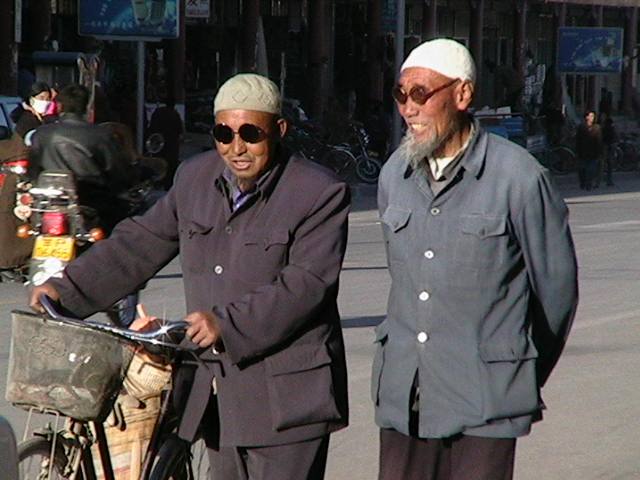
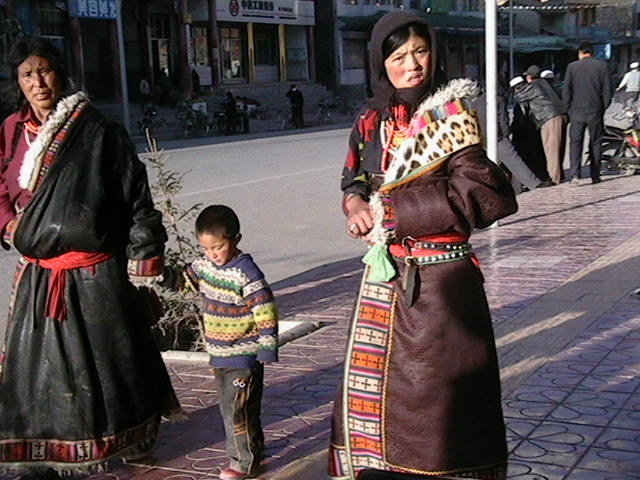
Then you could see everywhere the brightly coloured, ochre-red robes of the monks. Always happily walking through town in small groups, heads shaven, sometimes with a cellphone (yes!), and, surprisingly, filling many of the local teashops and restaurants (what's wrong with the canteen at the monastery?). Some would speak a few words of English and as all Tibetans they would respond to our "Tashi Delek" (Hello in Tibetan). Hui Muslims also form an important part of Xiahe, often as shopkeepers. They would sometimes wear beards and large round sunglasses. Because, yes, it was usually very sunny and bright this high up in altitude. Many of the shops sold Tibetan goods such as traditional clothes (Mommy and I got a beautiful warm coat & hat), religious objects (praying wheels and flags), jewelry, knives, photos of the old (dead) and new (13-year-old) Panchen Lama (photos of the Dalai Lama are still prohibited in China...), thangkas, saddles, etc. etc. Also I saw people selling large pieces of Yak meat right from the back of a truck, chopped off with an axe.