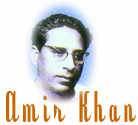
USTAD
AMIR KHAN
(1912-1974)
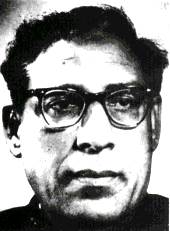
Hello friends
This, my personal
web-page, is a tribute to Ustad Amir Khan, one of the most important
Hindustani Classical vocalists and a singer I greatly admire. I first heard his voice during a very
non-musical exercise, when I was putting together different voices of classical
vocalists for a quiz programme. It was
a time when Hindustani Classical music was something very alien and distant for
me. Coming from South India, more
specifically rooted in Karnataka, the only link with Hindustani classical music
was Pt Bhimsen Joshi’s renderings of Dasara Padagalu in Kannada. Of course, I had heard about Pt Mallikarjun
Mansur, Pt Kumar Gandharva, Pandita Gangubai Hangal, Pt Basavaraj Rajguru, and
felt proud that these eminent singers (including Pt Bhimsen Joshi) were from
Karnataka. During this voice collection
exercise, way back in 1989, I happened to listen to an album (one of the few
studio recordings of Ustadji, I learnt later) of his rendering of four ragas,
which Prof. T V Hegde, one of the English teachers in our college in Shimoga,
graciously lent me. I neither had the
time nor the inclination nor the patience to try and understand what the whole
thing was about, but somehow the voice and the style stayed with me, not that
it haunted me or anything of that sort.
Two years of stay in Pune was supposed to have made me imbibe the finer
points of Hindustani Classical music, but nothing of that happened. It was in 1994 that I happened to come
across the same album by Ustad Amir Khan.
I recognized the album by its cover, which somehow managed to remain the
same. I was pondering whether to buy it
or not, when a friend of mine, very thoughtfully gifted me the album. This time I was really hooked and there was
no looking back.
Megh and Lalit mesmerized me, but Malkauns
was irresistible. Being a student of
literature meant that most of the things went to the head via the eyes, and it
was mostly by reading. I tried very
hard to listen to understand this music.
I found out that I did not have the requisite and prescribed patience to
sit for a minimum of half an hour (which is the usual duration of a raga on one
side of an audio cassette) with total concentration. Without someone telling me ‘what to listen’ to and ‘how to
listen’, it was an uphill task. Out of
sheer habit, I resorted to reading about this music, and there was ample
written material on it. All that ‘pentatonics’
and ‘komals’ and ‘dhaivats’ confused me even more. I put a stop to all this and decided to just
listen for enjoyment without trying to bother about the intricacies, and anyway
I didn’t want to become a technical expert.
I simply became a listener and I enjoy listening to Hindustani
classical. Sometimes, though, I envy people who are able to identify ragas
instantly. Over these past few years I
have unconsciously been trying to make connections between Hindi film songs and
the ragas that I have heard.
Coming back to Ustad Amir
Khan, most of the things that I know about his music are through reading. I have tried to read whatever I have been
able to lay my hands on, and of course, the sleeve notes. While listening to Ustadji, I used to feel
that his rendering of Vilambit is in extra slow motion. I realized that Ustadji borrowed this style
from Ustad Waheed Khan of the Kirana Gharana, who used this style of singing
for his riyaz. Ustad Amir Khan
brought this style of rendering onto the performing stage. This style of singing is called the Meerkhand
or the Khandameeru style. When I
read the sleeve notes carefully I saw that most of the Vilambit
renderings were in Jhumra Taal (14 beat ryhtymic cycle), which I learnt,
because of its ati-vilambit (extra-slow) tempo, suited his singing in
the Meerkhand style. But, sometimes the Drut is so fast (especially
Malkauns) that you wonder if it is the same person who is singing it. I learnt that the exuberance of his swift taans
and electric sargams were influences from Ustad Rajab Ali Khan of Devas
and Ustad Aman Ali Khan of Bhendi Bazaar Gharana respectively. This much I learnt from reading about Ustad
Amir Khan’s rendering.
Ustadji was born in 1912
and had his initial training from his father, Ustad Shamir Khan, a Sarangi
player employed in the court of the Maharaja of Indore. Prof Ajit Singh Paintal, a disciple of the
Ustad, says that Ustadji did not formally train under an Ustad of any Gharana,
and therefore did not wish to identify himself with any Gharana. As mentioned above, he was influenced by
Ustads of many Gharanas. Ustadji
designated his style as the Indore Gharana, after the name of the city
in which he had his initial training and acquired his musical consciousness.
In an article in the Indian
Express (October 24, 1993) written by Ashish Sharma, we get to know the
views of a number of Ustadji’s disciples regarding his music. Did you know that Pandit Gokulatsavji
Maharaj modelled his singing on Ustadji’s style by only listening to his
recordings and never having met him even once?
Even Panditji’s voice is so similar to that of Ustadji’s that AIR had
received angry letters from listeners in Pakistan indicating that in a
programme featuring Ustad Amir Khan someone else’s name was wrongly
announced. It was Pandit Gokulatsavji
Maharaj who was singing that day!
Panditji says: “It is my misfortune that I could never meet Khan Sahib,
but I listened to his recordings over and over again, and tried to emulate the
spirit behind his music” (Ashish Sharma, “A Legend and Its Legacy”, Indian
Express, October 24, 1993). Ashish
Sharma says that Panditji has a mind-boggling collection of Khan Sahib’s
recordings, which include even thumris, ghazals and qawwalis
besides khayals, which add up to around 3500-4000 hours, with rare ragas
like Sarparda, Zurtaba, Kalingra, Lachchasakh, Chayanat,
Khem Kalyan! And imagine one man
enjoying it all, when we mere mortals have hardly twenty hours of Ustadji’s
singing in commercially released recordings!
Khan Sahib never sang thumris
during public performances. Pandit
Mahendra Sharma, who accompanied Ustadji whenever he came to Delhi, says that
Ustadji did not sing thumris in public even though he was an expert
exponent of that genre because he considered Ustad Bade Ghulam Ali Khan as a
better singer of thumri. And
people actually speak of rivalry between these two stalwarts! Some of the articles that I read mentioned
that Ustadji closed his eyes to the public while singing and used to be so
immersed in his singing that he forgot the listeners. When I listened to the tapes, many a times I found Ustadji
actually explaining and elaborating either the words or the ragas. This actually shows that the listener was
important for him and he wanted his listeners to know what he was singing. Years after he left us (he died in a car
accident on February 13th, 1974), we can even now listen to him
speaking to his audience. Pandit
Amarnath, a long standing associate of Ustadji, says: “At least 60 percent of
today’s musicians have been inspired by Khan Sahib.” Pandit Surinder Singh, of the Singh Bandhu duo, and one of
Ustadji’s disciples, says in a similar vein: “We are living in the age of Ustad
Amir Khan. While only three or four
records of his came out when he was alive, 14 have appeared since his death.”
This is all I have to say
about Ustadji. I have compiled a
detailed discography of the available cassettes of Ustadji’s renderings (at
least of what I have been able to collect).
I have also scoured the world wide web to bring you Ustadji’s renderings
available on the internet, and also some essays and articles on Ustadji as well
as on Hindustani Classical music. These
articles on Hindustani Classical Music also reflect the way I want to look at
Hindustani Music and music itself in general—devoid of hierarchies and itself
being subject to many pulls and pressures and influences.
(I completed the final editing of this webpage on February 13, 2002. I suddenly realized that February 13th is Ustadji’s death anniversary. I kept delaying the completion of this webpage for various reasons, and it was purely coincidental that it got completed on this particular day.)
REFERENCES:
Ajit Singh Paintal, Sleeve Notes to Pratidhwani (Music Today, 2001)
Ashish Sharma, “A Legend and its Legacy”, Indian Express (October 24, 1993)
Deepak Bannerjee, Biographical Notes to Ananya (Navras Records, 1998)
G N Joshi’s article on Ustad Amir Khan at www.chembur.com/anecdotes/amirkhan.htm
“Ustad Amir Khan: The Great Genius of Hindustani Classical Music” (author unknown) at www.ercwilcom.net/indowindow/delhimagazine/
Sumit Savur, Sleeve Notes to Taskeen (Ninaad, 1996)
Susheela Misra, “Ustad Amir Khan” in Great Masters of Hindustani Music (New Delhi: Hem Publishers, 1981; 168-173)
Vamanrao H. Deshpande, “Indore and Amir Khan” in Indian Musical Traditions (Bombay, Popular Prakashan, 1987 [first edn. 1973]; 63-66)
[My name is S
Jayasrinivasa Rao. I would like to know
your reactions, comments, corrections, advice regarding and for this web-page
and more information about Ustad Amir Khan.
Kindly write to me: [email protected]]
USTAD AMIR KHAN—A DISCOGRAPHY
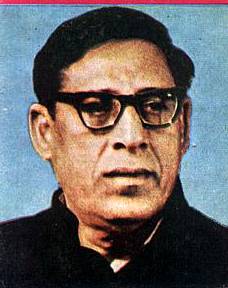
MEMORABLE EVENINGS WITH
USTAD AMIR KHAN SAHEB
A RARE COLLECTION—NEW RECORDINGS
HMV STC O4B 7371-74 SUPREME (A set of four cassettes) (pkd. 10/90)
(Source: A Private Collection)
Cassette 1: STC O4B 7371
Side A: RAGA BAIRAGI—Mansumarat nis din tumharo naam (Khayal in Teentaal)
RAGA CHARUKESHI—Laaj rakho tum mori gusaiyan (Khayal in Teentaal)
Side B: RAGA PURIYA—Chin chin baat takat hun tori (Khayal in Teentaal)
RAGA MADHUKAUNS—Bairanbhai rain (Khayal in Teentaal)
Cassette 2: STC O4B 7372
Side A: RAGA SHUDDHA KALYAN—Karam karo (Khayal Vilambit in Jhumra Taal)
RAGA SHUDDHA KALYAN—Tarana in Teentaal
Side B: RAGA BAGESHRI—Begun kaamna jaage (Khayal Vilambit in Jhumra Taal)
Cassette 3: STC O4B 7373
Side A: RAGA MIYAN MALHAR—Karim naam tero (Khayal Vilambit in Jhumra Taal)
Side B: RAGA MIYAN MALHAR—Barasan lagi re badariya (Khayal Drut in Teentaal)
RAGA RAMDASI MALHAR—Chhai badara kaari (Khayal in Teentaal)
Cassette 4: STC O4B 7374
Side A: RAGA JOG—O balma (Khayal Vilambit in Roopak Taal);
Saajan more ghar aye (Khayal Drut in Teentaal)
Side B: RAGA DARBARI—Mori aali ri jab se bhanak (Khayal Vilambit in Jhaptaal); Kin bairan kaan bhare (Khayal Drut in Teentaal)
(Khayal in Jhumra
[14 beats]):
www.dovesong.com/MP3/MP3_India_kanada.asp
è 1989, Original sound recording made by The Gramophone Company of India Ltd. Copyright owner and manufacturer: The Gramophone Company of India Ltd., 5, Old Court House Street, Calcutta 700 001. © 1989, The Gramophone Company of India Ltd., Calcutta.
AMIR KHAN: A Bouquet of Rare Live Concert Recordings
HMV CLASSIC GREATS (NEW RECORDINGS)
HMV STC 850350/51 SUPREME (a set of two cassettes) (pkd. 8/94)
(Courtesy: Mr Adinath Mangeshkar & Mr R H Bengri)
Cassette 1: STC 850350
Side A: RAGA BAGESHRI KANADA—Gore gore mukh par (Vilambit Khayal in Jhumra Taal)
Side B: RAGA BAGESHRI KANADA continued—Gore gore mukh par (Vilambit Khayal in Jhumra Taal)
RAGA ABHOGI KANADA—Laaj rakh lijo mori (Drut Khayal in Ektaal)
Cassette 2: STC 850351
Side A: RAGA SHAHANA KANADA—Sunder angana baithi (Drut Khanayl in Teentaal)
RAGA DARBARI KANADA—Ye re man biya biya (Drut Khayal in Ektaal)
(Khayal in Jhumra
[14 beats]):
www.dovesong.com/MP3/MP3_India_kanada.asp
Side B: RAGA KAFI KANADA—Ab man laag tumhi sang (Vilambit Khayal in Jhumra Taal)
è 1994, Owner manufacturer: The Gramophone Company of
India Ltd., 33, Jessore Road, Calcutta 700 028. © 1994.
USTAD AMIR KHAN—TASKEEN:
THE ULTIMATE BLISS
NINAAD PREMIUM NC0001/2 (set of two cassettes) (pkd. 12/96)
Cassette 1: NCOOO1
Side A: RAGA KOMAL RISHABH ASAVARI—Jagaat sapna ka karat guman (Vilambit Khyal set to Jhumra Taal)
Side B: RAGA KOMAL RISHABH ASAVARI continued—Eri ab to (set to Madhya Laya Teentaal)
(Khayal in Jhumra
[14 beats]; Khayal in Teentaal [16 beats]):
www.dovesong.com/MP3/MP3_India_asawari.asp
RAGA JOG Tarana (set to Teentaal)
Cassette2: NCOOO2
Side A: RAGA TODI—Ja ja re more piya (Vilambit Khyal set to Jhumra);
Man ke panchhi bhaya bavre (Drut Khyal set to Teentaal)
Side B: RAGA MEGH—Barkha ritu ayee (Vilambit Khyal set to Jhumra);
Tarana (set to ektaal)
www.ercwilcom.net/indowindow/delhimagazine/
Live recording of an open air concert at Mumbai, one of
the last concerts of the maestro; digitally remastered at Sumi Audio Studio,
Mumbai, by Ashok Shukla; Recording produced by kind permission of Smt Raisa
Begum Amir Khan and with courtesy of Shri R H Bengeri.
© & è 1996
Ninaad Music and Marketing Pvt. Ltd., 5/16 Vrindavan, Tarun Bharat
society, Andheri (East), Mumbai 400 099.
ANANYA—USTAD AMIR KHAN
NAVRAS NAV-RATNA—THE GREAT MASTERS
NAVRAS NRCC 0091/92 (set of two cassettes)
(pkd. 2/98)
(Archival Recordings from the collection of Mr Ain Rashid Khan & Shahbaz Khan; period 1960s)
Cassette 1: NRCC 0091 (71:13)
Side A: RAGA
YAMAN
(Khayal in Jhumra
[14 beats]; Khayal in Teentaal [16 beats]):
www.dovesong.com/MP3/MP3_India_yamen.asp
www.ercwilcom.net/indowindow/delhimagazine/
Side B: RAGA HAMSADHWANI
Cassette 2: NRCC 0092 (60:41)
Side A: RAGA PURIYA
Side B: RAGA ABHOGI
Accompanists: Pt Gyan Prakash Ghosh (Harmonium); Pt Gobinda Bose (Tabla)
© Navras Records Ltd., February 1998; è
Navras Records Ltd., February 1998.
Navras Records Ltd., 22 Sherwood Road, London, NW4 1AD
U.K.
Navras Records (Pvt.) Ltd., 102 Astron Apartments Behind Mukund Nagar, Andheri (E), Mumbai 400 059, India.
AMIR KHAN—PRATIDHWANI: VOICES OF THE LEGENDS
MUSIC TODAY A01036/37 (set of two cassettes) (pkd. 05/2001)
(Source: Shahbaz Khan)
Cassette 1: A01036—Recorded live in 1965, Mumbai; Accompanist: Nizamuddin Khan (Tabla)
Side A: RAGA BASANT MUKHARI—Prabhu data vidhata saban ke (Madhyalaya in Jhaptala) (33:59)
Side B: RAGA BASANT MUKHARI continued (06:52);
RAGA NAND—Ae vaare saiyyan re (Vilambit in Jhoomra Tala);
Man bair bair chahat (Drut in Ektala) (25:31)
www.ercwilcom.net/indowindow/delhimagazine/
Cassette 2: A01037—Recorded live in 1971, Mumbai; Accompanists: Gyan Prakash Ghosh (Harmonium); Gobindo Bose (Tabla)
Side A: RAGA TODI—Kajo re Mohammad Shah (Vilambit in Jhoomra Tala);
Man ke panchi bhaye banware (Drut in Teentaala) (23:52)
RAGA SHAHANA—Sundar angana baithi nikas ke (Madhyalaya in Teentala) (10:10)
Side B: RAGA YAMAN—Shahaje karam barmane (Vilambit in Jhoomra Tala)
Aiso sughar sundarva balamva (Drut in Teentala) (32:43)
www.ercwilcom.net/indowindow/delhimagazine/
(Khayal in Jhumra
[14 beats]; Khayal in Teentaal [16 beats]):
www.dovesong.com/MP3/MP3_India_yamen.asp
Remastered and edited by Pratik Biswas at Digital Sound Studio.
© 2001 Original sound recording made by Living Media India Ltd., Registered Office: 9 K Block, Connaught Circus, New Delhi 110 001; è 2001 Living Media India Ltd.
USTAD
AMIR KHAN
INRECO 2711-C 398 PREMIUM MUSICASSETTE
Side A: AN UNTITLED RAGA (Part 1)
Side B: AN UNTITLED RAGA (Part 2);
RAGA CHANDRAMADHU
Accompanist: Gobinda Bose
(Tabla)
è
& © 1990 The Indian Record Mfg. Co.
Ltd., 45, Moti Sil Street, Calcutta 700013
A RARE
GEM FROM USTAD AMIR KHAN
HMV STC 850190
(pkd. 1/98)
Side A: RAGA CHANDNI KEDAR—Ye ri thu dhan dhan tero bhaag
(Vilambit in Jhoomra Taal)
Side B: RAGA CHANDNI KEDAR—Ye ri thu dhan dhan tero bhaag
(Vilambit in Jhoomra Taal)
è
1991, Owner manufacturer: The Gramophone Company of India Ltd., 33, Jessore
Road, Calcutta 700 028; © 1991
USTAD
AMIR KHAN
EMI HMV SUPREME STC 5090 STEREO (pkd. 10/92)
Side A: RAGA LALIT—Kahan jaage raat (Vilambit);
Jogiya
moey ghar (Drut)
RAGA MEGH—Barkha
ritu aai (Vilambit)
www.ercwilcom.net/indowindow/delhimagazine/
Side B: RAGA MARWA—Pia mohe aanat Des (Vilambit);
Guru bin
gyan na pawe (Drut)
RAGA MALKAUNS—Jin ke man ram biraje (Vilambit)
Aaj morey
ghar aaila baalma (Drut)
Accompanist: Afaque Hossain
(Tabla)
è
1981 Original sound recording made by
The Gramophone Co. of India Ltd.; © 1981, The Gramophone Co. of India Ltd.
USTAD
AMIR KHAN—THE LEGEND LIVES ON
MAGNASOUND/ATLANTIS MUSIC C3HV0636 STEREO
Side A:
RAGA NAND (ANANDI KALYAN)—Vilambit in Jhumra (14 beats); Madhyalaya and drut in Ek Taal
(12 beats) (28:58)
www.ercwilcom.net/indowindow/delhimagazine/
Side B:
RAGA BAHAR—Drut in
Teen Taal (16 beats) (15:03)
RAGA DARBARI KANADA—Vilambit in Jhumra (13:06)
(Khayal in Jhumra
[14 beats]):
www.dovesong.com/MP3/MP3_India_kanada.asp
è/©
1993 Magnasound (India)/Atlantis Music;
Manufactured and Marketed in India by Magnasound (India) Pvt. Ltd., Lorette
Ville, 25/E, Main Avenue, Santacruz (West), Bombay 400 054, the Exclusive
licensee of WEA International Inc., A Warner Communications Company, USA.
AMIR
KHAN
HMV (MARGA—PATHFINDERS Series)
STC 851005 (pkd. 1/96)
Side A:
RAGA RAM KALYAN—(Persian
composition) Vilambit Jhoomra
Side B:
RAGA SHUDDHA KALYAN—Tarana
(Teentaal)
RAGA LALIT—Tadpat
hun jaise jal bin meen & Dar aa jane man (Drut in Teentaal)
Accompanist: Sheikh Dawood Khan
(Tabla)
è
1995, Owner manufacturer: The Gramophone Company of India Ltd., 33, Jessore
Road, Calcutta 700 028. © 1995
AMIR
KHAN
HMV (MARGA—MILESTONES Series)
STC 851063 (pkd. 1/96)
Side A:
RAGA AHIR BHAIRAV—Vilambit
in Jhoomra Taal; Drut in Teentaal
Side B:
RAGA BAGESHREE—Vilambit
in Jhoomra Taal; (Tarana) Drut in Teentaal
è
1984, Owner manufacturer: The Gramophone Company of India Ltd., 33, Jessore
Road, Calcutta 700 028. © 1984
USTAD
AMIR KHAN
HMV STCS 850489 SUPREME STEREO (pkd. 11/94)
Side A: RAGA HANSDHWANI—Jai maate vilumbh taj de (Khayal Vilambit in
Ektaal); Tarana (Drut in Teentaal)
Side B: RAGA MALKAUNS—Jin ke man ram biraje (Khayal Vilambit in Jhoomra
Taal); Aaj more ghar aaila baalma (Khayal Drut in Teentaal)
Accompanist: Afaque Hossain
(Tabla)
è
1970, Copyright owner and manufacturer: The Gramophone Company of India Ltd., 5
Old Court House Street, Calcutta 700 001; © 1970, The Gramophone Company of
India Ltd. [“è & © 1996”
inscribed on the cassette]
RARE
AND LIVE—USTAD AMIR KHAN & USTAD BADE GHULAM ALI KHAN (Live in 1956)
MUSICURRY GOONJ
P0003 (pkd. 10/2000)
Side A (Ustad Amir Khan): RAGA ADANA
Side B (Ustad Bade Ghulam Ali Khan): RAGA BIHAG; Thumri
Digitally remastered at Trio
Digital studio (Mumbai), by Hassan Sheikh
© & è 2000, Manufactured and marketed by Questionable Ventures
Media Pvt. Ltd., 1 New Udyog Mandir, No. 2, Mogul Lane, Mahim, Mumbai 400 016.
USTADJI SANG FOR A FEW FILMS TOO!
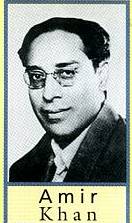
BAIJU
BAWRA (Prakash Pictures, 1952)
HMV SPHO 830124 (Economy)
Music: Naushad; Lyrics: Shakeel
Badayuni
Tori Jai Jai Kartaar—Raga
Puriya Dhanashree
Aaj Gawat Man Mero (with Pt D V Paluskar)—Raga Des
Sargam
JHANAK
JHANAK PAYAL BAJE (Rajkamal Kalamandir
Pvt. Ltd.)
HMV SPHO 820582 (Economy)
(combination cassette with DO AANKHEN BARAH HAATH)
Music: Vasant Desai
Jhanak Jhanak Payal Baje (with chorus)—Raga Adana (Lyrics: Hasrat Jaipuri)
RAAGINI (Ashok Pictures Pvt. Ltd., Bombay; 1958)
HMV SPHO 820922 (Economy)
(combination cassette with KALPANA)
Music: O P Nayyar
Chhed Diye Mere Dil Ke Taar (Lyrics: Jan Nisar Akhtar)
SHABAB (Sadiq Productions Pvt. Ltd.)
in CLASSICS FROM FILMS:
CLASSICAL ARTISTES SING FOR FILMS—
HMV SPHO 44251 (economy)
Daya Kar Giridhar Gopal (Music: Naushad; Lyrics: Shakeel Badayuni)
LINKS
TO USTAD AMIR KHAN’S RENDITIONS AVAILABLE ON THE NET:
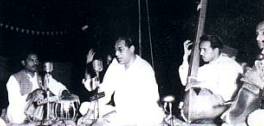
RAGAS MEGH, NAND
and YAMAN:
www.ercwilcom.net/indowindow/delhimagazine/
RAGA YAMAN (Khayal
in Jhumra [14 beats]; Khayal in Teentaal [16 beats]):
www.dovesong.com/MP3/MP3_India_yamen.asp
RAGA KOMAL RISHABH
ASAVARI (Khayal in Jhumra [14 beats]; Khayal in Teentaal [16 beats]):
www.dovesong.com/MP3/MP3_India_asawari.asp
RAGA DARBARI
KANADA (Khayal in Jhumra [14 beats]):
www.dovesong.com/MP3/MP3_India_kanada.asp
LINKS
TO ARTICLES ON USTAD AMIR KHAN AND SOME ARTICLES ON HINDUSTANI CLASSICAL MUSIC:
Article on Ustad Amir
Khan by G N Joshi: www.chembur.com/anecdotes/amirkhan.htm
“Ustad Amir Khan: The
Great Genius of Hindustani Classical Music” www.ercwilcom.net/indowindow/delhimagazine/
“USTAD AMIR KHAN” by Susheela Misra (from GREAT MASTERS OF
HINDUSTANI MUSIC [New Delhi: Hem Publishers, 1981; 168-173])
www.sawf.org/newedit/edit07232001/amirkhan.htm
“Some Words about Khyal” by Warren Sanders
www.medieval.org/music/world/warvij.html
“On Raga
Charukeshi” by Rajan P. Parrikar
www.sawf.org/Newedit/edit10292001/musicarts.asp
(this site has a link to other articles on Ragas in Classical Music by
Rajan P. Parrikar)
“Hindustani
Classical Music: A Secular Tradition”
www.ercwilcom.net/indowindow/delhimagazine/
“Carnatak
Music and Hindustani Music: a long history of cross-pollination”
by Shantha Benegal
http://minchu.ee.iisc.ernet.in/mirror/iicm/ch.txt
“Raga on the
Rocks” by
Jitendra Pratap
www.indian-express.com/ie/daily/19980812/front.html
Gharanas or
Schools of Hindustani Classical Music