| THE JASONVILLE STORY CONTINUED... |
| The establishment of Shakamak State Park is an example of how great things can be accomplished where everyone is cooperative and willing to do their bit. As I write this I have before me a copy of the first letter ever written concerning this park. It is dated July 21, 1926 and is addressed to George N. Mannfeld, who was then Supt. of Fisheries and Game of the state conservation department. It is a lengthy and detailed letter of information of how, by stopping up a five foot sewer a huge lake could be created, and that no such body of water existed at that time in Southern Indiana. The letter pointed out a huge railroad fill had been made to extend the Golden Knob mine switch to the Badders mine and this would form the Lake�s dam. Estimates at the time were that it cost $150,000. The land surrounding the proposed lake site lay in almost equal acreage in Greene, Sullivan, and Clay Counties. We convinced Governor Ed Jackson that there was a reasonable need for a park in this section of Indiana. The state had no means of buying the land and in several localities the communities were offering to donate land to be developed as state parks. A law had to be passed permitting counties to sell bonds to raise money for this purpose and to levy a tax to retire such bonds. The House and Senate both had to pass such a law, the Governor sign it, and then convince the county commissioners of each of the three counties that they should issue the bonds to pay for the land, and levy a tax. A member of the group of Park promoters was sent to Indianapolis where he remained for the last four weeks of the legislative session to lobby through the law. Others were called in almost daily to talk to some member of the legislature with whom they might exert some influence. So well were the plans laid and the groundwork done, that it was the first law in the history of the state, to that date, providing for a bond issue and a tax levy, to pass the Indiana Senate without a dissenting vote. A fine group of men from Hymera and Coalmont worked tirelessly with the local committee and called in men of influence from other part of their respective counties. After overcoming what seemed almost insurmountable obstacles the three groups of county commissioners voted to levy the tax and they purchased the land. By this time Harry 0. Leslie had been elected Governor (1928) and he was most cooperative in advancing the project. On May Il, 1930 Governor Leslie and Richard Lieber released the first two bass in the new lake. To avoid confusion- I should have stated �the first lake�. They weighed 3� pounds each and were caught by Frank Hastings purposely for this occasion. During the next two years conservation department employees seined many old riverbeds and ponds and the fish rescued from these drying ponds placed in the lake. It was opened for public fishing on July 1, 1932 and has attracted thousands of fishermen each year since. A new lake built a few years later has proven to be quite attractive to fishermen. Knowing that 144,330 visitors enjoyed the park and its facilities last year will recompense, in a great measure, for time and energy expended by those who brought it about. One thousand acres of wooded land, two beautiful lakes with facilities for fishing and bathing is a decided asset to any community. |
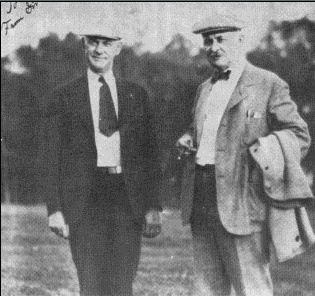 |
| SUMMER 1930 -- THE BEGINNING OF INDIANA'S FINEST STATE PARK -- SHAKAMAK -- Early in the summer of 1930, Governor Harry G. Leslie (left) and Col. Richard Lieber, head of the Department of Conservation, came to Jasonville to release the first bass in the old lake at Shakamak. The park was formally opened to the public on July 1, 1932. |
| If ever two people were subjected to a night of abject terror it was visited upon our beloved and highly respected John Pope, manager of the local bank and his good wife Stella. On the evening of November 30, 1954 two men appeared at the Pope apartment at Park Inn and, upon indicating they wished to discuss business with Mr. Pope, they were admitted. Once inside, they immediately produced guns and warned John to make no outcry and to follow orders or he would he killed on the spot. Then the three of them began the vigil of awaiting Mrs. Pope�s return from a service at the Methodist Church. When she entered the apartment she was seized, bound and gagged, and likewise threatened with death. When John tried to protect his wife against this rough treatment, he was struck over the head with a gun barrel, which was the only actual act of violence committed. Under almost unbearable tension, this silent watch continued, the minutes running into hours until three o�clock in the morning. At this time Mrs. Pope was left in the apartment. In order to further terrorize them and insure their silence, the Popes were told that John was being taken to an abandoned house, to be held there, while the bank was robbed, leaving a third member of their gang nearby to guard Mrs. Pope, so that if she succeeded in attracting any attention she would be immediately killed. Then they would dispose of John and get away. Thus they were both rendered helpless in fear that any overt act on the part of either might cause the death of the other, or both. John was taken outside, placed in a car, blindfolded and driven about the countryside. Well after daylight and the blindfold was removed and John found they were parked in Shakamak state park. He was driven east through town on Main Street in broad daylight, although the morning was quite foggy as the writer remembers from another incident occurring that morning. The car traveled east on Road 48 about a mile to where the state road swings to the south to join the Shanklin street road. Here they parked on an abandoned, or little used road leading north. Here John sat captive in a car and watched people pass nearby on the state road including Frank Hastings and Otto Crawl, local postal employees on their way to work, and both of whom lived near where the car was parked. Later he was driven into town on Shanklin to Washington, thence North to Main and parked in front of the room first door West of the bank, Frank Tribby across the street saw John and another man walk to the bank door and enter, but thought the other man was a local school teacher. George Williams, enroute to his work at Sinders� garage also noted the two, but thought of nothing wrong. Fred Bennett, who occupied the room in front of which the car was parked, noticed a man appearing to read a newspaper in the car, but the newspaper shielded his face. Upon entering the bank, the time for operation of the time lock was awaited, and then John was forced to open the vault. Forty two thousand dollars in currency was taken, all bills larger than $20 denomination being left in the vault, evidently in the fear that they might he traced. John was ordered into a small room and told to stay there until his working force arrived or the Mrs. Pope would he killed. Mrs. Pope, who had been in the apartment bound and gagged all this time, was in such agonizing pain that she could maintain complete silence no longer. Her moans through the gag attracted the attention of Tom Dickerson, their milkman, and he asked Bess Croft owner of the hotel to investigate. She discovered Mrs. Pope and immediately got word to the police. The writer was enjoying a usual morning cup of coffee with Chief Suthard when he received the word. He and Mayor Row hurried to the hotel where the terrified Mrs. Pope got out enough of the story that they knew a bank robbery was involved which sent them racing to the bank. There they found John in a terrible state of nerves and near the breaking point from fear of the fate of his wife. Only after assurance that she was safe and protected could he bring himself to reveal the details of the crime. It was exactly 8:20 a.m. when the officers entered the bank. They couldn�t have been far behind the robbers as the time lock on the vault was set for 8 o�clock, but Mr. Pope explains that there is a variation of ten to fifteen minutes at times. The state police were alerted and the description of the car, as nearly as Mr. Pope could give it, was broadcast. The F.B.I. converged on the city and some of them remained for several days. So far as the writer knows the case is no nearer a solution than the day it happened. If apprehended and convicted, the guilty could have suffered the death penalty as provided in the Indiana statutes against kidnapping. It is said the F.B.I. never considers such a case closed, so in time the facts may be known. In 1823 Greene County charged taverns a license fee of $10.00 per year and fixed the rate of charges as follows: Dinner 25 cents, Breakfast 20 cents, Supper 20 cents, Horse, corn and Hay, 25 cents, Whiskey, one half pint, 12� cents, Cider per quart, 12� cents, Good rum, pint 37� cents. Boarding by week with lodging $2.00, keeping a horse by week $1.25. I have questioned many old timers and practically all agree that Jim Heap, local clothier, owned the town�s first automobile. Other early owners were Tom Judson and Dr. Marshall. In 1908 Clara (Burch) Bledsoe, Dr. Osbon, Charles Kirk and Oscar Price purchased cars from the John S. Cox Agency at Terre Haute. These were two cylinder, chain drive, Maxwells with right hand steering and geared to 35 miles per hour. They had coal oil headlights and the squeeze bulb horns. The state law at the time required all autos upon meeting a horse drawn vehicle to �stop dead still until such vehicle was safely past�. Rude, indeed, was the motorist who would not alight from his car and lead the horse safely past for a lady driver. Miners wage contracts sometimes lasted two years but at times wages changed twice within a year. This schedule is not complete, but is gives the approximate wages for the years shown according to records compiled by the district office, U.M.W. of A. 1902, $2.42, 1903, $2.56, 1910, $2.70, 1912, $2.84, 1916, $2.98; 1917, $3.60; 1917, $5.00; 1919, $5.70; 1920, $6.00; 1920, $7.50; 1928, $6.10; 1932, $4.75�; 1935, $5.07 1/2; 1937, $5.65; 1958, $22.25. There is no person in business here today that was in business when the writer opened a tailor shop on Main Street more than 50 years ago. To Willard Humphreys would go the laurels for having been in business continuously longer than any present business man, having come in January 1909 and Isaac Rotman runs a close second, coming in September of the same year. A saloon regulatory law of 40 years ago that might be a good thing even now, provided that there be only one seat, of any sort, in a saloon and that was a stool behind the bar for the bartender. That law was in effect for several years and it seemed that the �boys� got all they needed to drink under such adverse and difficult conditions. If asked to distinguish the difference between the old time saloon and its present day offspring I would say the seats in the present day establishment were the greatest difference. Some were well behaved, some not, some served good food, and some did not. Only upon rare occasions would you see a lady in one, but there was no law to keep her out. Doctors locating in Jasonville after the boom were: Foor, Padgett, Burkhart, Marshall, Mendenhall, Banta, Branham, Lowder, Stark, Hixon, Osbon Collins, Jennings, Hadley, Ellis, Goodwin, another Mendenhall, Rogers, S. Rotman, Porter, H. Rotman and Lillie. A few years ago the writer asked if the late Mrs. Dora Bunn is she knew the greatest number of boarders she had at one time in the boom days. Without reflection she replied that she knew exactly, that at one time she had 32 borders. These were all fed, and several slept, in the house that stands at the corner of NE corner of Lawton and Hickory streets. All were single men. There were several other boarding houses, some of them keeping as many as ten borders. With these dozens of single men living here, the girls could be pretty particular in their selection of a beau, and I oftimes wonder how many of us managed to fool them. My investigation leads me to believe that my old friend Jim Beckwith is the oldest man born in Wright Township and has lived in it continously since birth. That is, he has never lived outside the township since he was born August 28, 1870. He beats Elmer Warrick by a year or so. I also believe Watson Neal, past 75, to be the oldest man born where Jasonville is now located and has never lived outside the corporate limits. In 1913 a law was enacted in Indiana making it mandatory for coal companies, operating within the state, to construct washhouses at the mines, upon being petitioned by a certain number of their employees. Until this time miners bathed in a washtub in the kitchen at home, except a rare few that had built tarpaper shacks at the mines. They would walk home in zero weather their wd clothing frozen stiff and their wet sox frozen in their shoes. All of my older readers had witnessed or experienced this condition over so long a period that it was commonplace and expected. After the taking effect of this law the miners at Northwest mine were the first in the state to file a property petition. Upon failure to erect the structure as required by law, charges were filed in Mayor S.D. Dempsey�s court against Clarence H. Jones, general superintendent of the property. Trial was held on the 24th day of October 1914 when the accused was found guilty and fined in the sum of $100 plus costs. The coal company took no action, so Jones was again hauled into the same court on the 7th day of the following month and was again assessed the same fine and costs. The writer was present in the court on both occasions. On this latter one, Dempsey delivered the most blistering and scathing denunciation of the accused that I have ever heard in a court of law. Work was soon begun on the wash house and as I recall it all other mining companied in Indiana followed without further litigation. I have pretty well avoided mention of local citizens being tried for various offenses, thinking their grandchildren should not be embarrassed by the re-hashing of useless subjects. However, here is one so ridiculous that if the �culprit� had not passed away he would laugh with us: �On June 7. 1912 the late Ray Walters was hauled into the Mayor�s court and assessed a fine and costs amounting to $15.80 for having driven an automobile on Main Street at a speed in excess of eight (8) miles per hour.� The present church buildings were placed in use about as follows: Methodist, 1902, Baptist, 1922, Christian, 1907, Catholic, 1908, Assembly of God, 1921, Christadelphians, 1920. Church of Christ, 1916. Church of God, 1936; Pilgrim Holiness, 1917, Evangelical United Brethren, 1913, and the Undenominational Gospel Mission, 1958. |
| Click here to see "THE HISTORY OF SHAKAMAK STATE PARK" By Max Griffith |
| Before the days of the mining slump and the attending shrinkage of real estate values in the 1920�s, Jasonville had three healthy banking institutions. The First was the Citizens� Bank organized in May 1903 and changed to the First National Bank in July 1904. The First officers were, Job Freeman, President. W.J. Freeman, Cashier, W. Ed Shepherd, Ass�t Cashier. The Peoples State Bank, organized in 1913, had as its first officers: W. Culner Warrick, President; Dan Frew, Vice President and P.S. Hodges, Cashier. Officers of the Citizens Trust Company, opened January 1, 1923 were: J.S. Williams, President; W.C. Barr, Vice President; Archie E. McCullough, Secretary-Treasurer and Edith Keers, Ass�t Sec�y-Treas. The present banking institution is of Jasonville Branch of the Peoples Trust Company of Linton, several local businessmen holding stock. It was opened in 1937 with Ira Williams as manager. John Pope who still holds the position succeeded him in 1942. |
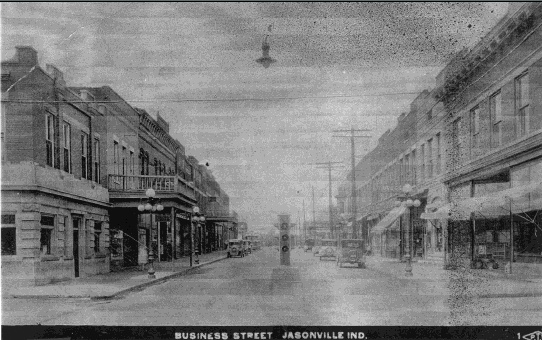 |
| Main Street, looking west from Lawton Street - late 1920s. First National Bank is located 2nd from right and Citizen's Trust Company is on the left corner. This bank was Peoples Trust Company at the time of Ben Sink's writing. Peoples Trust Company is still in business today with a new building just west of the old one, which has been demolished to make room for the new parking lot. |
| Another case that attracted much local attention was the strange death of Carl Motsinger in November 1937. He was suspected by some of having robbed a local lodge of whiskey and money. As I recall it, the only evidence was that he was seen near the place at a late hour. Those of us, who knew Mott well, know that you were likely to see him anyplace at any hour. He had plied his trade in most of the homes of the city and no one could recall an instance where anything had been missed after his departure. I knew him in his boyhood when he worked hard and took most of his money home to his mother to help with household expenses. Mott had his weakness, but never did I hear anyone suggest that he was a thief. He was lodged in the local jail and later taken to Bloomfield where he was found dead in the county jail the next morning. His broken and bruised body was sufficient proof for a doctor called in by family, and a deputy Attorney General who investigated the case, to agree, that in their opinion, the broken bones and bruises could not have been self inflicted, accidentally or intentionally, while confined in a jail. As I recall it no charge had been filed against him. It all resulted from his having been seen near a place where a robbery had allegedly been committed. The grand jury investigated the matter but did not find sufficient evidence against any certain person or persons to return an indictment. In a former chapter 1 mentioned the drug stores of the town but confined my writing to a few of the earliest. This seemed a popular early day business and other, engaged in it, but by no means all, were Ed Howell, Lewis Letsinger, John Perkins, Irwin and Braden, Dr. Marshall and John Wise. These were all before the boom. After the boom, C.C. Williams was the first to being in a, then up to date, drug store. Stores by Dr. Brannon, Dr. Hixon and J.J. Lacy and Son came soon thereafter. In the fall of 1908, J.O. Bryan and George Sharp moved a stock of Drugs here from Farmersburg. Sharp retired from the business within a short time. C.C. Williams sold to Bill Walters, as did J.O. Bryan at a later date. Following but not in this order, were Jack Stevenson, Dr. C.B. Collins, Clarence Collins, Dr. G.G. Osbon, Ozro Walters, Joyce and Bates and our present firms, Poe and Krutt and Orr�s Rexall Store. A few lawyers down through the years were, Plilander Long, W. Ed Bennett, August Bredeweg, Edward Kibler, Sydney Edington, Gary Harrell, Oscar R. Shields, Arthur T. Mayfield, Robert Irwin, John Todd, Rex Poe and Ben H. Sink. |
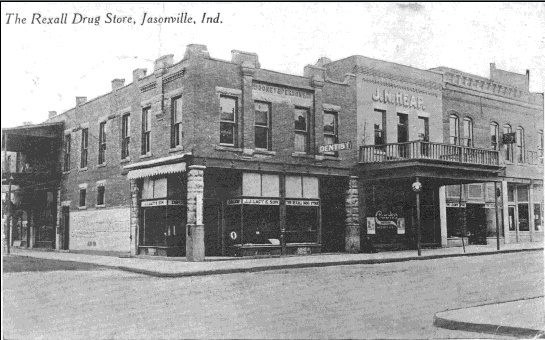 |
| J.J. LACY and SONS REXALL DRUG STORE Was located on the southwest corner of West Main and South Lawton Streets. This picture was probably taken around 1914. This building was later converted into a bank, and was purchased by Peoples' Trust Company of Linton in 1937. |
| During my writing I have searched many records and interviewed a great many people. A trip on May 19, 1958, and I hope my last, again led me out Lone Tree way. Here I talked to a dear old lady, Sarah (Love) Beckwith, who was born in Jasonville on October 14, 1868. She insists that this date is correct and the family Bible I examined corroborates the statement, but she is equally insistent that she is but 88 years of age. It seems to he the prerogative of a lady to exercise some latitude in giving her age, and it would be in bad taste, indeed, for a young upstart like me to question the word of this venerable lady. So she was born in 1868 and is 88 years of age. But the interesting point in my history is that she was born at what is now 110 West Main Street. The dwelling she was born in was later purchased by Lane Shephard and moved to the southwest corner of the intersection of West Main and South Horace streets. It is still occupied by Mr. Shepherd�s widow, Mrs. Wm. Zenor. The writer believes this to be the oldest dwelling in Jasonville, to be almost in its original form. I think we can safely assume that it is well over 100 years old. A few years ago when the present street lighting system was being installed, a hole was bored through the sidewalk in front of Orr�s Drug Store and into the well which was located in front of this house. It was necessary to move the location three feet east and you can see where the hole was plugged that entered the well. At this point, 100 years ago, was a hitch rack and watering trough. Robert Howe, keeper of a store, post office and blacksmith shop, laid out Howesville in 1856. One of the early preachers of Greene County was Hiram Abiff Hunter of Bloomfield. I am told there is a game where the number 7 plays an important part. If so keep your eyes on the boys from Coalmont. From 1850 to 1857, a period of 7 years, Lewis Township had seven road districts, seven road supervisors, seven school districts, seven teachers, seven families, each having seven children enumerated for school purposes, seven township officers and among the voters were Seven Crists, seven Pucketts and Seven Starks. The year of 1829 saw the first man tried in Greene County for horse stealing. Again my TV addicts will be disappointed as he was neither hanged nor shot, merely sent to the state prison for five years. From 1844 to 1884 Wright Township cast a majority for the Democratic presidential candidates except in 1872 when the Republicans carried the township by 133 to 120. The first explosion of the United States Powder Co. mill near Coalmont occurred about 8 a.m. March 17, 1908. The explosion was of a press cake mill and George Gorby, Crete Simons, Charles Myers and Lon Smith were killed. Seriously injured were Sam Stewart and Toy Gorby. An unusual item of expense allowed by the Greene County Commissioners in 1822 was: John Seamon, sheriff, $16 for arresting and keeping in custody 14 days Thomas Clayburn, a fugitive slave. The writer has delayed writing this paragraph of history, trying by various means to get more complete information. The men who gave their lives in the two world wars must never be forgotten. I implore the American Legion to secure and add those names, I have been unable to find, and make permanent record of the list by recording it. With apologies to the families of those honored dead I am unable to name. I submit the following record for this immediate community: World War One: William Joseph Bradley, Killed Argonne Forst, 10-15-1918, burial place unknown. Herman Hout, died at sea, 10-6-1918, buried at sea. Charles William Terhune, killed Vosges Sector, 7-2-19 18, burial place unknown. I am indebted to Max McClanahan for the following list of World War Two veterans who made the supreme sacrifice: Gerald Boston, Jr.; James �Scotty� Craig; Robert J. �Cotton� Field; Eugene R. Gibson; Benjamin B. Johnson; Joseph Myers; Blame L. May; Earl Rich, Jr.; Therman Sears; Ferrell Mann; Fred Hannon; Wm. �Bill� Humphreys Warren Harris, Coalmont; Dow Payton, Coalmont. Before ending this chapter, I must pay tribute to the man who rendered invaluable service on the home front during the last war, Walt Wakefield, Yes; he was subjected to criticism as a member of the draft board. So was each member of all the thousands of draft boards stretched across the nation. The few controversial cases I had cause to investigate, after full explanation of all the details, I found his rulings to be entirely just and equitable. He raised more funds in Bond, U.S.O., Red Cross and other allied drives, than any half dozen of we others, and contributed to all as liberally as anyone in the community. On one bond drive we gained national radio and newspaper publicity, when Walt, single-handed, had Jasonville�s quota sold at the hour when the bond drive was scheduled to begin. Thus, we were widely publicized as being the first city in the United States to sell our full assignment in this important drive. The fact has never before been made public, that I recall, that Walt entirely alone accomplished this feat. Every phase of the home war effort was ably promoted and generously contributed to, by the citizens generally. So, I bring to close after this effort to record some of the events that have a place in the history of Jasonville. The committee in charge of the Centennial warns me that my time is up and that I have allotted for this work. It has, truly, been a Herculean task for one wholly inexperienced as a writer. Yet, it is not without a pang of regret that I lay the work aside. There are so very many names and events that keep creeping from the recesses of my mind, seeming to almost demand recognition, and that they be recorded. For instance, I could write a book about the �doings� of those loveable characters, Curt Ragsdale, Willie Cochran, George Stephen, Taylor, Bill Ring, Mary Ellis, and others-how we all teased them, but would readily have fought anyone, imposing real harm upon them. Many of you have been most kind in personally expressing your approval of the work. Others have written from far distant places. This is ample reward for my efforts and, of course, all I shall receive as no one connected with the celebration receives any monetary remuneration whatsoever. May Jasonville and its citizens be blessed with happiness, success and prosperity for another century is my closing wish. The Writer (Ben Sink) |
| CLICK HERE TO SEE THE JASONVILLE STORY BOOK II: "REMEMBERING TIME" BY MAX GRIFFITH Now under construction (Max is working hard on Book II Winter of 2007-2008 - keep checking back!) |
| The brutal slaying of Mary Ellis in her lonely cabin Southeast of town was never satisfactory solved. Her lifeless body was discovered when neighbors failed to see any signs of life about the cabin as usual and relatives were called to investigate. She was found on January 27, 1933 and was thought to have been dead for some days. It was alleged that two men. Batchelor and Humphreys had admitted committing the crime to a third party, but upon being tried; there was insufficient evidence for a conviction. |
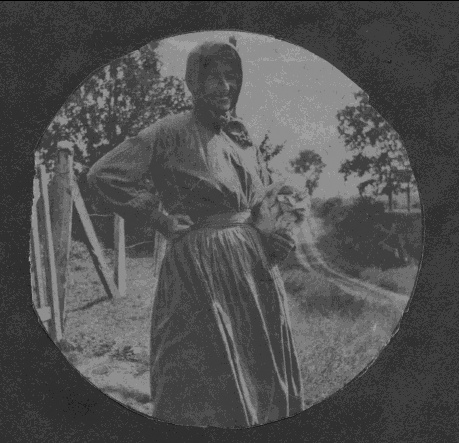 |
| Mary Ellis A Jasonville murder never solved |
 |
| HOME |