| Moments By Max Griffith Who can catch a moment And hold it in their hand? A golden precious slice of life Yet just a grain of sand. A grain of sand so precious, though, That no wealth for it we�d trade. But hold it closely to our breasts This moment that God has made. Yet each of us have moments We hold in memories dear Moments that we�ve plucked from life And carefully placed in here. As years go by we slowly add To what we have inside Till memory after memory in our hearts reside. And when we�ve reached those winter days That tell our time is near. We share these precious moments With those who�ve sense to hear. Yes, there are those who�ll laugh and jeer, And say they do not care. But there are those who�ll linger close And treasure what you share. So keep your legacy intact And hold your memories dear For those who know of their great worth and cherish what they hear. |
 |
 |
 |
 |
| Lifestream By Max Griffith Caught in the current of time as a leaf in a river gone wild With no choice but to be carried from the scenes we knew as a child. Strange how each moment�s passing makes those times now seem so dear. Strange why some memories leave us while others continue quite clear. Memories of loved ones we left there, how we�d love to see them once more. Just one more chance to touch them ere time again closes its door. As a sad and weary traveler grows ill for the sight of home. Longing so much to return there but it�s onward we�re borne on the foam Ahead lies a road we�ve not traveled. And what we know not, we fear. We wonder how far it will take us - will we still be on it next year So flows this lifestream we live in its� current carries us fast to the fate. We know that awaits us Where we�ll find still water at last. |
| The opening of the railroads through Jasonville, March 1, 1900, gave access to the large deposits of coal that had been discovered here. Almost overnight mines were sunk throughout this area, and miners came from near and far to work them. This resulted in the largest boom this small city has ever known. The miners came first and as soon as they were able they sent for their families. This sudden migration to Jasonville soon brought about changes in the town that were necessary to accommodate the increased population. In addition to the miners, many merchants and tradesmen arrived in town to provide their wares and services, which certainly were needed. These men also brought their families here as soon as decent housing could be provided for them. By 1902, the small one room school house was bursting at the seams, so to speak; with so many new students, that it became necessary to tear it down and build a new nine room brick structure in its place at a cost of $12,000. Two years later, in 1904, it was necessary to build an addition to this building. Six more classrooms were added, at a cost of another $12,0O0. In 1910, the school was overcrowded again, and it became necessary to construct a grade or ward building as it was called on South Park Avenue. This building was also known as the west building and the new building. Its cost was $15,000. and it would accommodate 450 students. So great was the influx of people to Jasonville in those years, that even this latest expansion became overcrowded after awhile, and two portable buildings were erected at the site of the grade school on South Park. From September through Apri1, the sounds of the school bell were heard throughout Jasonville, accompanied by the warnings of mothers, �You�d better hurry, there�s the first bell.� Students were never allowed to enter the school in a haphazard fashion but were lined up outside by the teachers, the sound of the bell, were marched inside in a very military manner. Transportation to and from school was, except for the privileged few, whose parents brought them, by � riding Shank's Mare� or for the younger generation, on foot. To most students, this was a daily routine, a necessary thing that was accomplished with little variation, but to a few, it was a daily adventure. All the sights, sounds, and wonders of the world seemed to surround them as they walked to school. Each block along the way offered new mysteries that needed to be investigated. Some if not all children have the ability to become fascinated with what they are doing, that the world ceases to exist for them. So they stop along the way completely engrossed in whatever has their attention this morning. Suddenly, the cold clear sound of the school penetrates and shatters this little world of their own that they have entered. As their heart drops and their stomach jumps, they gasp to themselves, "Oh no, LAST BELL." There is no sight in this world so cold or foreboding to a small child, than the school after the last bell has rung. Gone are the lines of children that they should have been apart of. Gone are the teachers, trying to make order out of chaos. All that remains is the school building, blackened by the coal smoke and much larger than the small child remembers it being. Inside is the seat that the child should be in, and wishes that he or she was. Inside all of the students are busy with their daily routine. Inside awaits trouble for our dreamer: a stern teacher, a principal, a paddle, and deep, dark horrible trouble. Choking back a sob, our dreamer opens the huge door, vowing never, but never to be late for school again. Were you that dreamer? I was. |
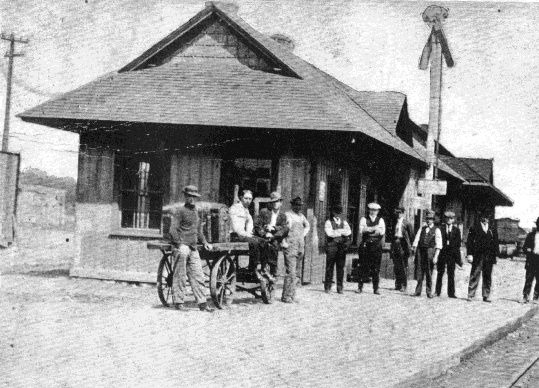 |
| The Jasonville Train Depot |

|
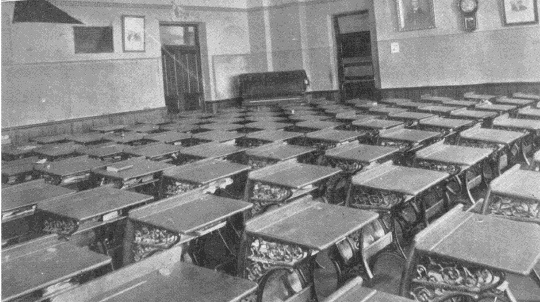 |
| A classroom in the Jasonville City School |
 |