| THE JASONVILLE STORY CONTINUED... |
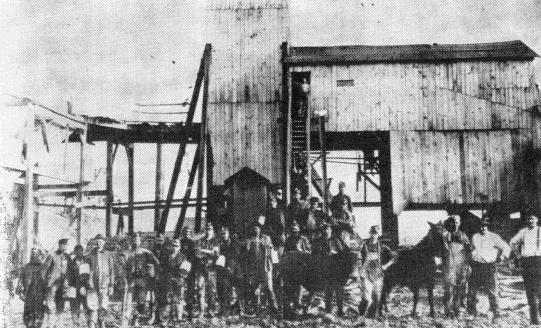 |
| JASONVILLE'S FIRST COAL MINE - THE P. FRY MINE was opened in 1901 by local investors. The coal proved to be of such high quality that other mines were soon sank in the new field. The city of Jasonville got its drinking water from the mine works from 1910 to 1952. The water had a mineral taste to it and local entrepreneurs bottled and sold the water, under the name of JASON WATER, all over the country, claiming it had health benefits. |
| In Jasonville�s long history of mining, the local mines had no great catastrophe where numerous lives were lost. An explosion in the Island Valley No. 3 seam on March 23, 1918 injured 16 men, one Linton resident dying from his injuries the same night. Elvin Price, one of the injured, furnished this information. On Friday February 20, 1925 the worst disaster in the history of this entire coalfield occurred at the City Mine near Sullivan, in which more than 50 miners lost their lives. The mine was largely operated with Jasonville capital, the same group of owners having operated the City Mine, East of Jasonville and moving to Sullivan upon its abandonment. The following men were killed who were residents, or not long before had been residents of Jasonville: Mike Cusack, James Miller, James Eller, John Row, Oliver Keagy and Blame Gibson. If I have overlooked any, I am sorry. These are the only ones I can remember as late residents of our town, and several people of whom I made inquiry could think of no additional names. Over the years we had many, many fatal accidents in the various mines and I recall these double tragedies and I am quite certain there have been more: Everett Neal and Dougald Malcalm, John and Fred Bennett (father and son) John and Ira Burns (not related), Clyde Burns, and Lawrence Pershing. The explosion at Little Betty (The old Gould Mine SW of Linton) claimed but one Jasonville life, Clarence McQueary. This occurred in January of 1931 and twenty-eight men lost their lives. Fred Reed of S. Lawton Street was listed as dead in this disaster and newspapers carried his name. However, when a Red Cross worker called here at the residence to inquire as to the family�s immediate needs. Fred answered the door. As Mark Twain once said �The story of his death had been greatly exaggerated.� Isaac Cotton from out Shakamak way was awarded the first Medal of Honor bestowed upon any citizen of Indiana by the Joseph A. Holmes Safety Association for heroic valor performed after an explosion at Antioch mine on April 18, 1923. �Ike� faced what seemed to be almost certain death, in going into a fire that raged after the explosion and carrying Logan and Muirl Bedwell, brothers of Linton, away a few days later from the burns received. |
 |
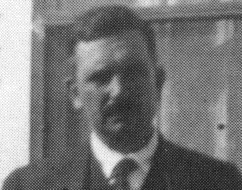 |
| JOHN L. GRIFFITHS, grandfather of Max Griffith, was, at one time, boss of Island Valley Mine. |
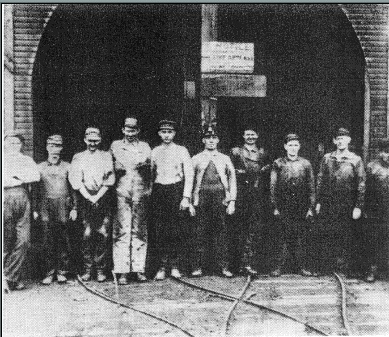
| ISLAND VALLEY MINE - Early 1900s - Located on the north edge of Jasonville on the east side of North Meridian Street. Sunk in 1903, the mine continued to produce until around 1920. Grouped around the Island Valley Mine entrance are (l. to r.) Cliff Moss, father of Helen Tribby and David Moss of Jasonville; Newt Williams, Al Vest, Porter Campbell, unknown; Ned Keers, father of Edith Wakefield and Ethel Huff of Jasonville, three unknown miners and on the far right Toad Strauders. |
| The first mine of note opened at Jasonville was the P. Fry mine. This was financed by local capital headed by Philbert Fry, after whom the mine was named. It perhaps resulted in a financial loss to the investors, but the high quality of coal had the effect of attracting corporations with money to open other mines. It was said that the coal was far superior in quality to that produced at the Midland and Gilmour mines, which had just |
| been placed in operation. Later Jim Persons leased this mine and had fair success with the operation. These mines were largely operated with Jasonville labor. Other mines with considerable output and where many Jasonville miners worked were: P & 1, Tower Hill, Old Midland, Lenoir, Coal Ridge, Alum Clave, Big Dirty, Red Rag, Bolt, Arizona, White Ash and City all of which were situated on railroad switches. The many smaller truck and wagon mines produced millions of tons over the period of almost 60 years. And remember, every pound of this coal was shoveled by hand. I list below a number of the principal mines of the community with data as shown by Department of Mines of the state of Indiana. There are several errors in these figures, to my personal knowledge, but since they will always stand as state records I offer no disagreement. I list the mines by the names commonly used, depth to the coal, date started date abandoned, and tons produced. |
| Name Depth Start Stop Tons Shipped Tater Hill 240 1904 1910 279,000 Bogle4 35 1903 1914 788,000 Bogle 3 107 1903 1914 41,000 Bon Ayr 1 127 1919 1930 2,984,000 Bon Ayr 2 110 1922 1931 2,649,000 Northwest 4 75 1902 1926 2,265,000 Northwest 3 117 1911 1924 53,000 Gilmour 152 1901 1919 2,291,000 Golden Knob 203 1903 1908 155,000 Green Valley 127 1902 1924 3,331,000 Island Valley 4 104 1903 1918 1,332,000 Island Valley 3 150 1918 1923 161,000 Lattas Creek 153 1902 1922 3,559,000 Letsinger 3 200 1903 1910 287,000 P. Fry 87 1901 1914 677,000 Queen 2 50 1911 1922 248,000 Queen 3 123 1913 1928 416,000 Queen 4 115 1913 1933 1,699,000 |
| click here for "More Mining Pictures" |
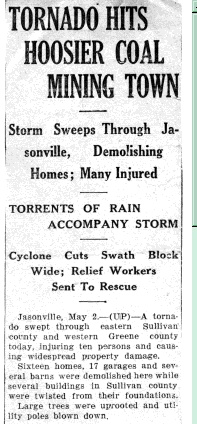
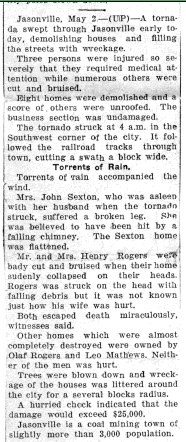
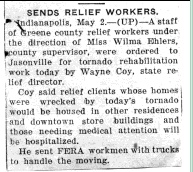
| STORMS As if to announce its coming to town, a tornado crushed two or three houses in the SW section of Jasonville, as it entered. Then in all its fury, it struck the north central part of town. This was at 4 a.m. on May 2, 1935 and in a matter of seconds 28 homes had been leveled, some entirely swept away. The family of John Sexton, and his family, suffered the greatest physical injuries, although many were injured more or less seriously. Mrs. Sexton had a leg broken in five places; John had four broken ribs; a daughter had her collarbone broken; and a son broke his leg. This was the only serious storm the city ever had except the big hailstorm in late April or early May of 1908. It is no exaggeration that practically every west window in the town was broken and many of those on the south side. I recall that it was on Sunday and the opening game of the baseball season was being played and that Charles Sheppard, town marshal, leaped from the grandstand and broke an ankle. The two lumber yards and two furniture stores each got in carloads of glass. As to the size and depth of the hailstones on the ground, you may inquire of another who remembers this incident of almost exactly 50 years ago. You would not believe me if I wrote the facts, and I couldn�t blame you. It seems that our town�s disasters must come from the air, rather than high water. The center of Washington Street at West Main is the dividing line between White River and the Wabash, the water falling on the east half going into Eel then White and that falling on the West half of Washington flowing to the Wabash. If you ever see water standing at that point, your only hope is an ark. |
 |
 |
 |
 |
 |
| HOME |