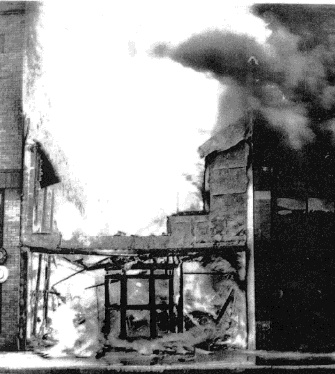
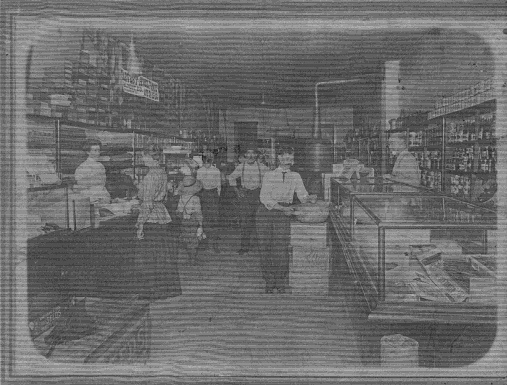
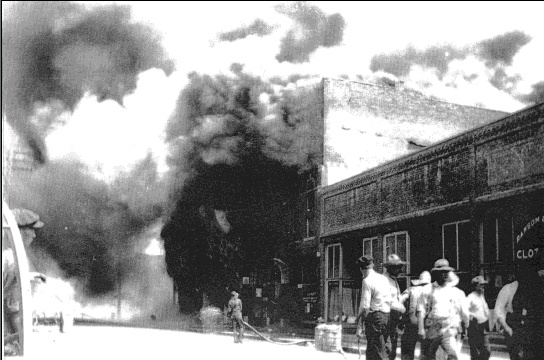
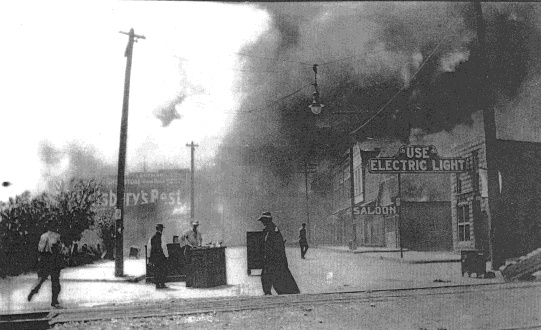
This block was completely wiped out destroying the following businesses: K. of P. Hall, Shields and Mayfield law office, Ax and Fry grocery, Opera House, Cary Harrel law office, Bryans Drug Store, Scott pool room, Miller barber shop, Irwin and Stark general store, Ransom and Lacy clothing, Ben H. Sink tailor shop, Post office, Carter Grocery co., Greek Candy Kitchen, Will Elson Jewelry, Joe Gold dry goods and the Peoples State bank. At the bank corner charge after charge of dynamite was exploded within the walls of the building. Once the floor was broken the burning interior dropped into the basement. This, together with a sweating, toiling, scorched bucket brigade using wet quilts, blankets and rugs on the Lacy Drug Store building across Lawton Street checked the spread westward. In this block Newby�s blacksmith shop and an old residence on the West side of Meridian also burned. I make no effort to follow the progress of the fire in sequence, as it was raging on all fronts at the same time. I try to locate the businesses in their proper places. From the K. of P. building, the flames leaped East across Meridian Street to the one story restaurant on the corner and in this block quickly destroyed Fred Crosby�s jewelry store, J. H. Beaver general merchandise, Isaac Rotman shoes and repair, Ben May pressing shop, the old Methodist Church built in the 1860�s the offices of Dr. C. B. Collins, M.D., and J.A. Wooten, Dentist. In this block next to the railroad to the south side of Main Street stood the dwelling of Mary Jane (Grandma) Larr, which she had occupied for almost half a century. This greatly beloved old lady stood nearby, terror stricken while this home she loved so well took its place in the parade of destruction. Here in this block, through desperate effort and great risk volunteers managed to save the Jack Fross garage and the Hastings harness shop. Had these buildings burned the fire would have taken the Bynum store and the Stalcup livery barn and then probably have raced� unchecked through much of the southern residential section of the city. It was thought for a time that the New Union Lumber Yard, which had suffered a $5000 loss the year before, would be ignited from flying embers from the old frame church building, but here again the volunteers prevailed.
East of Meridian and North of Main the Goldstein theatre situated on the corner was the first to ignite. Others destroyed in this block were, Win. Meade saloon, Hurst restaurant, W.H. Slough barbershop, Win. Keene and Joe Humphreys saloon Pat Hagerman pool room, Jim Dobbs saloon, and the depot and freight house, also the saloon, and the depot and freight house, also the Chinese laundry.
From the burning opera house the intense heat shattered the windows of the J.S. Williams store, across Main Street where the Masonic building is now located, and the fire burst out in fury all over the large store room and swept both East and West on the North side of Main. Nothing in this block was saved the destroyed buildings housing Sinders Saloon and Livery Barn, Les Garrison saloon, Yes Ladson saloon, Perry Wilson saloon, Bert Greenwood barber shop, Flem Van Meter hardware, Noah Gibson saloon, Hyatt�s clothing store, W.J. Powell insurance, and back off of Main Street the old John Gregg store and residence.
The fire was again checked at Lawton Street. Dynamite produced like results as across the street at the bank, letting the burning interior of this building partly fall into the basement. The West wall stood long enough for the flames to subside somewhat, and with heroic effort put forth on the Jasonville Mercantile Co. building, across the street. West, the fire was confined to the area between Lawton Street and the railroad. This building, the Odd Fellows, at the NE corner of Lawton and Main streets was the most imposing structure of the city. The opera house was as tall but this was the only three stories building on Main Street and had been completed only a year before the fire.
I will end my fire story by quoting from an article I wrote several years ago for another purpose, (Quote) �With the coal industry at low ebb at the time, the anvilchorus loudly proclaimed the death of the city. Ed Sheppard, cashier of the First National Bank, best exemplified the true spirit of the city. On the morning after the fire he appeared on Main Street in work clothes and with broom and shovel pitched in to clean up the debris and make Main Street passable. He scornfully reproached his fellow business men and citizens generally who took such a dismal view of the situation, and his cries of �This is Jasonville; Let�s clean it up, then build it back better than ever�, met with immediate response and those within hearing, seizing any implement at hand, attacked the huge clean up job. Sheppard�s admonitions bore fruit and the task of planning the rebuilding of two thirds of Jasonville�s entire business district was begun that day. Many boom town, frame store buildings, with false fronts as depicted in the Western movies were replaced with brick structures of modern design�. (End Quote)
The terrible holocaust was of short duration. Beginning at about 12:30 p.m. the entire area was just a smoldering mass of ruins in less than four hours. In addition to the business district, three or four dwellings were burned in the Northeast part of the city, their roofs ignited by flying embers.
The following days sightseers flocked in by the thousands. Saloons opened up in tents and they, along with improvised hot dog and hamburger stands, did a lively business. |