| THE JASONVILLE STORY CONTINUED.... |
| Chapter XIII The growing town and expanding mining industry were sadly in need of workmen and this word rapidly spread throughout the mining fields of other states. Each arriving passenger train brought in men seeking employment. Mining was on the wane in the Jackson County, Ohio, coalfields and former residents of Welliston, Jackson and Coalton flocked to Jasonville. So great was the influx of workers from this section that a native-born Jasonvillian innocently inquired if there was but one county in Ohio, commenting that Jackson was the only county in the state he had ever heard of. Kentucky furnished a substantial number of miners but not nearly so many as Ohio. Parke County, Indiana, which had been the leading coal producing county in the state, found her mines closing as the resource was depleted, and residents of Nyesville, Lyford, Coxville, Diamond, and Rosedale joined in the rush for jobs in the new Jasonville coal field. Coal Bluff, Fountanet, Burnett, and Seelyville all in Vigo County, sent a good number, as did Clay county, miners, coming from Brazil, Harmony, Knightsville, Centerpoint, and Ashboro. Some of the above named towns, that now are but a dot on the map, were thriving mining towns at about the time or just before, Jasonville had its boom. Many of the arrivals were single men who had to find regular board and lodging. Others were family men who sought temporary accommodations until they could find a home for their families. Of one thing they could be certain, there was a job awaiting them upon their arrival. There was a great work to be done in building a town and developing an industry, and with the exception of a handful of local workers, people coming in must do the whole job. The work to be done consisted of building railroad switches to the various mines, erecting mine tipples, mule barns, blacksmith shops, engine rooms, and other mining structures, the sinking of shafts and air shafts, and the building of the residence and business sections of an entire town and all detailed work incidental to ail of these. The first hotel, a makeshift affair, located at the Northeast corner of Main and Washington streets placed cots and pallets in every nook and corner and no one rated a private room, space was too valuable. The native villagers and newcomers, who had established home, rented out every foot of floor space they could spare as sleeping quarters. Many slept in barns and sheds until a better place could be found. Fourteen �Hunkies� batched in one room. They worked on different shifts and the beds or pallets, never got cold, one crew crawling into bed as another got out. In this same room fourteen cooked and ate their meals. Eating �joints� sprang up like mushrooms in every shack and shed. Here was a business easy to finance. The only requirements for a start were a stove, a skillet, coffee pot, two dollars worth of dishes and silverware, a pound of lard, buns, bread, coffee, and a few inexpensive items as salt, sugar, pepper, mustard, etc. Any sort of a stove would be sufficed. I omitted the coal oil lamp with the smoked chimney, which cast a yellow glow, or gloom over the counter made from a wide poplar board. In most places the dimmer the light the better the appetite. If, and when, the place prospered, an oilcloth would be tacked over the counter board. No sewer, no garbage man, offal was tossed out the back door. All this activity and there was still no gravel on the streets, no sidewalks and, of course, no electric lights and no town government. I have commented elsewhere that in the forefront of every pioneer settlement was the church. Likewise, in the forefront of every boomtown you found the saloon and professional gambler and Jasonville proved no exception. The class of women, not uncommon to boom towns, was here in numbers and plied their trade in quarters above the saloons. Law enforcement was up to a Justice of the Peace and a constable. There was no place to lock up a prisoner. This court was entirely supported on a fee basis, there being no salary at all connected with either office. If the person convicted of a violation did not pay his fine, the constable or �Squire� did not receive payment for the arrest or trial. For obvious reasons, it wasn�t too difficult to get a conviction, but the fine was usually assessed at a figure so low that payment was almost certain. This unjust practice is still in effect in Indiana except in a few of the larger cities, where the Justices are salaried. They receive no fee unless the accused is fined and the fine paid. The slang phrase, �You already have two strikes on you�, will apply when brought up for trial in some of these courts. Other Justices are ethical and honest and the collection or loss, of a fee will in nowise sway their verdict. Another essential part of the boom mining town human element was the so-called �bad man� and we had all known varieties. Some were by nature just �ornery� mean, other landed in that category after imbibing too freely, while others just liked to fight, with no particularly hard feelings or enmity toward their adversary and with these men the issue was forgotten with the ending of the fight. If a record had been kept of the number of encounters held on Main Street, you would think it in error. The common expression of that day was �that you could look out on Main Street at any time and see a fight.� That was an exaggeration, but you didn�t have to look too long or too hard to find one. In comparatively few fights was the use of weapons resorted to and the few fatalities resulting from so many incidents was surprising. This was before the day of the mine washhouse and the washing had to be done at home or at the boarding house in a common washtub. Of course, the town couldn�t boast of a single bathtub or indoor toilet. Some men �black as coal� would stop at a saloon on their way home from work and in their wet dirty clothes remain until the eleven o�clock closing hour. This was one side of the picture, and not a pleasant one. The other was the reliable citizen and family man who came with one thought in mind, to establish a home in decent surroundings for him and family. Maybe he had a house or something else to dispose of in his former home, or had saved up a little money and this would give him the necessary capital for the down payment on a home. A house of three, sixteen foot rooms completed, and with two coats of paint inside and out could be had for $400 to $450 and a four room house, with the same size rooms, for $500 to $600. The floor space in three, sixteen foot rooms would be greater than that of some four or five room modern homes, with their small rooms. To be assured that my memory was not faulty in these figures I contracted my old friend Lyman Howard, an elder builder and contractor, who approved the cost figures and cited this example as proof: At a little later date and in a nearby town he contracted and built six, four room houses, including solid foundation, front porch, two coats of paint inside and out and ready to move into a price of $600 each. He further stated that he made a satisfactory sum on the contract. We thus understand how it was possible for most any frugal family to buy a house on contract or through negotiating a loan. Miners� wages were but $2.25 per eight-hour day or $13.50 for a full six-day week. Often you found a milk cow staked out on nearby vacant lots, and a garden of the lot where the residence was located. Maybe, the lady of the house kept two or three, and up to half dozen boarders. There were no light, water or telephone bills for a very good reason, there were no electric lights, no water other than wells and cisterns, and no telephone lines. There were no monthly payments due on television, ear, washers and dryers, refrigerators, electric stoves and the many, many other appliances and gadgets which have become necessary to our present standard of living. By hard work and frugal living the people of that day built a city with the same spirit that the settlers on his same soil conquered a wilderness some sixty years before. As the family population increased a demand grew for something better than mire and dust and these folks began to talk of incorporating the community as a town. An election for the purpose was held late in 1902 and the proposition carried. At another election the same year the following town officials were elected: Members of Town Board, C.C. Williams. William 0. Nash and J.D. (Squire) Linthicum town clerk, John A. Pate, treasurer, Charles Hipplehouser. The first meeting of the newly elected officials was held December 29, 1902. At this meeting Town Ordinance No. I was adopted which fixed the license fee for the sale of liquor, withinthetownlimits2l saloons. One was located in the southwest corner of the intersection of Main Street and road 59, another in the southwest corner of Main and Park Avenue. These were exactly one mile apart; the others were spotted in between. Add to these 21, a roadhouse on Lattas Creek road and one on Bogle road and it gives the community 23 saloons. At the same time the community had but one church, the Methodist. At this same meeting of the town board Ordinance No. 2 was enacted, fixing the salary of the town marshal at $30 a month. John Benham was appointed marshal. At a meeting on March 10, 1903 the board decided to advertise for bids (quote) �for building a calaboose, the work to be completed within two weeks from the date of awarding the contract�. Browning and McKain were awarded the contract at a price of $143.89. This was built on the north side of Ohio Street between Meridian and Lawton. You may know this street as Hickory Street. West of this short block it is Hickory and east it is Ohio. At a meeting later the same year the board gave the town marshal authority �to have necessary repairs made to the calaboose, and file bill for the same�. The structure was made of lumber with a brick chimney on the inside. It seems that a tenant wasn�t pleased with the accommodations and tore down the chimney, escaping through the hole left in the roof. Building a new chimney (on the outside) was the repair work the marshal was authorized to make. The first few months in the life of the new town found many new rules and regulations for its government made effective and property owners began to discuss Street and sidewalk improvements. In March of 1903 the town board passed an ordinance making it unlawful �For any person having control or custody of any horse, mare, gelding, jack, jennet, or mule, or any cow, heifer, bull, bullock or steer, or any hog, sheep, or goat, to allow, suffer, or permit same to run at large within said town, shall upon conviction be fined in any sum not exceeding $25�. The following month an ordinance was adopted creating the office of Street Commissioner and fixing his salary at $2.00 per day, butt �Providing that in no case shall he charge for more than sixty days work in any one year.� The officers named above were elected to serve until a general election provided for in the statutes governing towns, and in April of 1903 such general election was held. The new town board consisted of John Atkins, C.C. Williams and Pleas Walter with Edgar West as Clerk and Marion Thomas as Treasurer. This new board must have swelled with pride when, within a month after assuming office, they granted the Indiana Coal Belt Traction Company a franchise �to lay tracks and operate a street car system along and upon the streets and alleys of the town.� Of course, the town never grew enough in size to warrant the building of this utility, but it afforded much speculation as to how long it would be, at the rapid rate of growth, before it would be built. The crowning triumph thus far attained by the town came on August 19, 1903 when the contract was let for the paving, with brick, of Main Street from Park Avenue to the railroad and the building of sidewalks 12 feet wide on each side. The bid of Peter J. McNerny of Brownstown, Indiana was accepted at a figure of $25,378.44. The work was completed and officially approved and accepted by the town officials on May 8, 1904. The years of 1903 and 1904 saw many of the main streets of the town widened and the construction of sidewalks completed on several of them. |
| The tax levied in 1903 for year of 1904 by the town board on each $100 of assessed valuation was: road 30 cents, town 35 cents, school 35 cents, total $1.00. Poll tax for town and school purposes was $1.25. During the year Edgar West resigned as town clerk and R.P. (Dick) Irwin was appointed to fill the vacancy. A scourge of small pox plagued the new town in 1904 and buildings were taken over as �pest� houses where some of those afflicted were segregated. The purse strings of the town were strained, in meeting the added expense of feeding and caring for the ill. Someone formerly having had the disease was employed to care for those confined in the pest houses and others thus immunized looked after victims quarantined in their homes. The town paid these attendants, the grocery and doctor bills, and for other necessities. After other irate drunks had escaped from the jail the board purchased a cage to be installed in the building. Heretofore the wooden walls had been the only barrier between the incarcerated prisoner and freedom. With the installation of the cage at a cost of $61.00, the drunken inmates vigorously protested thus being denied their only avenue of escape. They made known their displeasure in such a vociferous and vile manner, that a neighbor residing next door, threatened to sue the city unless the nuisance to be forthwith abated. To avoid litigation the town board voted to move the jail. They purchased the first lot on the east side of North Meridian street and across (North) of the first alley from Main Street. As evidence of what real estate sold for at this time, the town paid $1700 for this vacant lot 45 feet wide. As further evidence that we were becoming a law conscious town, an ordinance was adopted on August 9, 1904 providing that �any person who drives any horse, horses or other animals, or automobile on the streets of said town at a rate or gait of speed of more than six miles per hour shall, upon conviction, be fined in any sum not more than $100 nor less than $2.� With all the activities of a boom town in progress the newly paved Main Street was in darkness, except for the yellow glow of coal oil lamps from the business houses. In 1905 Howard L. Hyatt et al were granted a franchise for the construction and operation of an electric lighting system in town, the town being obligated to pay monthly for a specified number of street lights. A plant was constructed near the P. Fry mine where the power was generated. All of the smaller towns of the day had their own light plants, and each mine generated its own electricity. They were subject of frequent stoppages due to mechanical difficulties and seldom a night went by without one or more failures. These seemed usually to come at night when the picture shows were in operation. At one time we had seven such shows each charging an admission of five cents. Their programs were of but a few minutes� duration, and folks would go from one show to another as long as their nickels held out, and the electric power kept flowing. There were no electric appliances, in the early days except the electric iron was found in an occasional home. The housewife who permitted the light bill to exceed the minimum (one dollar per month) was considered wastrel. The light plant changed ownership two or three times but uninterrupted service did not come about until we had connection with outside power lines. While on the electric subject I quote an interesting item from a town board meeting held September 27, 1909 �(quote) �For a consideration of $5.00 per year, license was granted M.A. Ingole, electrician for the Jasonville Electric Co., giving him the privilege of riding a bicycle on the sidewalks of the town for expediency in attending to the electric lights of the town of Jasonville�. I well remember �Ad� and his bicycle. When the tools or material was too bulky to be thus borne, he resorted to the wheelbarrow. As the business grew he discarded the wheelbarrow for a two-wheel pushcart and this was in turn replaced by a one-horse wagon. This, to Ad, was the acme of perfection, he could ride to and from the places where he performed his many and varied tasks. But all this progress faded into insignificance when he became the proud possessor of a Model T Ford with a wooden box on the back end. The writer could recount enough of Ad�s history that it would read like the evolution of the power industry. |
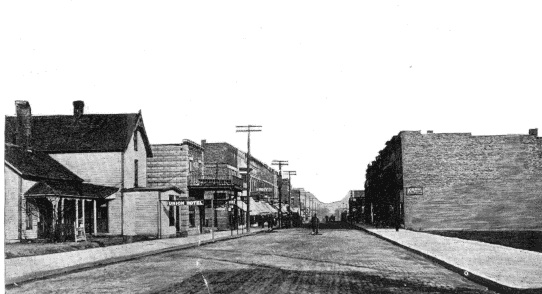 |
| WEST MAIN STREET LOOKING EAST FROM SOUTH WASHINGTON STREET. The contract for the paving of Main Street with brick, from Park Avenue to the railroad track was let on August 19, 1903. The work was completed and accepted by the Town Council on May 8, 1904. The contract also included the building of sidewalks 12 feet wide on each side of the street. The Union Hotel was Jasonville's first hotel and was owned by the Neal family. |
| On the 22nd of July 1906 the inhabitants voted on taking over the school property within the corporate limits. The proposal carried but the transfer was not made until a year later, when the town paid off all indebtedness against the property ($6000) as required by law and assumed charge of the school. Philbert Fry, Dr. T.I. Padgett and Edw. W. Bennet were at this time, July 29, 1907 named as the first Board of Trustees for the town schools. Again in March 1905 pride and hope swelled within the breasts of the citizenry, when the Terre Haute and Indiana Southern Traction Lines were granted a franchise to construct an interurban line through the city. The proposed line was to begin at Terre Haute, passing through Farmersburg, Shelburn, Sullivan, Linton, Jasonville, Hymera and rejoining the line at Farmersburg. The line was completed to Sullivan and used for several years until the automobile began to encroach on the business. Like the city streetcar lines, the interurban�s failure was no loss to the town. The several trains daily on the railroad afforded adequate passenger service. On April 4, 1906 the town board voted to appoint a town marshal to succeed John Benham, �who, in the opinion of the board is physically unable to perform the duties of said office�. However he recovered sufficiently to resume his duties and served until June 1907 and passed away in November of that year. He was known to, and addressed by, all as �Uncle� John, and many were the tales of his wielding the cane, which he always carried. I never knew him and was greatly surprised to learn that he was but 52 years old of age at the time of his death. On September 7, 1907 Thomas Anderson and Mike Mottsinger were awarded the masonry labor contract for the present city hall. The price was $4.00 per thousand for laying brick and 4 cents each for laying concrete blocks. Other labor was paid from 20 cents to 35 cents per hour. The total cost of the completed building was $1851.35. Also in this year the first fire truck was purchased at a cost of $450.00. This was a two wheeled cart with two chemical tanks mounted on it. |
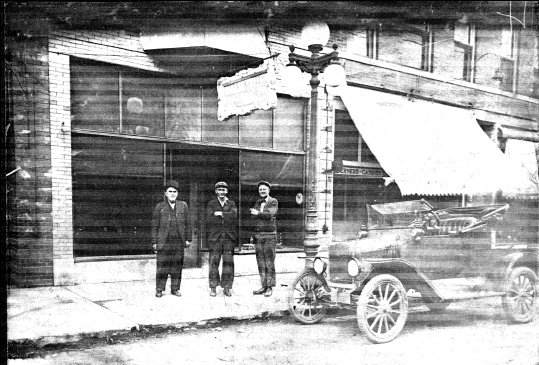 |
| M.A. Ingole, (left) and his Model T Ford with the wooden box on the back end |
| In February 1908 the town board petitioned the Greene County Commissioners as follows: �That the town be allowed the privilege of working on streets and alleys all able bodied male persons committed to the county jail, by any Justice of the Peace having his office in Jasonville, or upon his failure to pay any fine or costs for the violation of any town ordinance, or law of the State of Indiana and that such person be allowed $1.00 per day for each day of labor so performed. Work to be under the supervision of the town marshal or deputy who shall feed them three meals per day and will not compel them to do unreasonable labor, nor work longer hours than usual in work houses, and in case of refusal of any prisoner to work, greater punishment will not be imposed than by law provided for such prisoners in work houses. The county commissioners granted the requested permission and forthwith leg irons and balls (to you balls and chains) were ordered from the Detective Publishing Company, two sets at $17.25 each. The writer saw the project tried out on some transients and two or three local people at various times. One clause of the petition was fully complied with, �They did not compel the prisoners to do unreasonable labor�. My observation was that they did little if any worthwhile labor. The minute the officer left they sat down and remained in that position until his return. This was a near approach to the Georgia Chain Gang with all the brutality omitted. The �worker� had much humor and advice thrust upon him by the �Sidewalk Superintendents� standing about. This was just a �noble experiment� that didn�t work out. |
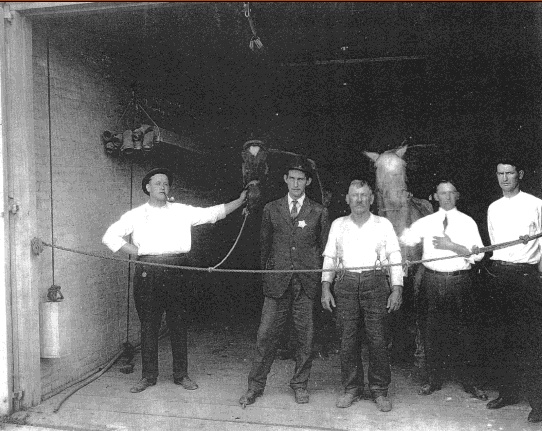 |
| 1912 Jasonville Firemen in their station in the city hall building which was built in 1907. Left to Right: James Dierdorf, Samuel Bates (constable), Levi Sinders, Samuel Preecs and Ben Mair |
 |
 |
| HOME |