| THE JASONVILLE STORY CONTINUED...... |
Chapter XIV In 1902 two teachers Miss Lillie Dean and Miss Margaret Allen taught The Jasonville Schools. In the following year the little one room brick schoolhouse was torn down, and a new, nine room brick structure erected in its place. At that time Nathan Powell was township trustee and John A. (Jed) Poe. Joel Ellis and W.H. Smith were members of his advisory board. The new building was erected at the cost of $12,000. Six teachers were required for the 1903 - �04 term, the attendance reaching 300 before it ended. During the next five years the enrollment increased to 750 requiring fifteen teachers. It again became necessary to provide more room to provide for the increasing enrollment. Nathan Powell who was serving his second term as trustee advertised for bids for the building of an additional six rooms. This annex was built in 1904 at a cost of $12,000. |
| The 1907-08 school year had as superintendent A.C. Williams and Oscar R. Shields as principal. During this year application was filed with the State Board of Education that the school be accredited as a commissioned high school. After an exhaustive survey and inspection, the high school inspector, Prof. W.W. Parsons, of Indiana State, recommended that the application be approved and the school was commissioned. Other superintendents before the school was commissioned were, L.L. Gooding, Fremand and Reubelt. The first graduating class of the commissioned high school (1908) was composed of three students, George Padgett, Mary Benham, and Edith Sebree. The second class (1909) had five: Walter Wakefield, Ray Wakefield, Margaret Wesnidge, Pearl Aldridge, and Forrest Hanna. Number of graduates in other early years were, 19fl� - 7; 1911 -9; 1912-21; 1913-23. During the 1918- 1919 school year the Flu epidemic was at its worst in the local community. I recall seven bodies were awaiting burial. All schools, churches, lodge and picture shows were closed in an attempt to stem the spread of the dreaded disease. The Red Cross brought in doctors and nurses and the school building was converted into a hospital. Several local citizens passed away in the building. This was the only year, after 1908, that we failed to have a high school graduating class. |
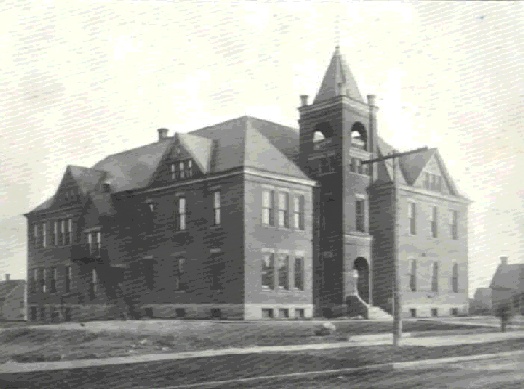 |
| JASONVILLE SCHOOL completed in 1904 |
| In 1908 Jasonville had its first high school football team under the management of Oscar R. Shields, principal of the high school, Jerry Ulen, a teacher, was captain. Johnson had attended school at Linton one semester and had gathered some of the fundamentals of the game. The other ten had never played in a game and most of them had never witnessed the playing of a game. Members of the squad were Ray Johnson, Walt Wakefield, Claude Johnson, Cliff Chandler, Jesse Ault, Disco Hubbard, Eli Miller, John Wasnidge, Blue Lowdermilk and Everett Osborn. There was no substitute team to scrimmage against the Regulars that year. The writer and two or three others who had played baseball during the season would don our baseball uniforms, and together with other fans, line up against the regulars. Not one of this scrub team had ever seen a game but we were quick to learn that it was rough enough. After a few sessions, during which I managed to survive, I was tearing down the field in pursuit of Deacon Ault who was making a run of fifty or more yards with the bail. I was faster than Deac and just about to tackle him from behind when he gave me what he termed a �straight arm� but what I had always called a left jab, in my amateur boxing experience. After a few days I could begin to turn my head a little. My back seemed to turn with my head and I turned it (my back) forever on football. Later when the school had no coach the fans, by popular subscription, hired Heze Clark of Rose Poly to coach the team. He would come down each morning on a 7:00 o�clock train and return to Terre Haute on one going at 8:37, thus having practice before school. His charge was the $1.00 train fare and either two or three dollars per morning. |
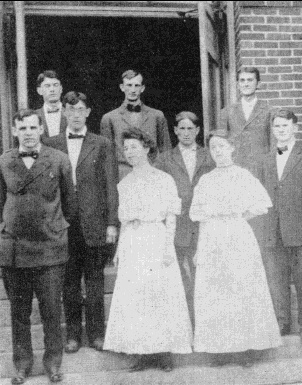 |
| CLASS OF 1909 The second graduating class of Jasonville HIgh School First Row: Alan Pate (Teacher), Pearl Aldridge, Margaret Wasnidge Second Row: Oscar Keith (Teacher), Forrest Hanna, Walter Wakefield Third Row: Oscar Shields (Teacher), Roy Wakefield, John Atkins (Superintendent) |
| In 1910 the cramped quarters called for additional expansion and the grade, or �ward� building as it was called, was erected that year. Soon increased enrollment made necessary further room and two portable buildings were erected at the site of the grade building on South Park Avenue. The latest addition to the building program was the high school gym in 1924. |
| Lack of time and space forbids my recording later history of the school. I leave that task to another writer in another day. The various high school annuals that have been published in late years should make the task not too difficult. City expenses for the year of 1908, fifty years ago, were as follows: Lights, $1467.94 Police, salaries and expense, $1047.83 Fire Department: sal. and exp. $219.87 Prisoner, exp. $112.46 Town Clerk, $197.00 Town Treas., $200.00 Town Atty., $200.00 Town Trustees (3 members) $395.00 Among the claims for that year I find this one: No. 359 - Ora Ax: services to date at fireman, $3.15. On May 31, 1909, Simon Hout was appointed day marshal and filed bond in the sum of $1,000 with a list of sureties that sounded like �Who�s Who� in finance. The list was as follows, D. W. Wetnight, E. VanFossan, James H. Persons, Oliver Speeker, Howard L. Hyatt, Alonzo F. Welcher, James N. Heap, Dr. Alfred W. Marshall, W. H. Freeman, Flem Van Meter, W.J. Hastings and Garrett Schloot. Needless to say the bond was quickly approved. Simon is still with us and will be 94 within 3 months from this date. Another of the early marshals still with us is Emanuel Souders. In April of this same year the town board sold a $1000 bond, the money to be used for assisting the still ailing light plant. In 1909 the light plant had passed into the hands of the Indiana Electric Transmission Co., a Cincinnati, Ohio, Corporation. Howard L. Hyatt representing this corporation was granted a franchise for a town water works. To help the promotion the town purchased $4500 in stock in the concern. This project, like the light plant in its early days, was wholly undependable. Several wells were drilled and a huge well dug near Latta but these entire fell far short of furnishing an adequate supply. As late as 1913, Charles McNamara, appeared before the town board, and requested permission to fill the mains with water from the P. Fry pond, as the supply from underground had failed. This shortage of water, together with antiquated equipment at the plant, permitted the flames to range unchecked during the great fire of 1914, which will be told of in a later installment. After his fire the water in the underground workings of the old P. Fry mine was tapped. The water was unfit for human consumption until Arthur Symmes acquired the property, and in 1924 perfected an aerating, settling and filtering system, which with added chlorine, made the water suitable for domestic use, except for its excessive hardness. The present supply comes from wells along Eel River and ranks with the best in the state, and in grains of hardness stands near the bottom. In pumping up to 8,000,000 gallons per month, the water level shows no appreciable variation, which is indicative of a lasting supply. On June 19, 1911, Ewing Shields of Brownstown was awarded the contract for paving, with brick, Meridian Street from the railroad to Shanklin Street for the price of $18,275. This was the last of our paving projects until East Main was completed in the early 1920s. For a time we had two weekly newspapers, when Pius Lankford of Clay City started the Two County News in 1912. Pius was quite capable as a newspaperman, but the town was just too small for two such publications. |
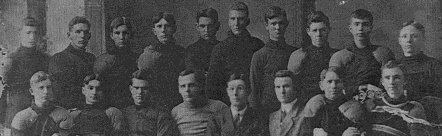 |
| 1908 - THE FIRST FOOTBALL TEAM Seated L to R - Ray Hanna, Oscar Gamon, Claude Johnson-Captain, Jerry Ulen-Coach, W.W. Keith-Principal, Walter Wakefield, William Walters I, Eli Miller, Standing - Miller, John Wasnidge, Fred Miller, Disco Hubbard, 'Chick' Chandler, Jesse Ault, Ray Johnson, Curt Letsinger, Fred Bledsoe, Wayne Nash, ('Blue' Loudermilk and Everett Osborn are not in picture.) |
| I have often been asked why Jasonville became a city. I have that story in mind quite well, as I was the last town clerk and the first city clerk, thereby holding office through the transition period. In those days most every election had a wet and dry angle. Before the National prohibition act we had laws providing, at various times, for state wide county wide, and township wide prohibition. In 1912 the township local option law was in effect. This law provided that when a certain per cent of the voters of the township (only men were voters at the time) filed with the county commissioners, a petition, an election would be held to determine whether the sale of alcoholic beverages should be prohibited in said township. The law further provided that an incorporated town and the township voted together, but an incorporated city vote separately from the township. Wright Township had had such an election and with the town participating had voted dry and the saloons (now taverns) were out of business. Stockton Township and Linton had such an election and Stockton Township had voted dry. Linton, being an incorporated city, voted separately from the township and voted wet. With several passenger trains, and a fare of only twenty cents, it was not to difficult for the Jasonvillians to catch a train for Linton at 6 p.m. drink for three hours and return at 9. This routine didn�t seem to inconvenience the drinkers too greatly, but the local saloonkeepers and bartenders wanted none of it. They immediately set about to get sufficient signatures to call an election to change the town into a city. Having nothing else to do they soon had the required number and an election was called. On one side was arrayed the temperance people and those who were against the extra taxes a city government would bring about. On the other side were the people who believed in the saloon as an institution and those who had been put out of business and jobs by the township voting dry. Those favoring the city idea won by a scant majority, 18, I believe. Then came the conventions of the Democrats and Republicans to nominate men to represent them in a city election to be held in April 1912. We had no primaries then. The voters of each party would meet on dates fixed, in a hail or in the opera house, and the voters assembled would nominate the ticket. I attended the Democratic convention, held in the opera house (only as an observer) and witnessed one of the neatest pieces of political strategy I have ever observed. Again we had the �wet� and �dry� forces, contending within the parties. Stanley D. Dempsey was labeled as �bone dry� and a stickler for rigid enforcement of the liquor laws as well as all other criminal statutes. The liberal element was divided between the candidacies of S.P. Mills and M.A. Thomas. Please, understand, that both were prominent citizens and businessmen and had nothing in common with law violators. It was just a case of the saloon men, and their followers, feeling that either of them would be more lenient in enforcement of the liquor laws, such as closing hours, sales to minors, than would Dempsey, who alleged that he would rigidly enforce all the laws. The three were placed in nomination at this Democratic convention. It is the usual practice when there are more than two candidates and neither receives more than half the entire vote on the first ballot, the low man drops out and another ballot is taken, and so on until one receives a majority of all votes cast. Dempsey had more potential votes than either of the two, but the combined strength of the two outnumbered Dempsey�s. Dempsey must win on the first and only ballot or be defeated. Upon the three being placed in nomination, the chair recognized a Dempsey follower, by prearrangement. He made a motion that the candidate receiving the highest number of votes be nominated. The motion was hurriedly stated and by a voice vote carried. The vote was then taken and Dempsey secured the �highest� vote but by no means a majority over the other two. Had the usual custom prevailed and the lowest man (Thomas) been dropped, Mills would have been decisively beaten Dempsey on the next ballot. The Dempsey forces had out maneuvered the opposition, but in an open and above board manner approved by the convention. Dempsey was elected in April 1912 over James D. (Squire) Linthicum by 11 votes. This first city administration held their first session on May 6, 1912 and was composed as follows: S.D. Dempsey, Mayor; Ben H. Sink, Clerk; Oliver Speeker, Treasurer; Fred L. Stalcup, Homer Baker, Everett Ingleman, Jesse Walters and J. Ed Barnhill councilmen; William Wakefield, chief of police; John L. Stewart, Patrolman; Oscar R. Shields, City attorney; and Levi Sinders, street commissioner. Of this group only Homer Baker and the writer are still living. At the first regular city election in 1913 it was difficult to distinguish party lines. There were two independent tickets in the field with candidates as follows: Citizens Party, S.D. Dempsey, Union Party, Jas. D. (Squire) Linthicum; Democrat, Dr. T. I. Padgett; Republican, Arthur R. Mayfield. As before the race was between Dempsey and Linthicum and Dempsey won by about twenty votes. One member of the council was elected with Dempsey on the Citizens ticket, while four and the clerk and treasurer of the Union Party were victorious. The Republican and Democratic candidates secured very few votes and none came close to being elected. This was another piece of political strategy that won out. Dempsey�s followers sensing that he could not possibly be nominated on the Democratic ticket, prevailed upon him to become a candidate on the Citizens� independent ticket. Stanley D. Dempsey was a capable, conscientious and fearless public official. I have no hesitancy in saying that he was, by far, the best mayor in the city�s history, in the opinion of this writer. By this statement I mean to cast no aspersions on any subsequent mayor, for the writer too subsequently served in the capacity. In 1917 Dempsey resigned the office and I was appointed to fill out eight months of his unexpired term, since the beginning of the city and in order the following have served as mayor: S.D. Dempsey, Ben H. Sink, John Brent, Mort Ladson, Ervin Huffman, Mack Walters, John Brent, William H. Slough and our present mayor, 1958, Earl R. Row. |
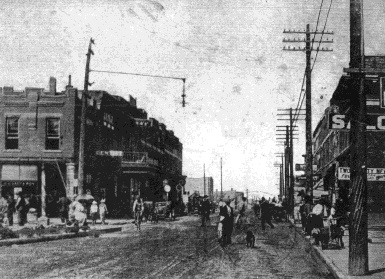 |
| MAIN STREET LOOKING WEST AROUND 1912 The Two County News sign can be seen on the right |
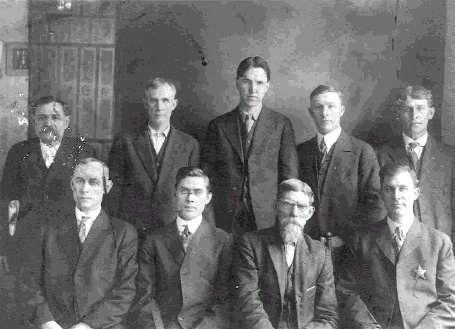 |
| 1918 CITY COUNCIL |
 |
 |
| HOME |