| THE JASONVILLE STORY CONTINUED...... |
| Chapter XII I have purposely left the coming of Lewis Rogers for a latter chapter, although he settled at an early date. In 1848 he secured from the Trustees of the Wabash and Erie Canal the following described tract: Beginning at a point on Main street one fourth mile East of Meridian, thence South one half mile to the Shanklin street road, thence East one fourth mile, thence due North to Main street, thence West to the place of beginning, containing 80 acres. I give this description that my readers may easily identify the land. The description is of course was different, �The West half of the southeast quarter of Section. 4-8-7�. He built his first house near the place where the railroad reservoir is now located. He was the father of six sons and six daughters. One of these sons he named after himself and this younger Lewis Rogers was the father of Addison Rogers, a well known as �Squire� Rogers, a Wright township Justice of the Peace for several years. Another son of Lewis Rogers, Sr., was an uncle of Squire Rogers, was Jason Rogers after whom the town �Jason� ville got its name. About the year of 1859 Jason Rogers opened a store on East Main St and about half mile East of Meridian. The land that first became Jasonville changed hands as follows: Philbert Wright in 1849 secured from the United States the forth acres the Northeast corner of which is the intersection of Main and Meridian streets; in February 1853 he sold it to Andrew Fry in 1854; Fry sold 2.45 acres to 1853 he sold it to Jason Rogers; Rogers sold it to Andrew Frye in 1854; Fry sold 2.45 acres in the Northeast corner to Nathaniel P. Merritt in December 1854; Merritt sold these 2.45 acres to Jason Roger in September 1855. In 1858 Jason Rogers filed, on January 23rd, with the Recorder of Greene County the �Plat of the Original Town of Jasonville�. The boundary of the plat was as follows: North, Main street, West, Lawton street, South, Cook street, and East Meridian street. In 1855 he had built a frame building in and moved his store from East Main Street into it. The location of this store and the manner in which it was named has been the subject of controversy, so I give it to you as it was given to me by Uncle Billy Buckallew many years ago, standing in front of the spot where the store had formerly stood. A short time after Jason Rogers had moved his store to the southwest corner of Main and Meridian streets, probably in 1855, Uncle Billy came to town with butter and eggs to trade for needed supplies from Jason�s store. He hitched his team at a hitch rail on the east side of the store. While loitering about the store, before leaving with his supplies, he dipped a stick, or rather a paddle, into the tar bucket of the wagon and scrawled on the East side of the store �JASON VILLE�. I have always had a yen for learning the facts of such lore and legend and I write it as it was told to me by �Uncle Billy� many years later standing on the same corner. I wouldn�t know where to secure more accurate information. It was quite natural that three years later when Jason filed the first plat of the town lie kept the name of Jasonville, and Jasonville it has been for one hundred years. The plat contained thirteen lots numbered from 1 to 13, inclusive. Rogers soon sold out his store to W.B. Squires and it is reported he operated a store at Howesville afterward. I have little definite information concerning the later activities of Jason Rogers. There was a Jason Rogers from this community in the Union army and I assume it was the same man. Bill Slough, whose wife was a relative of Rogers says that he understands Rogers moved into Illinois and was quite a successful businessman there in later years. Other additions to the town before the civil war were the Gadberry Addition, South of Main and East of Meridian, and the Barnes and O�Donnell Addition, North of Main and West of Meridian. The name had been established and these were filed, as were all the others to follow, as additions to the Town of Jasonville, Greene County, Indiana. There is no other town or city of �Jasonville� in the United States, nor in the world that I have ever learned of. Until some local citizen goes into the wilds and founds a town, and names it after, and in honor of his old home, I guess, in the parade of town and cities we will walk alone. |
| It is said the bears which ambled through the forests and over the prairie, that is now Jasonville, lay dormant in hibernation through the long winters. After Uncle Billy Buckallew christened the village in 1858, the infant town, emulating the bears, went into long, fitful slumber showing little sign of life. Unlike the bears it failed to awaken the following spring. In fact, many springs passed while the village still dozed. The slumber more than doubled in duration that of Rip Van Winkle which was reputed to have lasted for twenty years. Forty-two springs had come and gone and the year was 1900. The hamlet aroused one morning early in that year, shook itself and cocked an attentive ear to the south. The sound of �choos� and �chugs� the like of which had never before vibrated through the local forest and prairie, came faintly from the south. Then on March 31, 1900 the first locomotive, a work train crossed Main street building track northward. Thus the town�s first connection with the outside world, except by horseback or horse drawn vehicle, came with the building of the Southern Indiana Railroad later the C.T.H. & S.E., and now the Milwaukee road. |
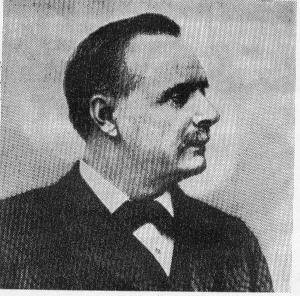 |
| Jason Rogers filed the Plat of the Original Town of Jasonville on January 23, 1858 with the recorder of Greene County. The boundaries of the plat were as follows: Main Street was the northern boundary; Cook Street the southern boundary; Lawton Street the western boundary and Meridian Street the eastern boundary. |
| JASON ROGERS FOUNDER OF JASONVILLE JANUARY 23, 1858 |
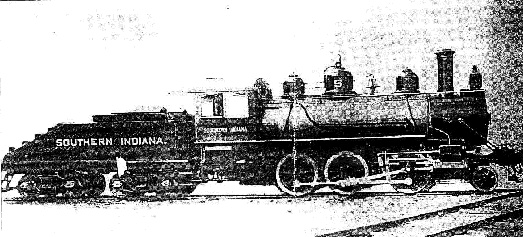 |
| SOUTHERN INDIANA RAILROAD |
| John R. Walsh a Chicago capitalist and banker had acquired some stone quarries at Bedford and bought a railroad extending from Elnora to Westport in Decatur County. This railroad was known as the Elnora & Richmond, but the builder, Mr. Mackey, died before its completion and it ended at Westport. There were no coalmines on this line and Walsh needed coal for his quarries and railroad. He planned and surveyed a line from Elnora northwest to a point near Sullivan, thus tapping that county�s coalfields, which were already in operation. Linton coalfields have been opened by the building of the IC. railroad through the town was already quite a mining center. The proposed Elnora Sullivan line would have missed them several miles to the south, so they set about trying to induce Walsh to build to Linton and northward to Terre Haute, there connecting his road with other important lines. Also the city of Terre Haute itself was an important asset to a railroad, it being third in size in the state at the time, only Indianapolis and Evansville having more population. Linton�s business and coal interests prevailed in their endeavor, after promising the builder to furnish free right of way through Greene County a distance of more that twenty miles. Landowners, anxious for a railroad donated the land for right of way, or sold it at an extremely low figure. The money required was raised through popular subscription. It is regrettable that John R. Walsh, the man, who built the railroad, was given a federal prison sentence for acts indirectly connected with the project. He was the owner of a Chicago Savings Bank and was charged with violation of the federal banking laws, although not one of his depositors lost a penny. When a pinch came in the financing of his mining, quarry and railroad interests he so manipulated the funds of the savings bank that it constituted a violation of the law. Suffering from a fatal illness during his prison term, petitions were circulated in the towns along the line and among the depositors of his Chicago savings bank, requesting William Howard Taft, then president, to issue a pardon that Walsh might die outside the prison walls. The petition was granted and the pardon issued, but as I remember it he did not live long thereafter. Many times down through the years, when reflecting back on the early days of the railroad, I have been well pleased with myself for having carried one of these petitions. It was some months after crossing Jasonville�s Main Street that passenger service was established on the new road. A round trip for Terre Haute could be had for $1.00, but each Sunday excursion rates prevailed and the round trip could be made for fifty cents. A ticket to Indianapolis then, by way of Terre Haute, or Beehunter was $1.70. This may prove a little difficult at one time we had fourteen passenger trains daily through Jasonville, seven each way. Now, no passenger train comes within the boundaries of the whole County on this, or any other road. If describing Jasonville at the time of the boom I would term it a cloud of dust in the summertime and a sea of mud the rest of the year. Business and residence buildings were going up everywhere. Not a sidewalk, not a street or road with a surface other than mother earth. Wagons by the dozens traveling in all directions hauling brick, lumber merchandise, and household goods. Teamsters cursing as their wagons bogged down and most of the load was removed before the vehicle could be extricated. Get this picture in your mind and you will have an idea of the situation. On June 1, 1901 the village was composed of six or eight business houses built largely of rough lumber and thirty-nine dwellings, eight of which were farmhouses. By Christmas of that year the dwellings numbered ninety-seven and in the summer of 1902 work was being done on 142 dwellings and business houses at one and the same time. All this activity, and the huge amount of material required for the several mines being sunk, caused new businesses to start. In 1901 a Mr. Burnham started a brick kiln on the north side of East Shanklin Street, east of the railroad. The clay at this point was not suitable for good brick and competition forced him out of business after some two years. In 1902 two brothers from Terre Haute named Asheranian started a kiln on the east side of the railroad near Latta Yards. The material here seemed more suitable and the brick of a little better quality. A year or so later a Mr. Cantrell started a kiln on the West side of Meridian street and south of the Latta Creek switch, but the bricks were used for inside work and the inside courses of walls, but for the most part those for outer use were imported from Brazil and elsewhere, many car loads located on the siding at the same time. The year the railroad was built, 1900, J.M. Langton located a sawmill just east of the tracks on the north side of Main Street. It transacted business under the name of the Dimension Lumber Company and produced a high grade of lumber with excellent equipment for that day. It did an enormous business during the boom. Later Langton sold out to Humphreys who operated the mill for a short time, then shipped it to Mississippi. Langton went to Los Angeles where he was quite successful in a lumber, sash and door factory. During the time his mill was in operation a Mr. McGee set up a sawmill near where the Asheranian brickyard was located near Latta. After operating some two years the mill burned and was not rebuilt, McGee buying a general store on south Meridian Street. |
| Again I digress to comment upon an incident, which attracted wide attention at the time. In order to refresh my memory, I looked up Bill Slough for facts and confirmation. This McGee had a son named Harry who was well known here fifty years ago. He had a trained horse, �Old Logan� and a trained dog whose name neither Bill nor I could recall. He put on performances with these two animals in opera houses and halls through out this section. It was more interesting to the writer to see him get his horse to an upstairs, door or though a window, by means of a chute or ramp, than to witness the actual performance. Harry McGee had gone to Indianapolis and engaged in the automobile business. He conceived the idea of racing a Pennsylvania fast passenger train from Indianapolis to Terre Haute, Harry driving a Cadillac touring car. According to Bill, this was about 1915 and he was at the Penal Farm, not as an inmate but on an official inspection, and standing at the gate saw I4arry go by. The Cadillac Company had widely publicized the event and the National Road (now Road 40) was cleared of traffic and thousands of spectators lined the roadside. There was no concrete, brick or blacktop on this road and it was full of holes, and had many hairpin turns. McGee partly offset this by filling the back end of the car with sand bags and Bill says he had a huge black man in the back seat with a hand clutching each door. Anyhow, to the surprise of most everyone Harry won the race. Thus, another homeboy attracted national acclaim, but with the building of better roads and faster cars the feat was soon forgotten. Back to the sawmills: A few years after McGee burned out, George Stultz and Harry Miller engaged in the business and continued for several years. I don�t recall that their mill was ever located within the limits of the town, but both lived here and local people and mining concerns were their main customers. In 1901 Herman Luben and Walter Neal built a feed mill on E. Liberty Street near the P. Fry mine. Later it was moved to Main has occupied these premises most of the time since that date. As the town grew by leaps and bounds the winter�s mud became deeper and the summer�s dust denser. Still there were no sidewalks and no gravel or rock on the streets or roads. The depot agent kept half dozen pairs of gumboots of various sizes for rental. A traveling salesman, (or drummer) as they were known then, coming in on the train would rent a pair of boots from the agent for twenty-five cents. He would then put them on leaving his shoes. After sloshing through the deep mire to call on his trade, he would return to the station exchange his footwear again and take his train out. The only walks or porches (uncovered) were in front of a few places of business. |
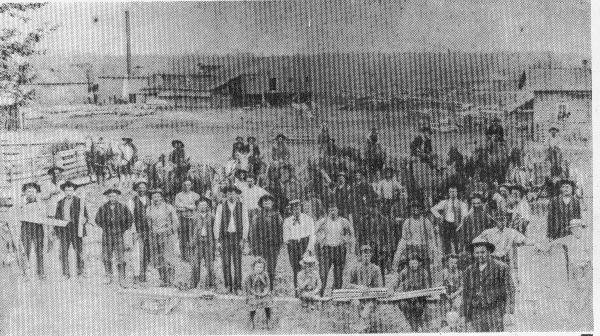 |
| DIMENSION LUMBER COMPANY was located where Ridinger's IGA now stands. The mill pond was located where the Dollar General Store is now and the road in front of it often floods in heavy rains. |
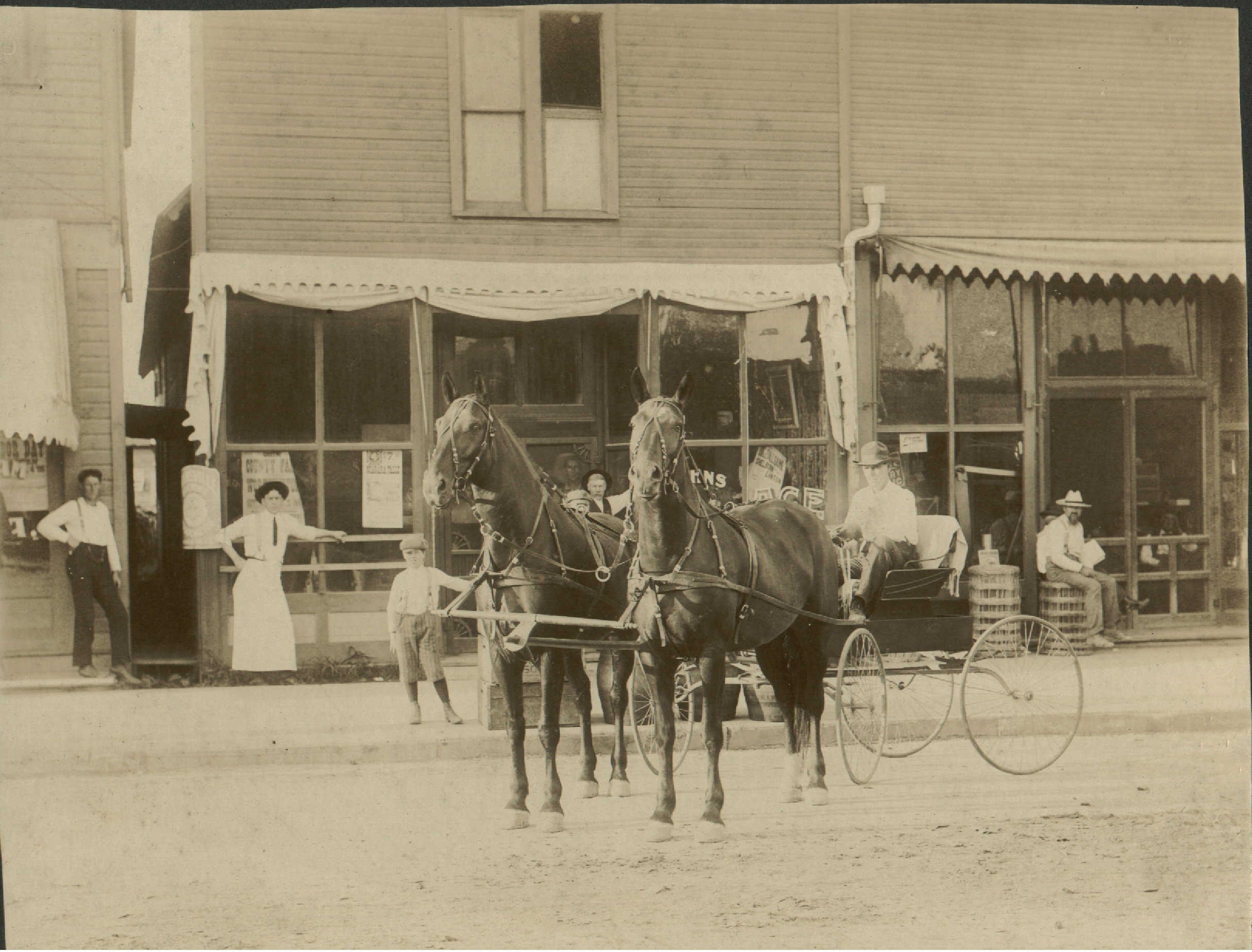 |
| Television's version of Main Street of the early cow towns is almost an exact duplicate of Jasonville's Main Street with the wooden framed, false front buildings that sprung up like mushrooms. |
 |
 |
| HOME |