| THE JASONVILLE STORY BY BEN SINK CHAPTER 11 CONTINUED |
Another early post office was named Wright Post Office and was located about one fourth mile East of Lebanon Church on the south side of the road. Eugene O�Bryan, who occupies this land at present, says the office stood in the front yard of what is now his home. This office was probably named after Richard Wright, as was the township. He likely lived in the community as he was buried in the Fry Cemetery, located about one half mile East, in 1843. While dealing with this community, I will tell of a happening of a few days ago. Lulu and Otto Sexton brought in a gavel made by their father, Howard Sexton, who passed away in 1920. To the gavel was fastened a card on which was inscribed, in Howard�s handwriting, the following information: The gavel was made from part of a burr oak tree under where the first election was held in Wright township, in which only eight men voted. The tree stood on the south side of the road about three fourths of a mile east of Lebanon near where Lattas Creek crosses this road. No ballot box was used; the men made out their tickets and dropped them in a hat. The gavel�s handle was made from a white oak log, which formed a part of the First Baptist Church in the township, built in 1823. This church stood about one half mile north of the point described above where Lattas Creek crosses the road. A few years ago the remains in a cemetery, which stood at this church, were taken up by the Maumee Collieries Co. and moved to Lebanon cemetery. I beg my readers� indulgence as I offer a strictly personal observation while dealing with the Lebanon community. For many years just north of the church on the same plot of ground, stood a schoolhouse. It was here that Emma Benham, who later did me the honor of becoming my wife, taught her first school. This was in 1902 and she, a slip of a girl, was less than three months past fifteen years of age. She was the only teacher and had all the grades from the first to the eighth. Many of the pupils were larger than the teacher and several of them were older. She continued teaching there and in Jasonville for a period of nine years. On August 15, 1956 that greatest of all Teachers, called her for service in Paradise. We miss her tremendously. She rests within a stone�s throw of the spot where she began her teaching career, which seems fitting and proper to the writer. Jasonville was officially but seven years of age when the civil war ended. When the boys came home and many of them were still boys and young men, they brought with them insatiable thirst for a better standard of living than they had heretofore known. Many of them had never been outside this immediate community before. They had looked with wonder upon the busy cities, the portentous homes and the great plantations of the old south. The thrifty among them began to acquire more land, erect more comfortable homes, place more land under cultivation and, by fencing their premises, prepare for the greater production of livestock. The added income from this expansion of farming called for added labor and those not so fortunate or so ambitious found work on these farms. Splitting rails for fences, clearing new ground and other general farm work was from sun up to sun down, and the toil was mighty. The only outside work the settlers had known was when a few of them found employment on the Wabash and Erie Canal in the forties. There was no ready-made entertainment for the people of this day, and few could have bought a ticket if there had been. A family and their neighbors provided their own enjoyment for their leisure hours. Young men found much pleasure in racing their horses up and down the dusty Main Street of Jasonville, which then was little more than a country lane. Hunting, fishing, and trapping afforded not only sport for the men, but excess of the game so taken produced cash income. Thousands of wild turkeys and quail were trapped throughout the year. It was a trapper�s paradise for rabbits, possums, coons and mink and other small food and fur bearing animals. Ducks and geese in countless thousands stayed in the lowlands during migratory season. Other forms of entertainment were spelling bees, singing schools, quilting parties, husking bees and log rolling. In the forefront of every community you found the preacher who labored to save souls and the fiddler who labored to help wear out soles. Country-dances were well attended and in many cases by the same people who kept alive the churches. The rasping moans and groans of the fiddler were sometimes pretty awful, but like many of the early preachers, what they lacked in artistry, they more than compensated for in fervor, enthusiasm and volume. Down through the early years there was little variation either in labor or pleasure. Sullivan had a railroad as early as 1853 or 1854 and in the years following the civil war grew into quite a trading post. Terre Haute, however, offered greater inducements to Jasonville people than elsewhere. Here, their products for sale found a readier and higher cash market, and it was a day long to be remembered when such a trip was made. A wagonload of apples, potatoes, corn or maybe mixed load of all three with a fat hog or two would be sold for cash and a part of the money spent for wares that could not be had in country stores. A boy who was lucky enough to make this trip with his elders to �Terry Hut� was the envy, and the center of attention, among his friends for months to come, as he told of the wonderful things he had seen. In 1869-1870 Greene County�s first railroad was completed, passing through the town of Worthington, Switz City, Lyons, and Marco and known as the I & V (Indianapolis and Vincennes). The various communities vied with each other in those days to have a railroad built within their borders. The state having given thousands of acres of land to the old canal with little lasting results now enacted a law permitting the townships to hold elections voting on the proposition of levying a tax to be given as a donation to a railroad company for building across the township. For a brief period Jasonville had illusions of grandeur. In 1872 Wright Township asked for, and was granted the right by the county commissioners for such an election. The issue vote on was permission to rise by taxation the sum of $5900 to aid the Cincinnati and St. Louis Straight Line Railroad in building across the township. The proposition failed to carry by a vote of 98 for and 104 against. Later the same year another vote on the same question failed by a vote of 58 for and 155 against. The issue had carried in Smith Township by a vote of 59 to 33. Again in 1881 Wright, Stockton, and Stafford townships petitioned and were granted the right to vote on financial aid to the Greencastle, Eel River and Vincennes Railroad to build a line through the three townships. For some reason, the commissioners rescinded their order for an election before the vote was taken. Jasonville was doomed to wait several years for the coming of a railroad. An old county history compiled by Jack Baber in 1875 devotes only the following to Jasonville. �The population of Jasonville is 100. Business houses; one dry goods store, one drug store, one post office, and a notion store. It has also three harness shops, two blacksmith shops, three doctors, one school house and one church� Jasonville again bestirred itself when the middle eighties the railroad (now C & E I) built a spur into the coalfields of Jackson Hill, Dunnville, Hymera and Alum Cave. Later they bought right of way from this spur to, and partly through Jasonville but the road was never built. This right of way crossed Main Street at Kentucky Street, angled through the city park and connected with North Meridian Street at Gray Street. Various individuals have long since brought up most of this land for delinquent taxes. A few men from Jasonville and surrounding countryside secured work in the mines opened up by this spur of the railroad. Most of them walked the five miles from their homes to Alum Cave, regardless of the weather. The first labor strife in this section was when the owners of the coal company sent strikebreakers from Chicago to Alum Cave during a labor dispute. Other miners of Sullivan County and the strikebreakers driven out without bloodshed organized a march of armed men. The strikers on the tracks burned a few railroad cars of coal, presumably where the spur connected with the main line near Farmersburg. Some of the early merchants of Jasonville were: Green Price, John Shaw, James T. Warrick, Lewis E. Letsinger, a Mr. Sappington, Jack Morgan, Martin Bonham, M. Neal and Sons, George Edmonson, Wes Crosby, Haviland and Aiken, John Gregg, Tennis and Company, Warrick and Perkins, Smith and Son, Jim Woodrow, Guy Bush and Co., Howell and Perkins. Wash Hays and Jason Rogers mentioned elsewhere. The business experience of these men and firms covered a long period of years, but many of them owned the same stores and some for a comparative short period of time. All were here before the mining boom. Dr. Kelshaw, who sold out to Stark and Branden and it then came into the hands of Ringo and Campbell, owned the first drug store, and no crossroads town was without one. This store then seemed to pass out of existence and a new drug store opened by Dr. Shanklin who sold to James D. Linthicum and taking in one of the Asbury�s as a partner it became Linthicum and Asbury and next Asbury and Cummins. |
| The first local gristmill seems to be one built by Wilson Culbertson in a hollow along the road, which follows the Eastern boundary of Shakamak boundary of Shakarnak state park. This would be North of the west Main street road. It is believed to have been started in 1855 or 1856. The writer thinks this is to be the same mill his old friend Barr Coulson told him of many years ago and which Barr referred to as Kemp�s mill. Kemp�s owned ground in this part of Wright Township and it probably got its name in this manner. According to Barr it was a meting place of the Knights of the Golden Circle, a society of southern sympathizers during the civil war. As I recall Barr�s lengthy narrative concerning the matter, he did not charge that the Kemps were members of the society. The mill was a steam mill and operated until about 1868. At an early date a mill was built on the ground we would now locate as cornering up in the Southwest corner of Meridian and Cook streets. They ground corn and feed but made no flour. It changed hands several times, being owned in turn by Wes Crosby, Jim Taylor, Alex Bonham and several others. The first saw mill in town that we learn of was located on the North side of East Main Street at the corner of Davis Street. Many late corners will remember the old millpond at this point and a few are still around who skated on it. The writer has just cause to remember it as he was tossed into it as a small part of the torture he suffered at the hands of his friends for having forsaken their ranks by getting married. Another saw mill was located just East of where the city hall now stands. This was at a later date and was owned by Isaac Bledsoe. Later Oscar Dougherty and John Bledsoe operated this same mill, or another on the same site. Oscar Dougherty, now deceased, was an old and dear friend of many, many years and I helped bear him to his last resting place. He built his home, which still stands, the last residence in the city limits on the east side of south Meridian Street. I have heard him tell often that when he built it in 1893 there were but three houses between it and Main Street on Meridian. These were the Heath, Humphreys and Perkins homes. Dr. W. B. Squire, mentioned elsewhere, was the first doctor to locate in the new town. In 1861 he volunteered in the Union army and his practice was taken over by Dr. Johnson who in turn enlisted in 1863. Following Dr. Johnson in order were, Drs. Coble, Briley, Ammerman, Fellows, Saucerman, Welty, Kelshaw, Shanklin, Taylor, Branilette, Asbury and Selfridge who came in 1897 or 98 and was the last to come before the mining boom. |
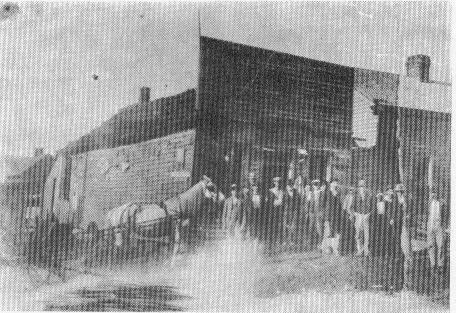 |
| EARLY 1900's--JOHN GREGG'S GROCERY STORE located on North Lawton Street just off Main was John Gregg's Grocery Store and residence. On the left is Jasonville's first delivery wagon, horse drawn, of course. This building and the residence were later destroyed by the fire of 1914. |
 |
 |
| HOME |