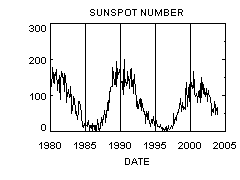
According to a study performed by two Danish scientists, the duration of the cycle of "solar acne" has a profound effect on the Earth's average temperature: quick cycles corresponds with a warm climate on the Earth, and slow cycles bring chilly decades.
The count of dark magnetic blemishes on the face of the sun rises, falls, and rises again once every 11 years, and the last peak was in 1990. The sunspot cycle can last from 9 to 13 years. During the past 100 years, the sun has shortened it cycle from 11.7 years to 9.7 years, and the global land temperature has risen by 0.6 degrees.
Nigel Cander also performed an analysis to explain the cooling that occurred between 1940 and 1970. During this 30 year period, carbon dioxide levels in the atmosphere began to rise, yet the Earth's average temperature declined. The solar model fit this scenario perfectly, because the Sunspot Cycle had slowed from 10.2 to 10.7 years between 1940 and 1970. After 1970, the length of the sun spot cycle increased, and thus raised the Earth's temperature.
Many environmentalists claim that these findings are merely a coincidence, and that the Greenhouse Gas Theory is valid, thus warning of a catastrophic global warming. More studies are currently underway to examine the role the Sunspot Cycle has in global warming, and whether human activity or solar activity is responsible for global warming.
Scientists have also developed a new theory - that electrons from the sun are to blame for the thinning of the ozone layer. In 1996, a set of four European satellites called Cluster went into orbit, and collaberated with American and Russian space missions to observe how wind particles from the sun interact with the Earth's upper atmosphere (stratosphere) and the Earth's magnetism. Scientists are currently studying the results from this mission.