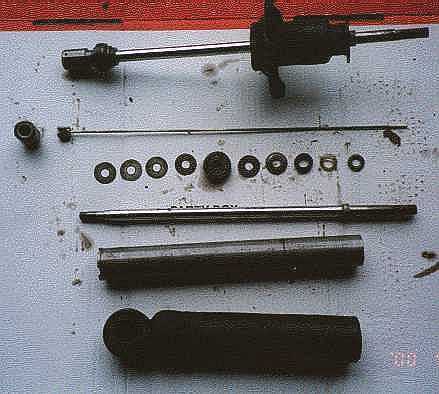
The second generation RX-7 GXL model has a complicated contraption called Auto-Adjusting Suspension that provides control over the suspension damping: ride comfort in cruise no-input situations; firmness in handling lots-of-input situations; and anti-dive when high brake line pressure is measured (firm front, soft rear). There are two user settings (normal and sport) that choose a different program for the system. The shocks and struts, as seen from the outside, have a thin shaft in the centre of the main shaft that can turn freely. The thin shaft is acted upon by a servomotor that is mounted atop the shaft itself under the car's rear speakers, and under the hood.
Each shock and strut has three modes of firmess that are set by a computer box in the ass end of the car beside the spare tire that controls the position of the 4 servomotors.
After replacing my old and worn shocks and struts with conventional units (the AAS wasn't working anyway) I had these AAS units and a lot of dangerous curiosity left over. Like most personal problems, it's nothing a hacksaw can't solve. One of the front struts was non-resistant to compression and soft in rebound, the other's shaft was only a bit wobbly. When I laid that second one on the ground, some very dirty smelly water poured out (?) and once that was empty (!) it was void of force in both directions. The two rears were simpler: both were just very soft. The empty front one wasn't too messy, the other front dribbled lots of oil when it was cut, and the rears? Well since they had pressure left, when the saw got through the case there was this nifty hydraulic-oil fountain about two feet high. There's a lot of oil in a shock absorber.
Mechanism at end of the shaft, below piston.
Dog-clutch shaped rotary valve core with holes in its lower end (where the shaft attaches) to let oil through.
Valve body has two sets of holes and three positions: no holes position, a single hole position, a two holes position. The closed position is the hard setting, the one-hole position is the intermediate setting, and the two-holes position is the softest setting. The two hole positions are 90� apart, and reflected on the opposite side of the valve body. These holes are lined up one above the other. The picture to the left shows one of the single holes, the double hole has one above it.
The core sits inside the valve body and can turn freely within it.
The centre shaft turns the dog-shaped valve core that exposes its open sides to the holes. This will let some hydraulic fluid through the main shaft around the conventional valving piston to relieve pressure.
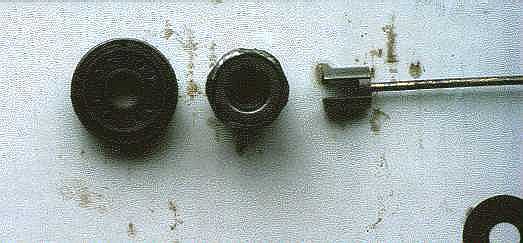
The valve assembly is fastened together by forging the valve body around a disk plate, like a rivet in reverse. The forged lip can be ground off to separate the assembly.
The rear shocks have the words "FB52 28 700C / TOKICO" stamped on their side.

The front strut's mechanism is the same as the rear strut, only configured inverted to the rear strut.
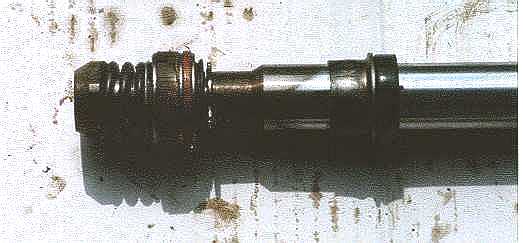
The valve body is contained in the shaft itself, and above the piston, not below it.
One set of holes per side, not two, in the upper shaft, with a mirrored set of holes 180� on the opposite side of the shaft.
A rotary valve core inside the shaft has two sets of holes set 90� apart: a single hole; and a double hole; for the same three possible positions as the rears. The holes are on the middle-sized diameter, right above the piston in the picture. below, and one is barely visible on the left side of the dark portion.�These holes are mirrored 180� on the opposite side of the shaft.
The holes in the valve core are presented to the fixed holes in the shaft to provide one of three bypass options for relieving pressure.
Unlike the rear, a little bit of grinding doesn�t get them apart. A lot of grinding might separate the 4 welds around the shaft but is also going to be pretty destructive, and as you can see I only had one good one to use. The good one had a very pretty upper seal and bearing at the top of the cylinder, but the bad one didn�t have this upper seal at all (good quality control, dirt for brains) and was filled with water, not hydraulic fluid. That explains the rust on the assembled piston in the above picture that you can compare to the one below. Without this bearing support the shaft rested on the case and wore a bigger hole, and fretted off a lot of the chrome plating.
The front struts also have the words "FB52 34 700A / GAS FILLED / DO NOT OPEN / DO NOT HEAT / KYB PJ08" stamped on their side, in both English and Japanese. I had previously thought that the AAS shocks, and all RX-7 dampers, were made by Tokico. Ah, the magic of competitive quoting.
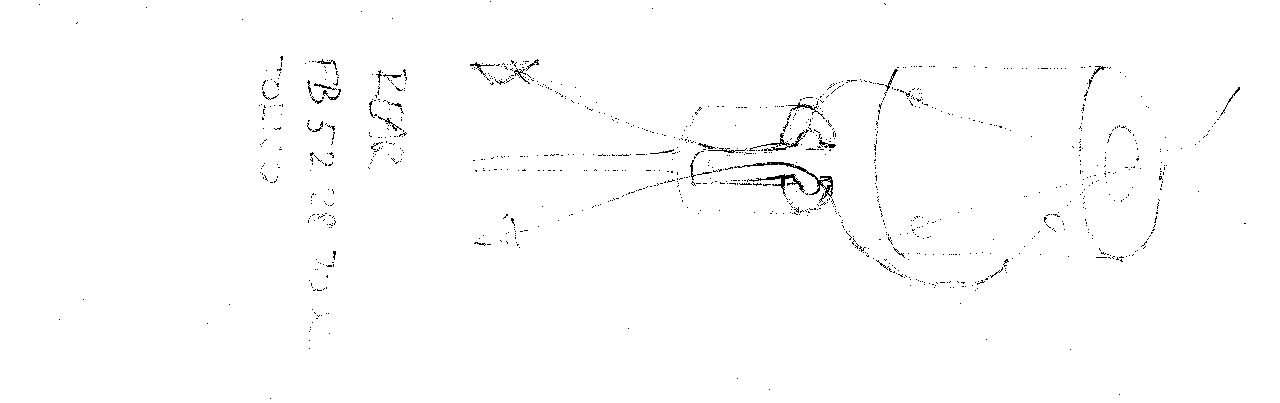
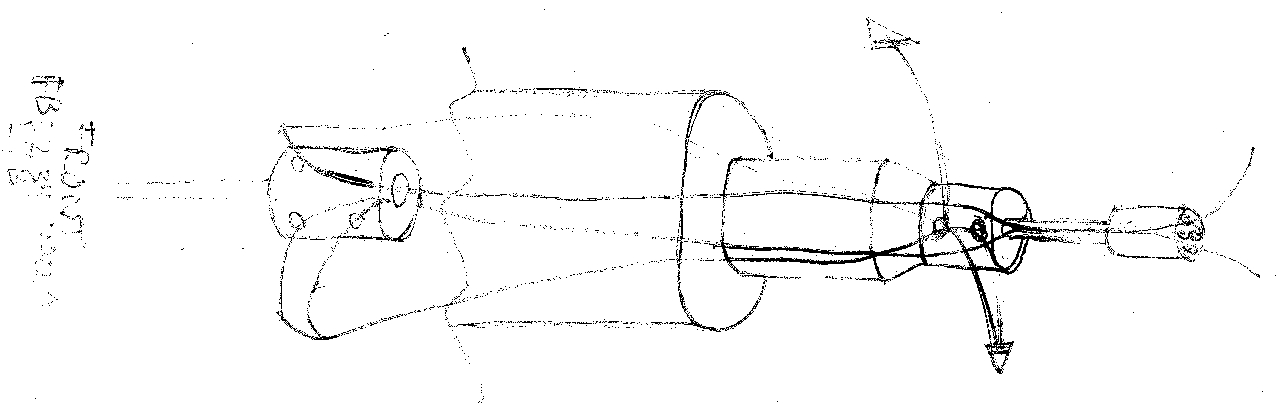
In the diagrams there isn�t actually any reversion in the oil flow, the parts are next to each other. It�s only a schematic (and they're blury):
Rear Schematic
Front Schematic